Polymerization of alkenes with acid | Alkenes and Alkynes | Organic chemistry | Khan Academy
TL;DR
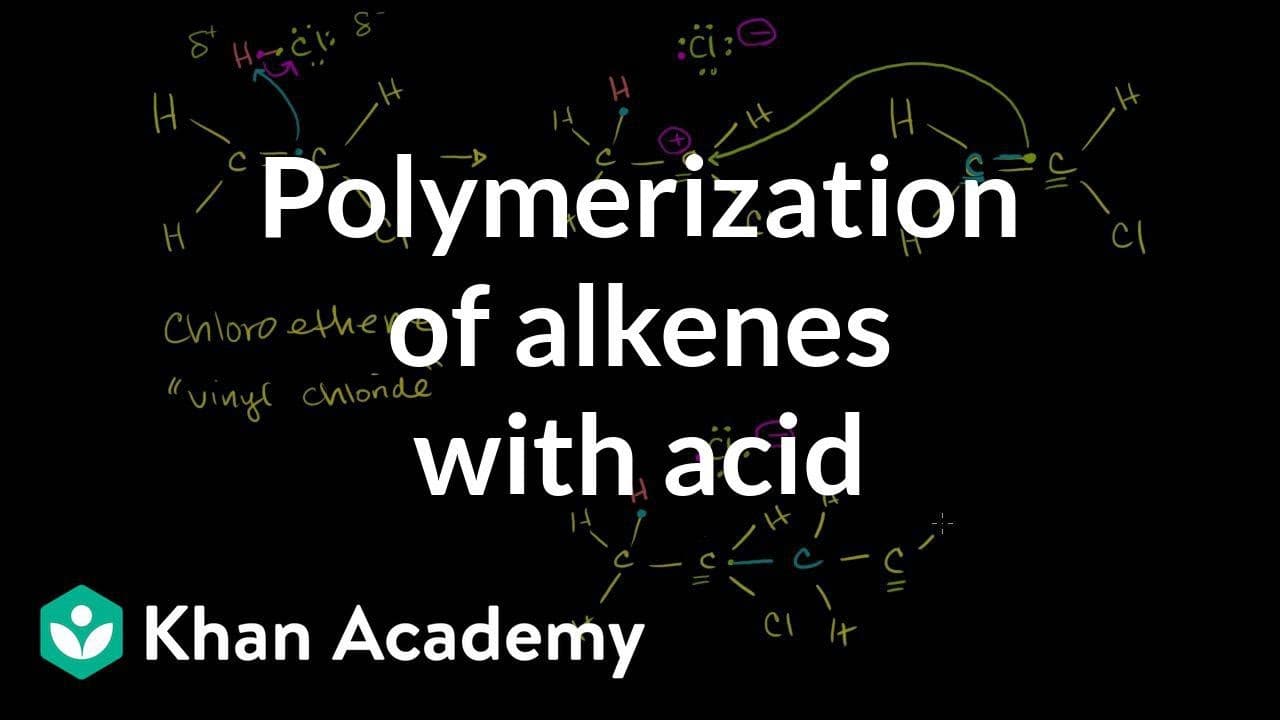
This content explains the process of how polyvinyl chloride (PVC) is formed from chloroethene molecules.
Transcript
Let's say we have some chloroethene here, and you wouldn't have to call this 1-chloro-eth-1-ene, because if you just go with chloroethene, there's only one way to draw this. And the common name for chloroethene is vinyl chloride. So let's say we have a bunch of chloroethene molecules along with or mixed with some hydrogen chloride. And I've drawn a... Read More
Key Insights
- 💁 Chloroethene can be referred to as vinyl chloride, and it is the precursor for the formation of PVC.
- 🥺 Chloroethene molecules can react with hydrogen chloride, leading to the formation of a carbocation.
- 💁 The carbocation can undergo further reactions with chloroethene molecules, resulting in the formation of a polymer.
Install to Summarize YouTube Videos and Get Transcripts
Explore YouTube Video Summarizer or Get YouTube Transcript Extractor
Questions & Answers
Q: How is polyvinyl chloride (PVC) formed from chloroethene?
PVC is formed by a reaction between chloroethene and hydrogen chloride. The chlorine atom in chloroethene attracts an electron from the hydrogen atom, resulting in a partially positive charge on the hydrogen. The chlorine atom then gains the electron, forming a chloride ion. This sets up the conditions for the formation of a carbocation, which can react with other chloroethene molecules to form PVC.
Q: What is the common name for chloroethene?
The common name for chloroethene is vinyl chloride.
Q: How does the formation of PVC occur?
The formation of PVC occurs through a repetitive process. Each chloroethene molecule reacts with a carbocation, resulting in the addition of another unit to the polymer chain. This process can repeat numerous times, leading to the formation of a long chain polymer.
Q: What is the significance of the reaction between carbocation and chloroethene?
The reaction between carbocation and chloroethene is crucial in the formation of PVC. The carbocation provides a site for the addition of another chloroethene unit, allowing the polymer chain to grow and form PVC.
Summary & Key Takeaways
-
Chloroethene, also known as vinyl chloride, can undergo a reaction with hydrogen chloride to form a carbocation.
-
The carbocation can then react with more chloroethene molecules, leading to the formation of a polymer.
-
This polymer is called polyvinyl chloride (PVC), which is commonly used for piping in plumbing systems.
Read in Other Languages (beta)
Share This Summary 📚
Summarize YouTube Videos and Get Video Transcripts with 1-Click
Try YouTube Summary with ChatGPT & Claude or YouTube Transcript Generator
Explore More Summaries from Khan Academy 📚



Summarize YouTube Videos and Get Video Transcripts with 1-Click
Try YouTube Summary with ChatGPT & Claude or YouTube Transcript Generator