RC Phase Shift Oscillator(using BJT) | Oscillators | Electronic Devices and Circuits 2 in EXTC
TL;DR
Explained design and analysis of RC phase shift oscillators using BJTs for frequency and gain criteria.
Transcript
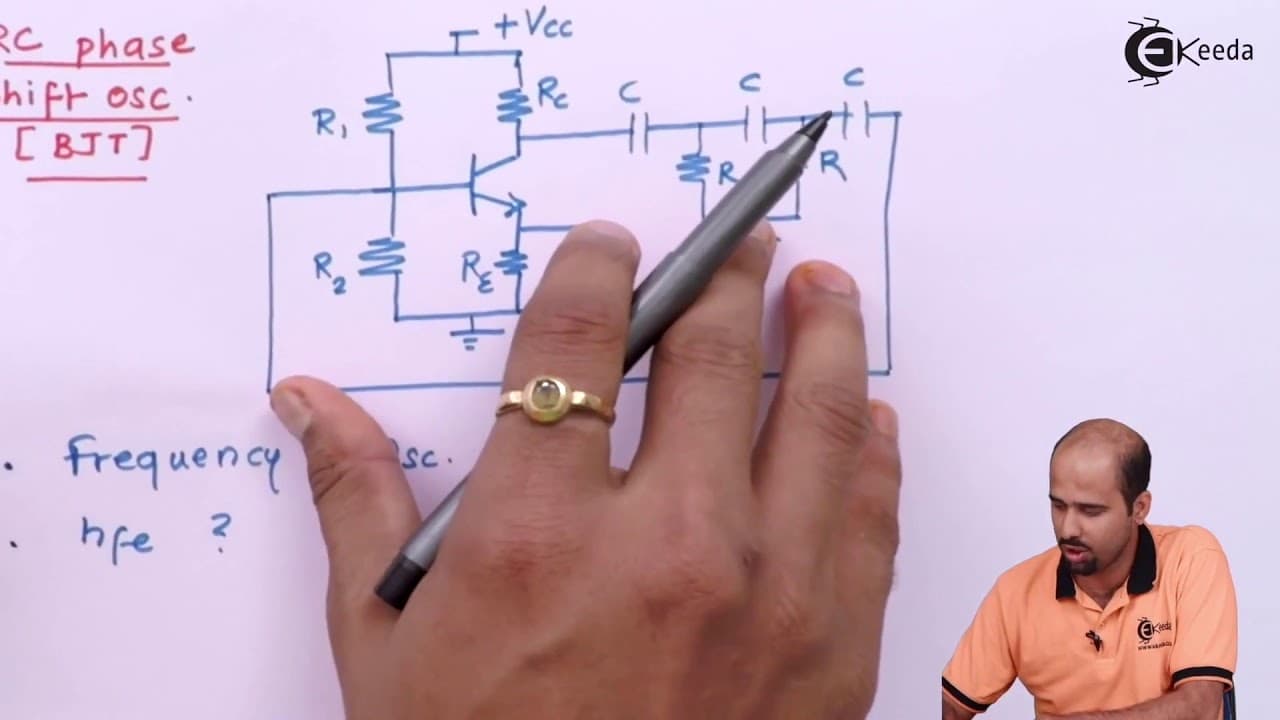
hello guys we are here to learn the module number six chapter number six that is oscillators and in this oscillator we are here to discuss the topic rc phase shift oscillators with bjt so if we want to learn the rc phase shift oscillator first of all we'll have to learn that why rc phase shift and why the term phase shift so first of all we want so... Read More
Key Insights
- ❓ RC phase shift oscillators utilize cascaded RC networks with BJTs to achieve 180-degree phase shift for sustained oscillations.
- 🧑🏭 The frequency of oscillation in an RC phase shift oscillator is determined by component values of resistance (R) and capacitance (C), alongside the gain factor (HFE) of the BJT.
- 🖐️ Criteria for gain, specifically the minimum HFE value, play a crucial role in ensuring stable oscillations in an RC phase shift oscillator.
- 🎨 Design considerations, such as component values and gain requirements, are essential for the successful operation of RC phase shift oscillators in electronics applications.
Install to Summarize YouTube Videos and Get Transcripts
Explore YouTube Video Summarizer or Get YouTube Transcript Extractor
Questions & Answers
Q: How does the feedback circuit using R and C components contribute to achieving a 180-degree phase shift in an RC phase shift oscillator?
The feedback circuit, comprising cascaded three RC networks, helps to achieve the necessary phase shift for oscillator functionality. Each RC network contributes 60 degrees of phase shift, totaling to 180 degrees when connected in cascade.
Q: What key factors determine the frequency of oscillation in an RC phase shift oscillator with BJTs?
The frequency of oscillation is determined by the values of resistance (R) and capacitance (C), as well as the gain factor (HFE) of the BJT transistor used in the oscillator circuit.
Q: Why is the gain factor (HFE) critical for sustaining oscillations in an RC phase shift oscillator?
The gain factor (HFE) influences the feedback loop's behavior and must meet a minimum threshold to ensure sustained oscillations. It affects the magnitude criteria specified by Barkhausen for the oscillator circuit.
Q: How is the design and analysis of an RC phase shift oscillator with BJTs crucial in electronics applications?
Understanding and implementing RC phase shift oscillators with BJTs are fundamental in generating stable oscillations for various electronics applications, from signal generators to audio oscillators.
Summary & Key Takeaways
-
Explained the concept of RC phase shift oscillators with BJTs using feedback circuits with R and C components.
-
Detailed the design process of cascading three RC networks to achieve a 180-degree phase shift for oscillator functionality.
-
Demonstrated calculations for frequency of oscillation and gain criteria, highlighting the importance of HFE and component values in sustaining oscillations.
Read in Other Languages (beta)
Share This Summary 📚
Summarize YouTube Videos and Get Video Transcripts with 1-Click
Try YouTube Summary with ChatGPT & Claude or YouTube Transcript Generator
Explore More Summaries from Ekeeda 📚





Summarize YouTube Videos and Get Video Transcripts with 1-Click
Try YouTube Summary with ChatGPT & Claude or YouTube Transcript Generator