What Can My Homemade Quantum Computer Solve?
TL;DR
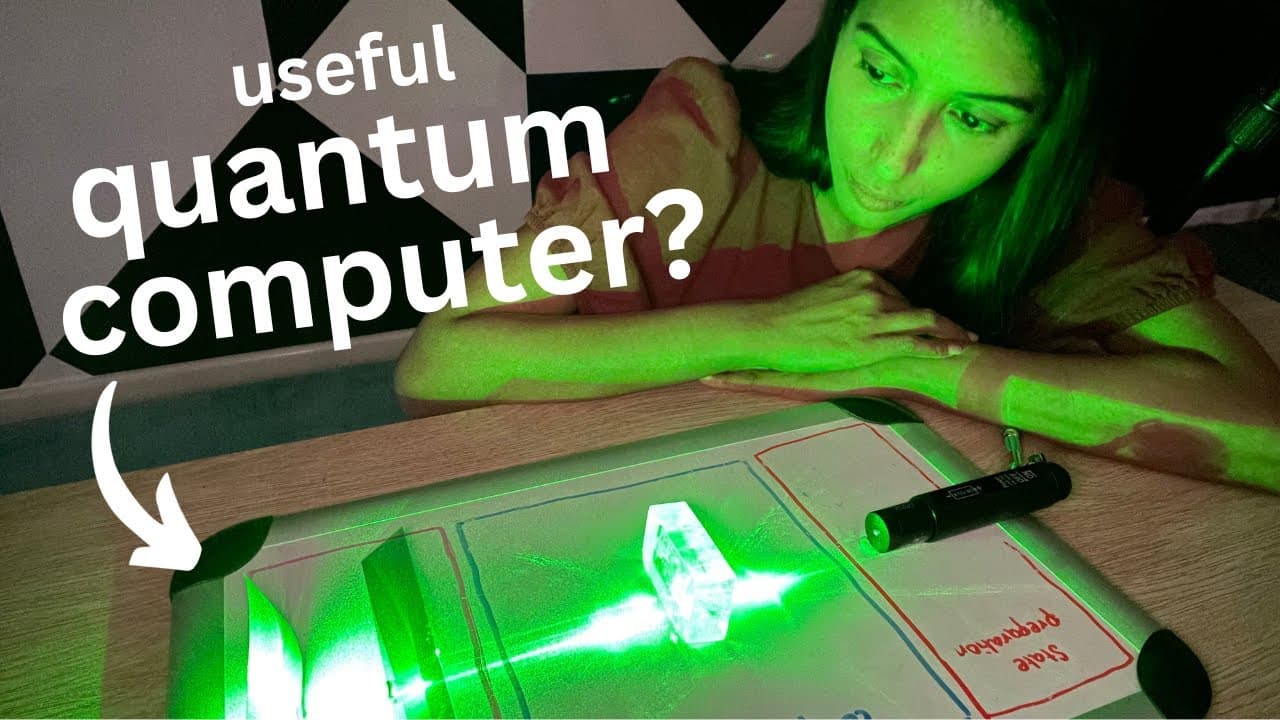
My homemade quantum computer can implement the Deuts Jozsa algorithm, which quickly determines if a secret function is balanced or constant with just one computation. Despite quantum computers being difficult to build and not universally superior to classical ones, they demonstrate unique capabilities, making them valuable for specific types of problems.
Transcript
so I made a quantum computer in my last video you don't have to watch that video because I'll try and explain what this does as I go but when I was making that video I realized that my quantum computer seems to be working kind of well enough that I could actually use it for a computation that is really surprising I didn't expect it to be this good ... Read More
Key Insights
- 💻 Quantum computers are not universally superior to classical computers and face challenges in implementation.
- ❓ The Deuts Jozsa algorithm utilizes quantum properties to solve a specific problem.
- 🏛️ Building a practical quantum computer requires careful engineering and understanding of quantum processes.
- 💋 The recent discovery of a new polynomial-time quantum algorithm marks a significant advancement in the field.
Install to Summarize YouTube Videos and Get Transcripts
Explore YouTube Video Summarizer or Get YouTube Transcript Extractor
Questions & Answers
Q: How does the Deuts Jozsa algorithm work?
The Deuts Jozsa algorithm solves a problem where a secret function is either balanced (outputs an equal number of zeros and ones) or constant (outputs the same value for all inputs). By inputting a plus state (a superposition of zero and one), measuring the output at 45 degrees, and observing the light behavior, it is possible to determine if the function is balanced or constant.
Q: What are the advantages of quantum computers over classical computers?
Quantum computers have the potential to solve certain computational problems much faster than classical computers. For example, factoring large prime numbers, which is important for encryption, can be done efficiently with a quantum algorithm. However, building practical quantum computers is still challenging.
Q: How does the video explain the difficulty of building a quantum computer?
The video highlights that quantum computers are technically challenging to build compared to classical computers. Quantum processes must be reversible, and the components used, such as wave plates and polarizers, have specific properties to encode and manipulate quantum information. The video also mentions the 30-year wait for new polynomial-time quantum algorithms and the recent development of a quantum algorithm that changes the landscape.
Q: How does the Deuts Jozsa algorithm demonstrate the capabilities of quantum computers?
The Deuts Jozsa algorithm showcases the power of quantum computers by solving a problem that is difficult for classical computers. By inputting a superposition state and utilizing interference effects, the quantum computer can determine the nature of the secret function with just one use, unlike classical computers which require multiple uses.
Summary & Key Takeaways
-
The video starts by introducing the concept of quantum computers and their capabilities compared to classical computers.
-
The focus then shifts to the Deuts Jozsa algorithm, which solves a riddle by determining whether a secret function is balanced or constant.
-
The video discusses the intricacies of building a quantum computer and the challenges involved in implementing quantum gates.
Read in Other Languages (beta)
Share This Summary 📚
Summarize YouTube Videos and Get Video Transcripts with 1-Click
Try YouTube Summary with ChatGPT & Claude or YouTube Transcript Generator
Explore More Summaries from Looking Glass Universe 📚






Summarize YouTube Videos and Get Video Transcripts with 1-Click
Try YouTube Summary with ChatGPT & Claude or YouTube Transcript Generator