Equivalence partition testing - Testing Techniques - Software Testing and Quality Assurance
TL;DR
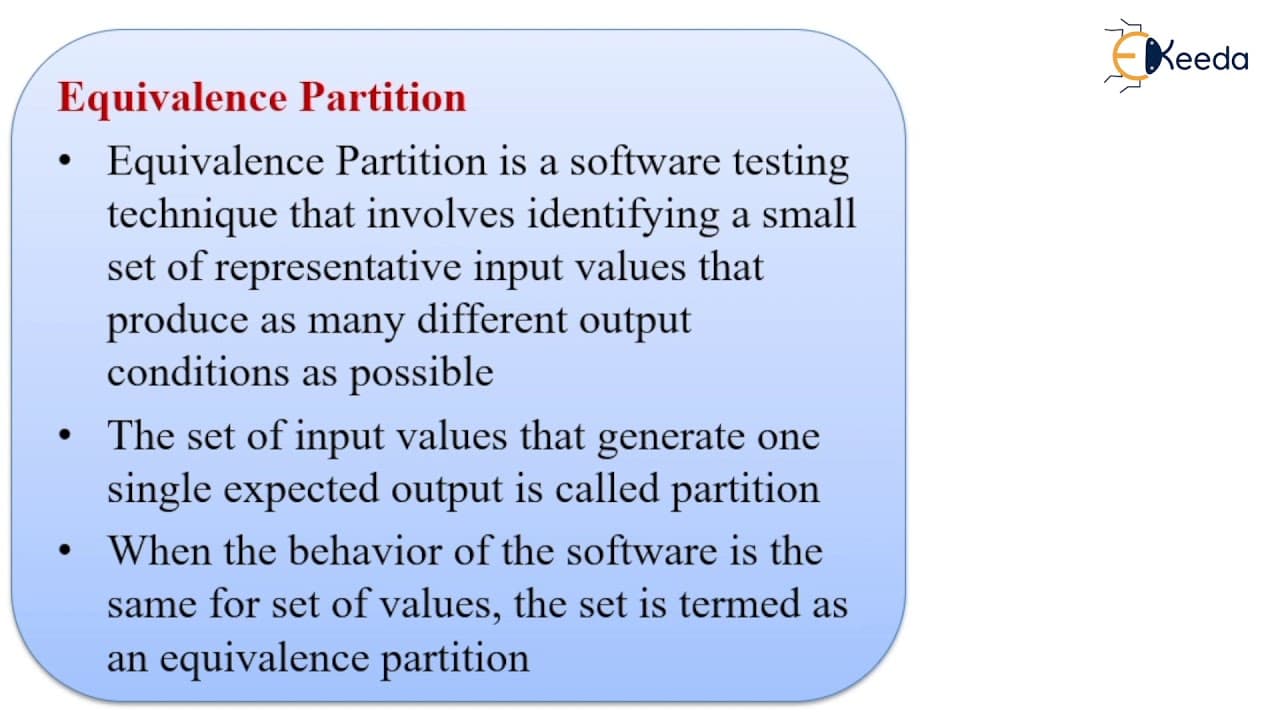
Equivalence partitioning involves identifying representative input values to test software behavior comprehensively.
Transcript
hello friends and this is the second chapter of testing technique equivalence partition we have already seen the black box testing definitions we have also seen the reasoning of the black box testing and then we know the how to do the black box system and then we saw requirement based testing the table the trs now we see earlier we have seen bounda... Read More
Key Insights
- ❓ Equivalence partitioning is a vital software testing technique for comprehensive coverage.
- 😫 It categorizes input values into representative sets for thorough testing of software behavior.
- ⚾ The technique helps in identifying different output behaviors based on input partitions.
- 📔 Equivalence partitioning ensures all input scenarios are covered effectively in testing.
- ⚾ It follows boundary value analysis and is crucial for requirement-based testing.
- 🔠 By partitioning input values, expected behaviors can be defined more accurately.
- 🏆 Testing through equivalence partitioning maximizes coverage of software behavior.
Install to Summarize YouTube Videos and Get Transcripts
Explore YouTube Video Summarizer or Get YouTube Transcript Extractor
Questions & Answers
Q: What is equivalence partitioning in software testing?
Equivalence partitioning is a technique that involves categorizing input values into representative sets to test the software's behavior comprehensively. It ensures testing different output behaviors based on partitioned input values, maximizing coverage.
Q: How does equivalence partitioning relate to boundary value analysis?
Equivalence partitioning follows boundary value analysis as a testing technique. It helps in identifying input value classes and their impact on software behavior, ensuring thorough testing scenarios.
Q: Why is it important to partition input values in equivalence partitioning?
Partitioning input values helps in categorizing representative sets for testing, allowing for comprehensive coverage of software behavior and ensuring all input scenarios are tested adequately.
Q: Can you provide an example of equivalence partitioning in software testing?
Sure. For example, if testing age groups for insurance premiums, partitions could include below 35, 35-59, and 60+, with defined behaviors for each partition to validate software responses.
Summary & Key Takeaways
-
Equivalence partitioning is a software testing technique to identify representative input values.
-
It helps in testing different output behaviors based on partitioned input values.
-
By categorizing input values, complete coverage of software behavior is ensured.
Read in Other Languages (beta)
Share This Summary 📚
Summarize YouTube Videos and Get Video Transcripts with 1-Click
Try YouTube Summary with ChatGPT & Claude or YouTube Transcript Generator
Explore More Summaries from Ekeeda 📚




Summarize YouTube Videos and Get Video Transcripts with 1-Click
Try YouTube Summary with ChatGPT & Claude or YouTube Transcript Generator