Area of a parallelogram | Perimeter, area, and volume | Geometry | Khan Academy
TL;DR
The area of any parallelogram can be calculated by multiplying one of its bases by the height.
Transcript
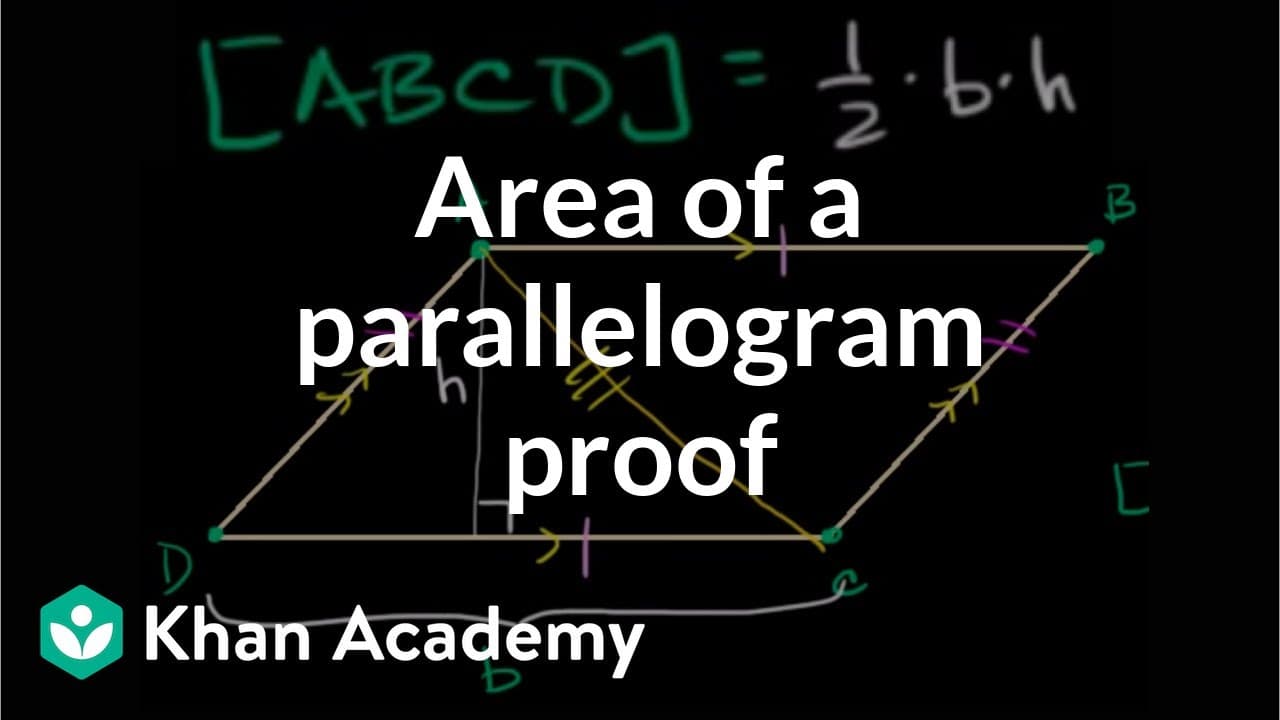
We know that quadrilateral ABCD over here is a parallelogram. And what I want to discuss in this video is a general way of finding the area of a parallelogram. In the last video, we talked about a particular way of finding the area of a rhombus. You could take half the product of its diagonals. And a rhombus is a parallelogram. But you can't just g... Read More
Key Insights
- 🙃 The opposite sides of a parallelogram are parallel and congruent.
- 🫤 A parallelogram can be split into two congruent triangles by drawing a diagonal.
- 🟰 The area of a parallelogram is equal to twice the area of one of these triangles.
- ✖️ To find the area of a parallelogram, multiply the length of one of its bases by the height.
- ⚾ The height of a parallelogram can be determined by drawing an altitude perpendicular to the base.
- ⚾ The area of a parallelogram can also be calculated by multiplying the length of a different base by the corresponding height.
- 🔺 The formula for the area of a triangle, 1/2 * base * height, can be applied to find the area of one of the triangles formed by the diagonal.
Install to Summarize YouTube Videos and Get Transcripts
Explore YouTube Video Summarizer or Get YouTube Transcript Extractor
Questions & Answers
Q: How do you determine if a quadrilateral is a parallelogram?
A quadrilateral is a parallelogram if its opposite sides are parallel and congruent.
Q: How can you find the area of a parallelogram?
To find the area of a parallelogram, you can multiply the length of one of its bases by the height.
Q: What is the relationship between the areas of the two congruent triangles formed by the diagonal of a parallelogram?
The areas of the two triangles formed by the diagonal of a parallelogram are equal.
Q: Can you calculate the area of any parallelogram using the diagonal?
No, the area of a parallelogram cannot be calculated by halving the product of its diagonals, as is done with a rhombus. Instead, the area can be found by multiplying a base by the height.
Summary & Key Takeaways
-
A parallelogram is a quadrilateral with opposite sides that are parallel and congruent.
-
By drawing a diagonal in a parallelogram, we can split it into two congruent triangles.
-
The area of a parallelogram is equal to twice the area of one of these triangles, which can be calculated using the formula: 1/2 * base * height.
Read in Other Languages (beta)
Share This Summary 📚
Summarize YouTube Videos and Get Video Transcripts with 1-Click
Try YouTube Summary with ChatGPT & Claude or YouTube Transcript Generator
Explore More Summaries from Khan Academy 📚



Summarize YouTube Videos and Get Video Transcripts with 1-Click
Try YouTube Summary with ChatGPT & Claude or YouTube Transcript Generator