Enzymes - Catalysts
TL;DR
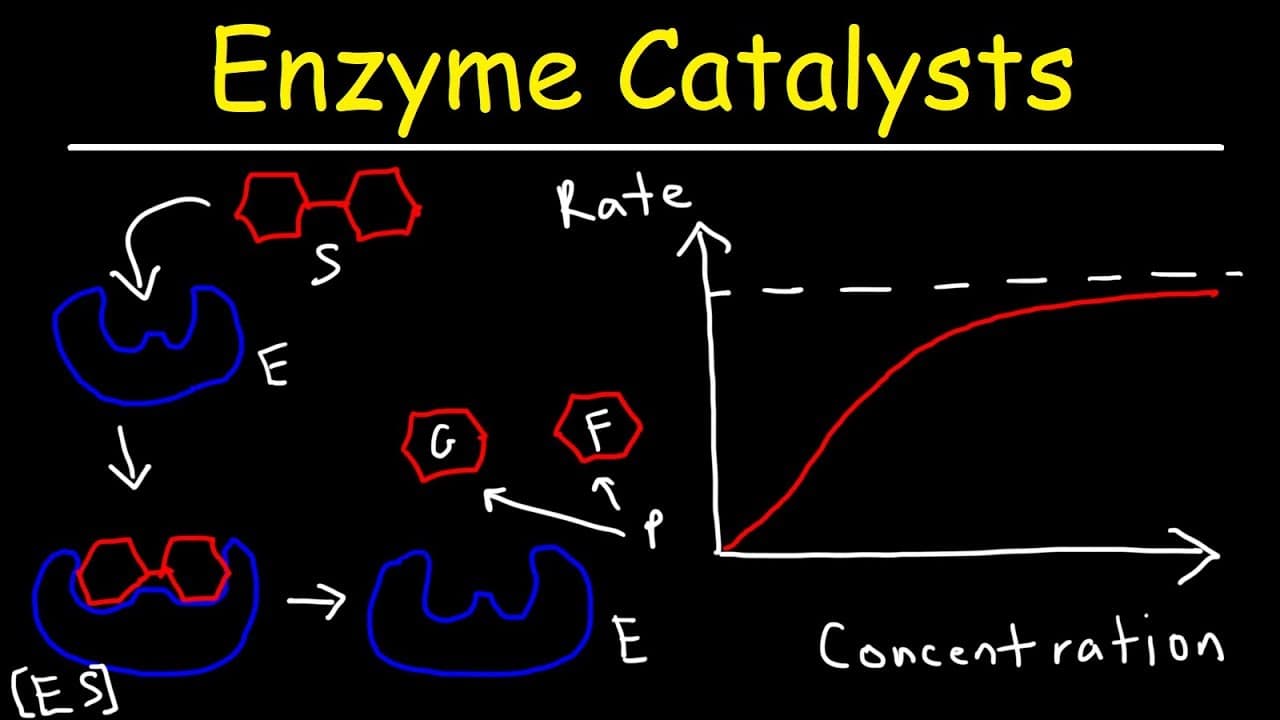
Enzymes are protein-based catalysts that lower the activation energy of chemical reactions, speeding them up. They have a unique three-dimensional shape that is specific to the substrate they bind with.
Transcript
in this video we're going to talk about enzymes so what are enzymes enzymes at least most of them are protein-based catalysts that speed up chemical reactions and the way they speed up chemical reactions is by lowering the activation energy so let's draw an energy diagram we have energy on the y-axis the reaction coordinate on the x-axis in blue th... Read More
Key Insights
- 🐎 Enzymes are protein-based catalysts that speed up chemical reactions by lowering the activation energy.
- 💠 Enzymes have a unique three-dimensional shape that binds specifically to the substrate they interact with.
- 😥 Factors that affect enzyme activity include pH, temperature, concentration, and the presence of inhibitors or activators.
- 😄 Enzymes can be identified by their name, typically ending with "ase".
- ❓ Some examples of enzymes are protease, lipase, isomerase, transferase, kinase, amylase, oxidoreductase, and hydrolase.
- 😑 Enzymes can require cofactors or coenzymes, such as metal ions or organic molecules, to function properly.
Install to Summarize YouTube Videos and Get Transcripts
Explore YouTube Video Summarizer or Get YouTube Transcript Extractor
Questions & Answers
Q: How do enzymes speed up chemical reactions?
Enzymes speed up chemical reactions by lowering the activation energy, making it easier for the reaction to occur. They do this by providing an alternative reaction pathway with a lower energy barrier.
Q: What is the difference between the lock and key model and the induced fit model?
In the lock and key model, the enzyme's active site perfectly fits the substrate, like a key in a lock. In the induced fit model, the active site slightly changes its shape to fit the substrate better, enhancing the enzyme-substrate interaction.
Q: Can enzymes be reused after catalyzing a reaction?
Yes, enzymes are not used up in a reaction. They can be reused to catalyze another reaction with the same substrate. Enzymes appear in the beginning and at the end of the reaction, unchanged.
Q: How does pH affect enzyme activity?
enzymes have an optimal pH at which they work most efficiently. pH values below or above the optimal range can denature the enzyme, leading to a decrease in activity.
Summary & Key Takeaways
-
Enzymes are protein-based catalysts that speed up chemical reactions by lowering the activation energy.
-
Enzymes have an active site with a unique three-dimensional shape that binds specifically to the substrate.
-
There are two models to describe the enzyme-substrate interaction: lock and key model and induced fit model.
Read in Other Languages (beta)
Share This Summary 📚
Summarize YouTube Videos and Get Video Transcripts with 1-Click
Try YouTube Summary with ChatGPT & Claude or YouTube Transcript Generator
Explore More Summaries from The Organic Chemistry Tutor 📚


Summarize YouTube Videos and Get Video Transcripts with 1-Click
Try YouTube Summary with ChatGPT & Claude or YouTube Transcript Generator