How to Use K-Fold Cross-Validation for Kaggle Competitions
TL;DR
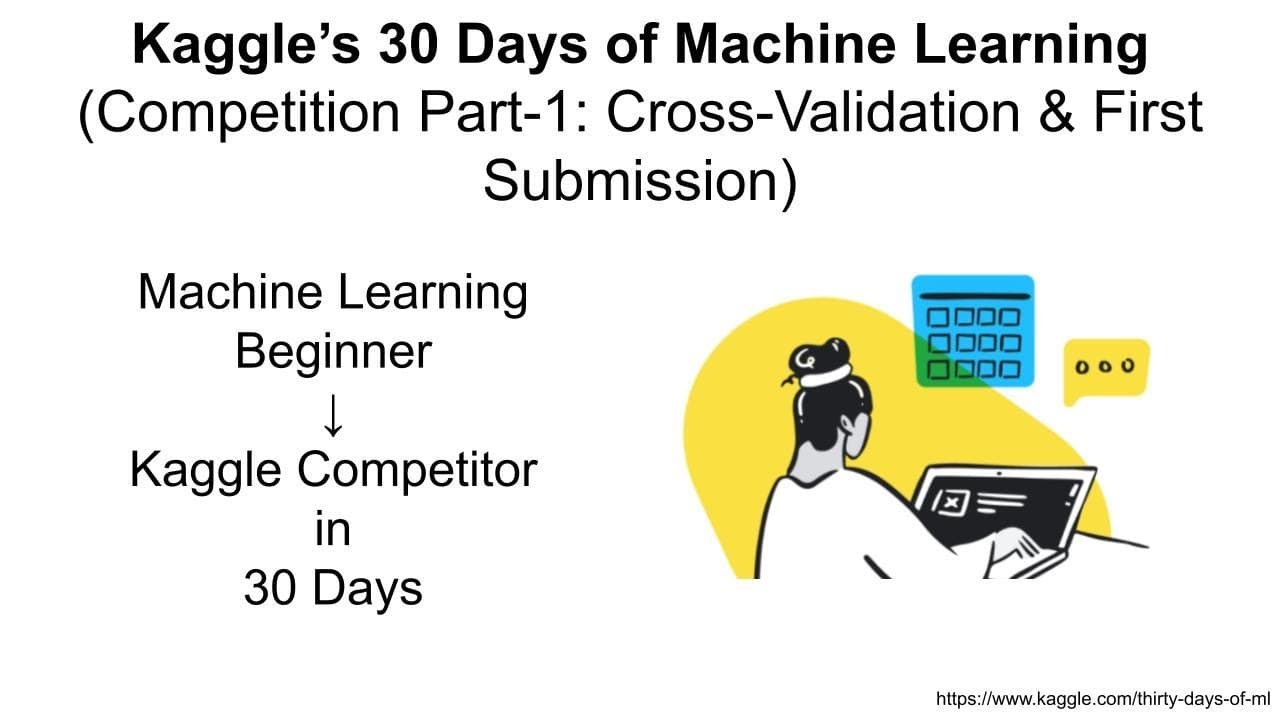
To effectively use k-fold cross-validation in Kaggle competitions, divide your dataset into several folds, ensuring that each fold has a similar distribution. Train your model on the combined training folds while validating on the hold-out fold, and repeat this for all folds. Average the predictions from each fold to minimize overfitting, resulting in more reliable submissions.
Transcript
hello everyone and welcome to day 15 of kaggle's 30 days of ml challenge and today we don't have a tutorial we have uh the competition for the next 15 days it's a regression problem so take a look at the competition um and uh yeah there's a lot of gaggle swag prizes the evaluation is rmse so yeah it's regression problem what i'm going to do is i'm ... Read More
Key Insights
- 🥳 Kaggle's 30 Days of ML challenge includes both tutorials and competitions, allowing participants to apply their learnings in real-world scenarios.
- ☠️ Creating folds using k-fold cross-validation is essential for effectively evaluating the performance of machine learning models.
- 💨 XGBoost, a gradient boosting library, can provide faster performance compared to random forest in certain cases.
- 🏛️ The presenter emphasizes the importance of understanding data distribution and feature selection when building machine learning models.
- 🙏 Averaging predictions across multiple folds helps in reducing overfitting and increases the reliability of the final submission.
- 💯 The leaderboard on Kaggle only represents the scores on a subset of the data, while the final results are calculated on the entire dataset during the private leaderboard phase.
- 👨💻 Code readability and organization are crucial for maintaining and reusing machine learning models effectively.
Install to Summarize YouTube Videos and Get Transcripts
Explore YouTube Video Summarizer or Get YouTube Transcript Extractor
Questions & Answers
Q: What is the purpose of creating folds in a machine learning problem?
Creating folds allows us to split the data into training and validation sets, enabling us to evaluate the model's performance on unseen data. By using k-fold cross-validation, we can generate multiple train-validation splits to ensure robustness in our model evaluation.
Q: Why is k-fold cross-validation used in this example?
The presenter uses k-fold cross-validation because it is a common and reliable method for evaluating model performance on limited data. By dividing the data into multiple folds, each fold acts as a validation set once, ensuring that the model is tested on different subsets of the data.
Q: Why does the presenter switch from random forest to XGBoost?
The presenter switches to XGBoost due to its faster performance compared to random forest. XGBoost is a gradient boosting library known for its efficiency and accuracy, making it well-suited for this regression problem with a large dataset.
Q: How are the final predictions generated for the test data?
The presenter saves the predictions generated for the test data in each fold iteration and then takes the mean of these predictions across the folds. The averaged predictions serve as the final submission for the competition.
Summary & Key Takeaways
-
The video introduces Kaggle's 30 Days of ML challenge and announces a regression competition that will last for the next 15 days.
-
The presenter demonstrates how to create folds for training and validation data using k-fold cross-validation.
-
They import the necessary libraries and read the training data into a dataframe.
-
The target variable is plotted to understand its distribution.
-
The k-fold cross-validation is implemented, with the data divided into five folds.
-
The folds are added as a new column in the dataframe.
-
The code for creating folds is saved in a separate notebook.
-
The presenter then starts building a regression model using random forest, but switches to XGBoost for faster performance.
-
The model is trained using the folds and predictions are generated for the validation and test data.
-
The final predictions are averaged across all folds and saved as a submission file for the competition.
Read in Other Languages (beta)
Share This Summary 📚
Summarize YouTube Videos and Get Video Transcripts with 1-Click
Try YouTube Summary with ChatGPT & Claude or YouTube Transcript Generator
Explore More Summaries from Abhishek Thakur 📚

Summarize YouTube Videos and Get Video Transcripts with 1-Click
Try YouTube Summary with ChatGPT & Claude or YouTube Transcript Generator