Problem on Moment of Inertia and Radius of Gyration of a Circle - Strength of Materials
TL;DR
Find fluid pressure in a spherical shell with volume change using volumetric and hoop strain.
Transcript
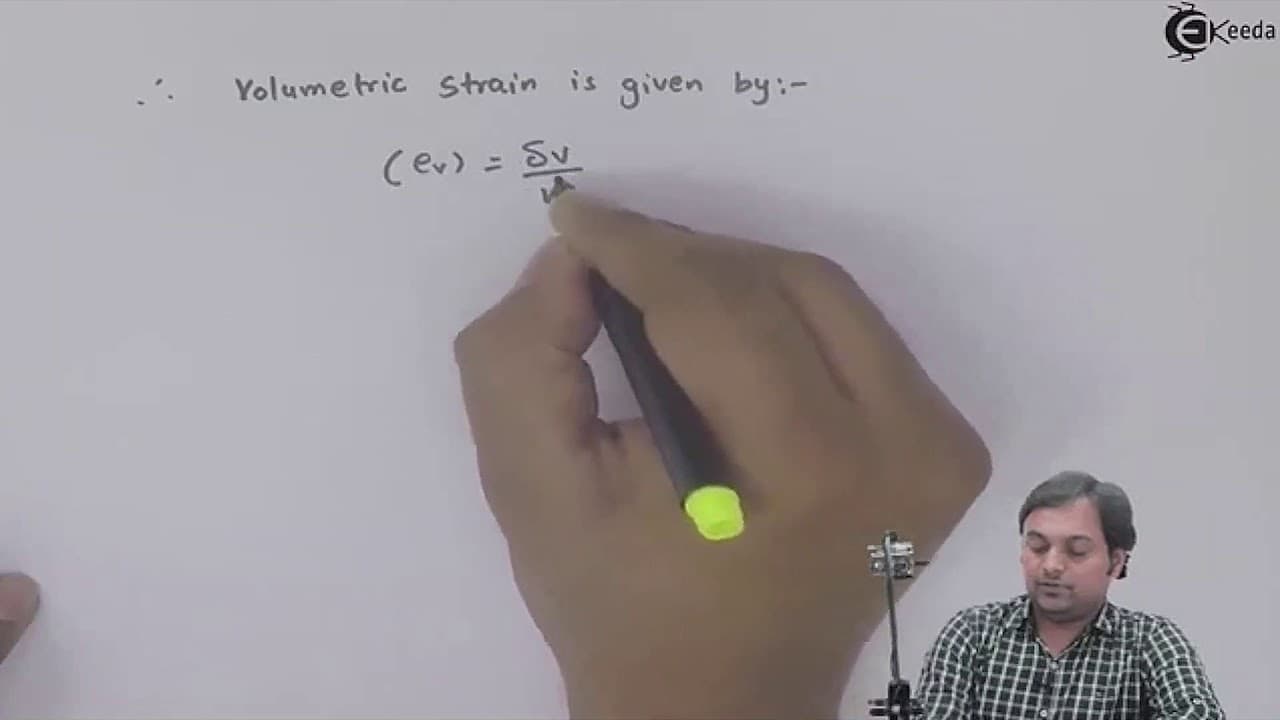
let us read this question a seamless spherical shell is of 8 meter internal diameter and 4 mm thickness full stop it is filled with fluid under pressure until its volume increases by 50 10 raised to 3 mm cube full stop determine the fluid pressure now this is the question which we have in which they are asking us to get how much will be the fluid p... Read More
Key Insights
- 🤭 Thin spherical shells undergo volumetric and hoop strain analysis to determine internal fluid pressure accurately.
- 🔇 Changes in volume and strain are crucial for assessing pressurized systems' equilibrium and pressure distribution.
- 🤭 Equating volumetric and hoop strain equations provides a robust method for calculating internal pressures in spherical shells under stress.
- 🤭 Understanding the interplay between volumetric and hoop strain enhances the accuracy of fluid pressure calculations in complex geometric structures.
- 🐚 Fluid pressure determination in spherical shells requires comprehensive knowledge of strain concepts and their application in physics problem-solving.
- 🐚 The relationship between pressure, volume changes, and strain in spherical shells showcases the intricate dynamics of pressurized fluid systems.
- 🤭 Volumetric and hoop strain equations offer a systematic approach to quantifying internal pressures in challenging physics scenarios.
Install to Summarize YouTube Videos and Get Transcripts
Explore YouTube Video Summarizer or Get YouTube Transcript Extractor
Questions & Answers
Q: How is the internal pressure of pressurized fluid determined in a spherical shell?
The internal pressure is calculated using volumetric and hoop strain equations by equating the changes in volume and strain values, leading to an answer of 35.5x10^-6 N/mm^2.
Q: What is the significance of calculating volumetric and hoop strain in determining fluid pressure?
Volumetric and hoop strain equations help to link changes in volume and strain to calculate the pressure inside the spherical shell accurately, providing a comprehensive understanding of the system.
Q: Why is it crucial to differentiate between volumetric and hoop strain when analyzing pressurized fluids in a spherical shell?
Volumetric strain relates to changes in volume, while hoop strain factors in the circumferential stress, allowing for a comprehensive assessment of the fluid pressure distribution within the shell.
Q: How does understanding the concepts of volumetric and hoop strain contribute to solving complex physics problems like fluid pressure determination?
Volumetric and hoop strain concepts offer a systematic approach to analyzing pressure changes in various geometries, enabling precise calculations and solutions to physics problems involving pressurized fluids.
Summary & Key Takeaways
-
A seamless spherical shell with 8m diameter and 4mm thickness is pressurized until its volume increases by 50x10^3 mm^3.
-
Original and changed volumes are calculated, with volumetric and hoop strain equations used to determine fluid pressure inside the shell.
-
By equating volumetric and hoop strain equations, the internal fluid pressure is found to be 35.5x10^-6 N/mm^2.
Read in Other Languages (beta)
Share This Summary 📚
Summarize YouTube Videos and Get Video Transcripts with 1-Click
Try YouTube Summary with ChatGPT & Claude or YouTube Transcript Generator
Explore More Summaries from Ekeeda 📚





Summarize YouTube Videos and Get Video Transcripts with 1-Click
Try YouTube Summary with ChatGPT & Claude or YouTube Transcript Generator