Building makemore Part 5: Building a WaveNet
TL;DR
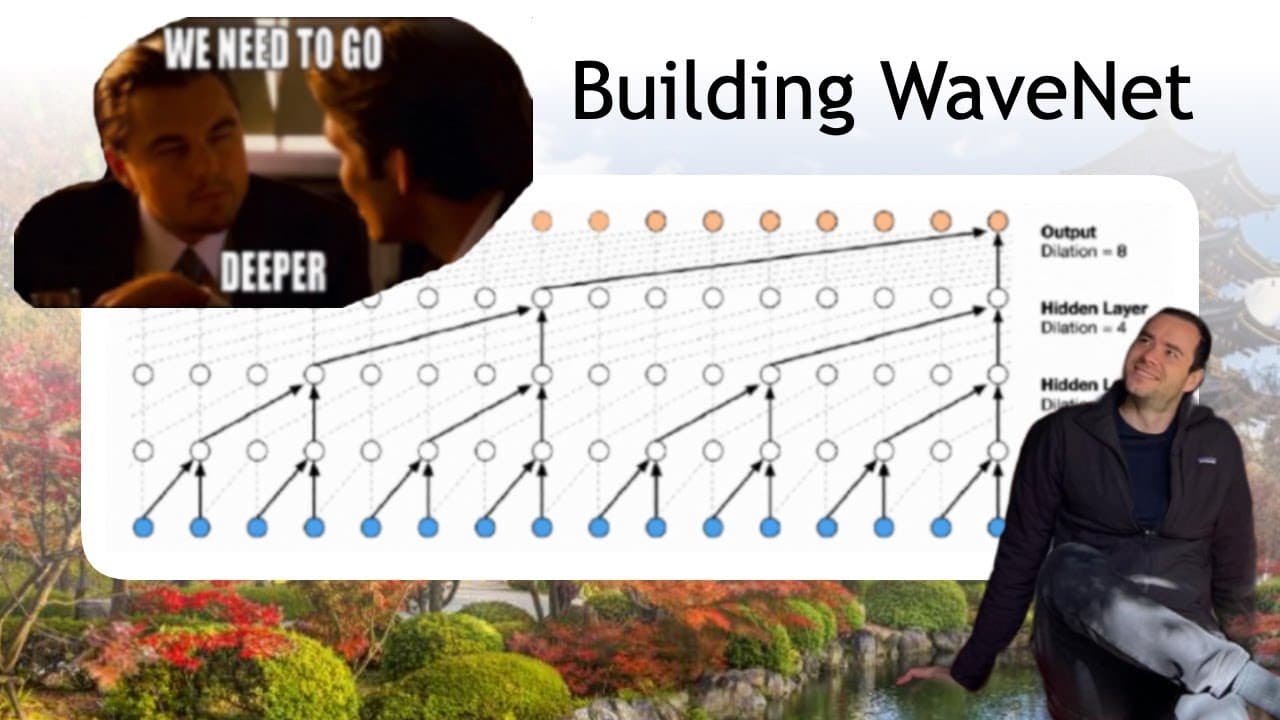
Implementing a hierarchical language model in PyTorch to improve performance by gradually fusing information from previous characters in the sequence.
Transcript
hi everyone today we are continuing our implementation of make more our favorite character level language model now you'll notice that the background behind me is different that's because I am in Kyoto and it is awesome so I'm in a hotel room here now over the last few lectures we've built up to this architecture that is a multi-layer perceptron ch... Read More
Key Insights
- 😕 The hierarchical architecture progressively fuses information from previous characters, leading to improved predictions.
- ❓ The implementation involves using embedding layers, linear layers, and the batch normalization layer.
- 🇦🇪 The architecture can be further optimized by tuning hyperparameters, such as the number of hidden units and learning rates.
- 🥺 Setting up an experimental harness and conducting more rigorous experiments could lead to better performance.
Install to Summarize YouTube Videos and Get Transcripts
Explore YouTube Video Summarizer or Get YouTube Transcript Extractor
Questions & Answers
Q: What is the purpose of making the language model architecture more complex?
By making the architecture more complex, the model can gradually fuse information from multiple characters in the sequence, leading to better predictions and improved performance.
Q: How does the hierarchical architecture differ from the previous architecture?
In the hierarchical architecture, characters are fused in a progressive manner, starting with pairs of characters, then bigrams, and so on, rather than all characters being fed into a single hidden layer at once.
Q: How does the use of batch normalization affect the language model?
Batch normalization helps to control the statistics of the activations by computing running means and variances. It ensures more stable training and improves the performance of the language model.
Q: What challenges arise when implementing the hierarchical architecture?
Challenges include maintaining the correct state of the batch normalization layer, addressing bugs related to training and evaluation mode, and correctly reshaping tensors to match the desired input shapes.
Summary & Key Takeaways
-
The content discusses the implementation of a hierarchical language model using PyTorch.
-
The hierarchical architecture progressively fuses information from previous characters to predict the next character in the sequence.
-
The implementation involves using embedding layers, linear layers, and the batch normalization layer.
-
The content highlights the importance of maintaining the correct state and addressing bugs in the implementation.
Read in Other Languages (beta)
Share This Summary 📚
Summarize YouTube Videos and Get Video Transcripts with 1-Click
Try YouTube Summary with ChatGPT & Claude or YouTube Transcript Generator
Explore More Summaries from Andrej Karpathy 📚





Summarize YouTube Videos and Get Video Transcripts with 1-Click
Try YouTube Summary with ChatGPT & Claude or YouTube Transcript Generator