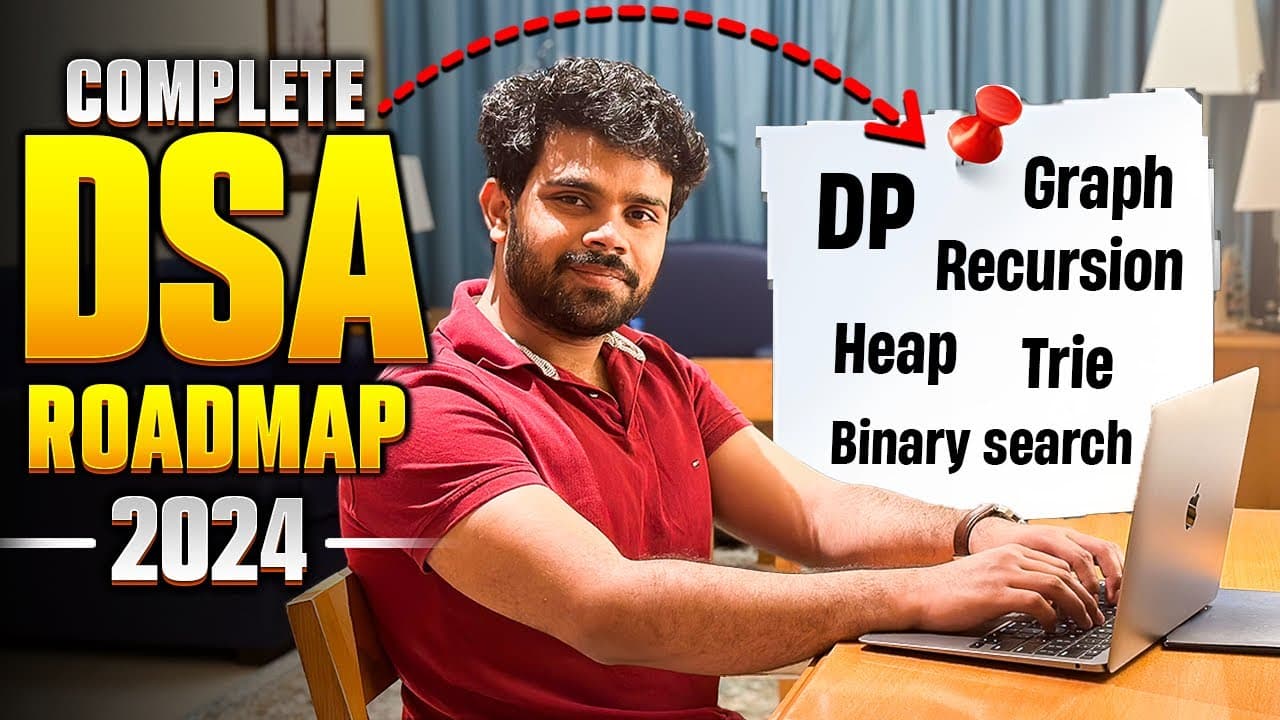
Complete DSA Roadmap 2024 with Live Course Update
TL;DR
The video outlines a DSA course structure and curriculum for independent learners.
Transcript
Hi everyone! Welcome to a new video. So, today's video is useful for those who want to learn DSA through our course or want to know DSA's complete curriculum so that they can study it by themselves. If you don't want to learn DSA then, this video isn't useful for you. So, you can stop watching the video right now. Rest, let's move on in the video. ... Read More
Key Insights
- ❓ A solid foundation in programming basics is essential before tackling DSA concepts to ensure meaningful understanding.
- 😇 Interactive course elements, including feedback sessions and TAs, enhance student engagement and retention of knowledge.
- 🏃 Problem-solving practice, through exercises like Fizz Buzz and pattern printing, is critical for mastering programming logic.
- ❓ Recursion is integral for understanding advanced algorithms and is emphasized early in the curriculum.
- 💪 The curriculum comprehensively covers data structures, with a strong focus on arrays, loops, and associated algorithms.
- 🌍 Object-oriented programming concepts are introduced to develop understanding of real-world modeling in software applications.
- 👾 Time and space complexity are crucial for evaluating algorithm efficiency and are taught through practical analysis of coding tasks.
Install to Summarize YouTube Videos and Get Transcripts
Explore YouTube Video Summarizer or Get YouTube Transcript Extractor
Questions & Answers
Q: What should beginners know before joining the DSA course?
It is essential for beginners to have a solid understanding of programming basics before starting the DSA course. They should be familiar with fundamental concepts such as variables, data types, control statements, and functions. New students are encouraged to review recorded sessions from the introductory classes to catch up on essential knowledge, as the DSA curriculum builds on these foundational elements.
Q: How does the course facilitate interactive learning?
The course is designed to be interactive, featuring live classes where students engage in problem-solving discussions with instructors and peers. Additionally, there is a dedicated doubt session every Sunday, allowing students to ask questions and clarify concepts. With real-time teaching and tutorial assistant support, students receive immediate feedback and guidance during their learning journey.
Q: What are some of the programming concepts covered in the course's first month?
In the first month, students learn fundamental programming concepts such as pseudocode and flowcharts for logic building, control statements like if-else and switch cases for decision-making, and loops for repeated tasks. They practice various coding problems, including the famous Fizz Buzz challenge and patterns, to solidify their understanding of these essential constructs.
Q: Why is recursion introduced early in the curriculum?
Recursion is introduced early because it plays a crucial role in various algorithms, such as sorting methods like quick sort and merge sort. By learning recursion's basic concepts, students can better understand how to solve problems that can be broken down into simpler subproblems. Recognizing recursion's applicability will help students tackle more complex algorithms later in the course.
Q: How does the course address data structures like arrays?
The course covers arrays in detail, starting from basic memory allocation concepts to practical applications such as traversals and manipulations. Students learn about different types of arrays, including 1D and 2D arrays, and are introduced to advanced topics like dynamic arrays and matrix traversals. The emphasis is on hands-on practice through problem-solving exercises relevant to arrays.
Q: What are the key differences between procedural and object-oriented programming covered in the course?
The course highlights the contrast between procedural programming, which focuses on functions and procedures, and object-oriented programming (OOP), which uses classes to encapsulate data and methods. Students explore OOP principles such as encapsulation, inheritance, and polymorphism, learning how these concepts enhance code reusability and organization in software development.
Q: How do students learn about time and space complexity?
Students learn about time and space complexity analysis through practice. They are taught to analyze algorithm performance by determining how the input size affects execution time and memory usage. This understanding is reinforced through coding exercises where students calculate complexities, fostering a deeper grasp of performance evaluation essential for efficient algorithm design.
Q: What resources are recommended for further understanding data structures and algorithms?
The video suggests several resources, including reputable websites that offer detailed explanations and examples of programming concepts. Specifically, platforms like cplusplus.com and educational articles on read.learnyard.com provide comprehensive insights into data structures and algorithms. Additionally, students are encouraged to practice coding problems on platforms such as LeetCode to enhance their skills.
Summary & Key Takeaways
-
The video discusses an updated Data Structures and Algorithms (DSA) course, highlighting the interactive teaching approach and supplementing class sessions with technical assistance for students.
-
The presenter details the DSA curriculum, emphasizing the importance of foundational programming knowledge, logical thinking, and practical application through problem-solving and hands-on exercises.
-
Topics covered include data structures, algorithms, recursion, and object-oriented programming, with suggestions for resources and practices to enhance mastery of each subject area.
Read in Other Languages (beta)
Share This Summary 📚
Summarize YouTube Videos and Get Video Transcripts with 1-Click
Try YouTube Summary with ChatGPT & Claude or YouTube Transcript Generator
Explore More Summaries from Fraz 📚
Summarize YouTube Videos and Get Video Transcripts with 1-Click
Try YouTube Summary with ChatGPT & Claude or YouTube Transcript Generator