Leetcode 1765. Map of Highest Peak
TL;DR
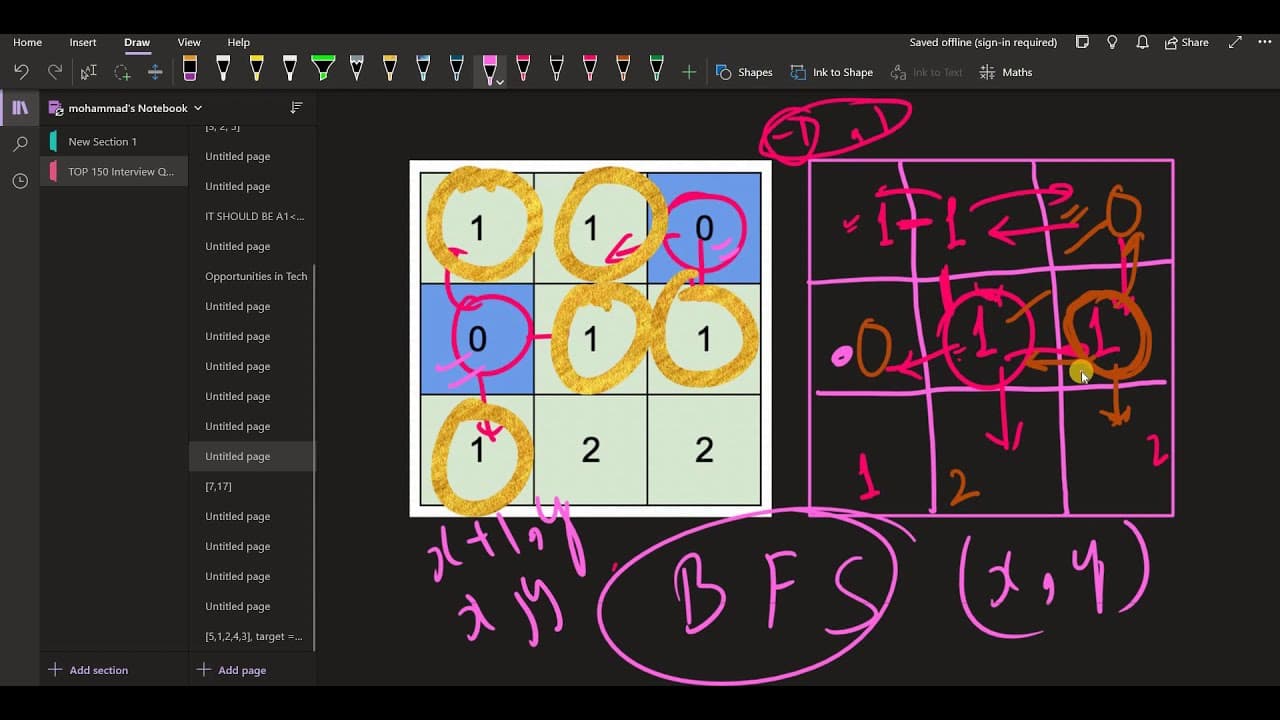
The content explains a BFS approach to solve a matrix height assignment problem related to water and land cells.
Transcript
hey there everyone i'm your host faraz we are solving the contest by weekly contest 46 and this is the problem number three so let us go through the problem statement once we are given a matrix m cross n and each cell is either zero or one zero represent land and one represents water now we have to return a matrix of size m cross n as the answer an... Read More
Key Insights
- 💦 Understanding matrix representation is crucial for solving spatial problems involving land and water arrangements.
- 👻 Leveraging BFS allows simultaneous processing from multiple sources, optimizing the height assignment.
- 🫡 The necessity to ensure the maximum height respects adjacent cell height constraints illustrates the complexity involved in matrix manipulation problems.
- ❓ Initializing and managing a queue for BFS is essential for efficient traversal and height assignment in the matrix.
- ⚖️ The process of neighboring cell exploration must balance between maintaining matrix bounds and value constraints on heights.
- ❎ The output matrix must reflect both the requirements of height maximization and the prohibition of negative heights.
- 😒 The strategic use of temporary storage for neighbors simplifies navigation within the matrix and reduces redundancy in neighbor checks.
Install to Summarize YouTube Videos and Get Transcripts
Explore YouTube Video Summarizer or Get YouTube Transcript Extractor
Questions & Answers
Q: What is the main task we need to achieve with the matrix?
The main task is to assign heights to the land cells (marked as 0) in such a way that the maximum height is as high as possible while ensuring that any two adjacent land cells have a height difference of at most one and that water cells are marked with zero.
Q: How does the BFS algorithm operate in this problem?
The BFS algorithm starts from all water cells (marked as 1) since they serve as sources. Each water cell is initialized with a height of zero, and as we explore adjacent cells, we increment heights while ensuring the absolute difference remains within the specified limits. This ensures all land cells are processed systematically.
Q: Why is it important to maximize the height assigned to land cells?
Maximizing the height assigned to land cells not only adheres to the problem constraints but also allows for more flexibility in future computational problems that may depend on these height values, such as simulations or terrain modeling. Higher values can also represent taller land formations, which could be crucial in geographical contexts.
Q: What are the boundaries that the algorithm must respect when assigning heights?
The algorithm must ensure that when processing a cell, it does not exceed the matrix dimensions and that the height assigned does not create an absolute height difference greater than one with any of its adjacent cells. Careful index management ensures that the BFS does not access invalid positions in the matrix.
Q: How do we keep track of which cells have been processed during the BFS?
Processing is tracked using the answer matrix that stores the assigned heights. Cells initialized to a special value (like -1) are considered unprocessed. If a height is assigned to a cell during BFS, it is noted in the answer matrix, preventing re-processing of the same cell.
Q: What potential issues might arise with indexing during the BFS implementation?
Indexing issues may occur if the conditions for exploring cells are not correctly set, leading to attempts to access out-of-bounds cells. Additionally, mishandling the size of the temporary array used for neighbor exploration can also lead to erroneous access and runtime errors. Proper checks and validations are essential.
Q: Can you explain the significance of maintaining a non-negative height for each land cell?
Maintaining non-negative heights is critical because negative heights are not permitted as per the problem statement. This restriction ensures that every assigned height reflects a real-world scenario where heights represent physical attributes of land, such as elevation above sea level, which cannot be negative.
Q: What might be alternative approaches to solve this problem besides BFS?
Alternative approaches could include Depth-First Search (DFS) for single-source explorations or even dynamic programming methods that iteratively build up from known values. However, BFS is particularly effective here due to its level-order exploration, naturally accommodating the requirement for adjacent height constraints.
Summary & Key Takeaways
-
The problem involves a matrix where cells are marked as land (0) or water (1), with the goal of assigning heights to land cells while ensuring adjacent cells have a height difference of at most one.
-
The solution employs a multi-source BFS algorithm starting from all water cells (marked as 0) to assign non-negative heights to the land cells in a manner that maximizes the maximum height.
-
The BFS explores adjacent cells, ensuring constraints are met, and fills an answer matrix that represents the desired heights before returning it as the solution.
Read in Other Languages (beta)
Share This Summary 📚
Summarize YouTube Videos and Get Video Transcripts with 1-Click
Try YouTube Summary with ChatGPT & Claude or YouTube Transcript Generator
Explore More Summaries from Fraz 📚


Summarize YouTube Videos and Get Video Transcripts with 1-Click
Try YouTube Summary with ChatGPT & Claude or YouTube Transcript Generator