What Are Oscillators and How Do They Work?
TL;DR
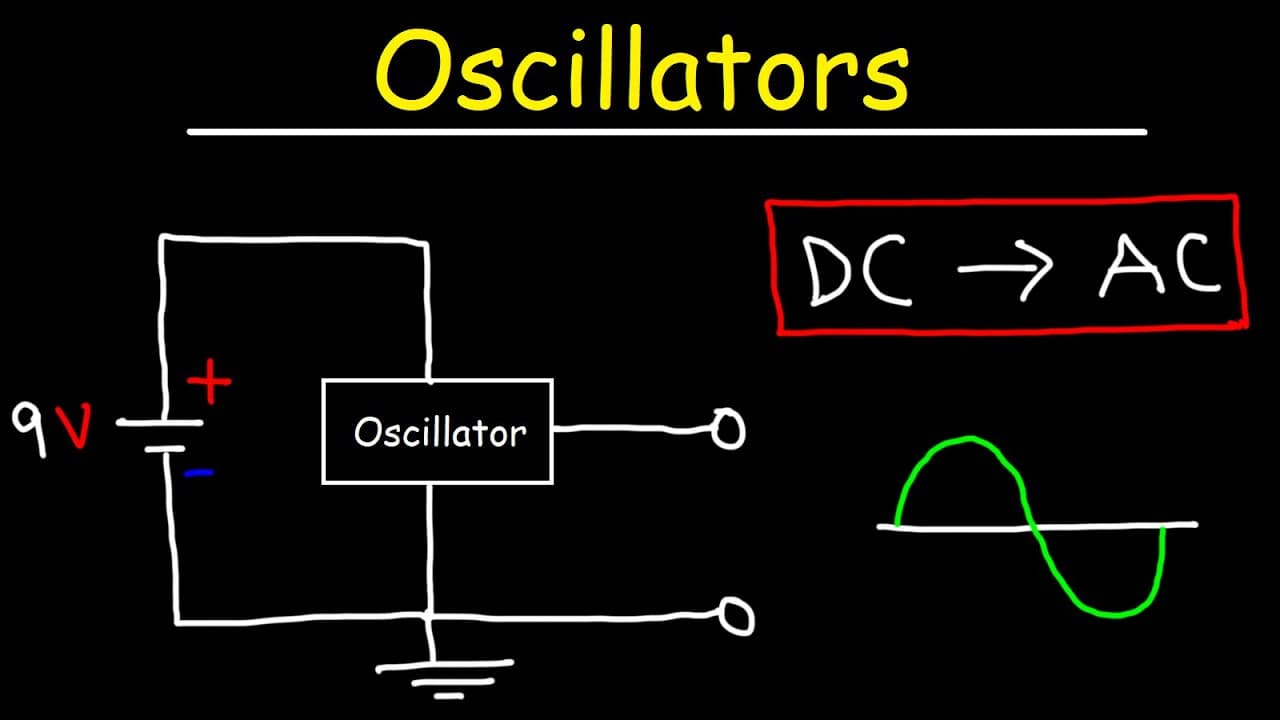
An oscillator is a circuit that converts DC into AC output, producing various waveforms like sine, triangle, and square waves. For sustained oscillations, it requires a feedback signal in phase with the input and a loop gain equal to one, meeting the Barkhausen criterion. Common types include LC and RC oscillators, which use inductors and capacitors or resistors and capacitors, respectively.
Transcript
in this video we're going to talk about oscillators what is an oscillator an oscillator is basically a circuit that takes in a dc input and converts it into an ac output now the output can be of a sinusoidal nature you can get a sine wave also known as a harmonic oscillator or you could get non-sinusoidal outputs this would be classified as a relax... Read More
Key Insights
- 👋 Oscillators convert DC input into AC output, producing different waveforms like sine, triangle, square, and sawtooth waves.
- ⚡ They consist of an amplifier that increases voltage and a feedback network that attenuates voltage.
- ❓ Oscillators require specific conditions to sustain oscillations, including the Barkhausen criterion and a total phase shift of 360 degrees.
- 🖖 LC oscillator circuits and RC oscillator circuits are common types of oscillators, using inductors and capacitors or resistors and capacitors, respectively.
- ❓ The frequency of oscillations can be calculated using specific formulas for LC and RC oscillator circuits.
- 👋 The 555 timer can be used to generate square waves and can convert them into sine or triangular waves with the addition of appropriate LC or RC networks.
- 🌉 Other types of oscillators include the negative resistance oscillator and the Y-bridge oscillator, each with their own frequency formulas.
Install to Summarize YouTube Videos and Get Transcripts
Explore YouTube Video Summarizer or Get YouTube Transcript Extractor
Questions & Answers
Q: What is an oscillator and what does it do?
An oscillator is a circuit that converts DC input into AC output. It generates different waveforms like sine, triangle, square, and sawtooth waves.
Q: What are the main components of an oscillator?
An oscillator consists of an amplifier and a feedback network. The amplifier increases the voltage, while the feedback network attenuates the voltage.
Q: What conditions must be met for an oscillator to sustain oscillations?
The oscillator must meet the Barkhausen criterion, where the loop gain (attenuation factor multiplied by voltage gain) is equal to one. Additionally, the total phase shift must be 360 degrees.
Q: What happens if the loop gain is less than one or greater than one?
If the loop gain is less than one, oscillations will initially occur but eventually dampen and die out. If the loop gain is greater than one, oscillations will initially occur and grow until they reach a ceiling and clip.
Summary & Key Takeaways
-
Oscillators are circuits that convert DC input into AC output, producing different waveforms like sine, triangle, square, and sawtooth waves.
-
They consist of an amplifier that increases voltage and a feedback network that attenuates voltage.
-
For sustained oscillations, the feedback network should provide a signal in phase with the input, and the loop gain must be equal to one.
Read in Other Languages (beta)
Share This Summary 📚
Summarize YouTube Videos and Get Video Transcripts with 1-Click
Try YouTube Summary with ChatGPT & Claude or YouTube Transcript Generator
Explore More Summaries from The Organic Chemistry Tutor 📚

Summarize YouTube Videos and Get Video Transcripts with 1-Click
Try YouTube Summary with ChatGPT & Claude or YouTube Transcript Generator