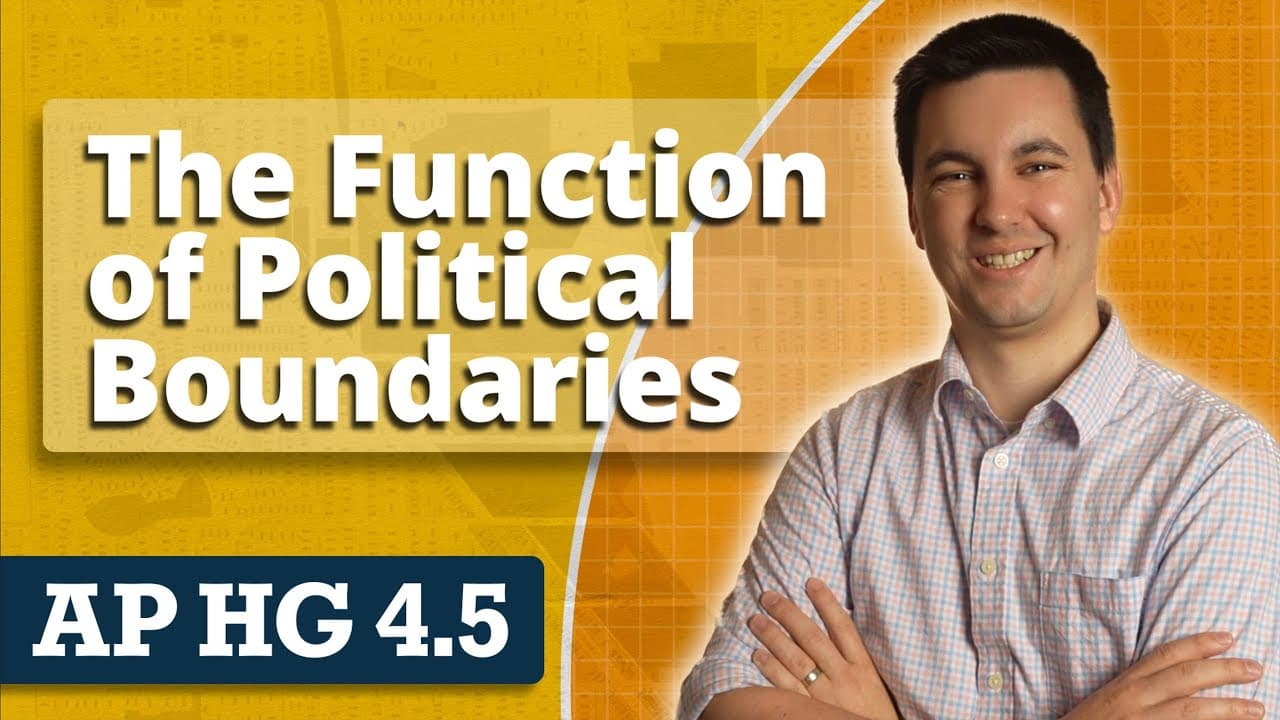
Political Boundary Disputes & The Law Of The Sea [AP Human Geography Unit 4 Topic 5]
TL;DR
Political boundaries separate states and can be defined by cultural, physical, and economic differences. Disputes over boundaries can occur due to interpretation, changes in geography, or allocation of resources. The South China Sea is currently a major hotspot for boundary disputes.
Transcript
in this video we are going to be reviewing the function of political boundaries and talk about the law of the sea remember if you find Value in these topic review videos consider subscribing and check out my ultimate review packet for more help with your AP Human Geography study now like we talked about in our last video a boundary is an invisible ... Read More
Key Insights
- ⚾ Boundaries separate states based on cultural, physical, or economic differences.
- ❓ Boundary disputes can arise due to interpretational, locational, operational, or allocational issues.
- 🏆 The South China Sea is a highly contested area due to its valuable resources and strategic location.
- 🤢 UNCLOS provides guidelines for resolving boundary disputes in the sea.
- 🇨🇳 China's historical claim and construction of artificial islands have contributed to tensions in the South China Sea.
- 🇺🇸 The involvement of the United States has further increased tensions in the region.
- 🇨🇳 The outcome of the South China Sea disputes will have significant political and economic implications.
Install to Summarize YouTube Videos and Get Transcripts
Explore YouTube Video Summarizer or Get YouTube Transcript Extractor
Questions & Answers
Q: What are political boundaries, and how are they established?
Political boundaries are invisible barriers that separate states, and they can be established based on cultural, physical, or economic differences. For example, a boundary might be based on linguistic characteristics or the presence of different nations in an area.
Q: What are some reasons for boundary disputes?
Boundary disputes can occur due to definitional issues (interpretation of original documents), locational changes (geographical shifts), operational disagreements (how to handle a major issue concerning the boundary), or allocational conflicts (disputes over the use of resources on or within the boundary).
Q: What is the United Nations convention on the law of the sea (UNCLOS)?
UNCLOS is an international agreement that provides guidelines for handling boundary disputes in the sea. It consists of territorial waters (up to 12 nautical miles from shore), contiguous zone (12-24 nautical miles), exclusive economic zone (24-200 nautical miles), and international waters (beyond 200 nautical miles).
Q: Why is the South China Sea a subject of intense boundary disputes?
The South China Sea is rich in natural resources and serves as a major trade route. Multiple countries, including China, Vietnam, the Philippines, and Malaysia, claim territories and resources in the region. China's historical claim based on the nine-dash line has caused tensions, and its expansion of military bases on artificial islands has further escalated the disputes.
Key Insights:
- Boundaries separate states based on cultural, physical, or economic differences.
- Boundary disputes can arise due to interpretational, locational, operational, or allocational issues.
- The South China Sea is a highly contested area due to its valuable resources and strategic location.
- UNCLOS provides guidelines for resolving boundary disputes in the sea.
- China's historical claim and construction of artificial islands have contributed to tensions in the South China Sea.
- The involvement of the United States has further increased tensions in the region.
- The outcome of the South China Sea disputes will have significant political and economic implications.
- Understanding political boundaries and the law of the sea is crucial for studying AP Human Geography.
Summary & Key Takeaways
-
Boundaries are invisible barriers that separate states and can be established based on cultural, physical, or economic differences.
-
Boundary disputes can arise due to disagreement over interpretation, changes in geography, or allocation of resources.
-
The South China Sea is a prime example of a contentious boundary dispute, with multiple countries, including China and the United States, claiming territories and natural resources in the region.
Read in Other Languages (beta)
Share This Summary 📚
Summarize YouTube Videos and Get Video Transcripts with 1-Click
Try YouTube Summary with ChatGPT & Claude or YouTube Transcript Generator
Explore More Summaries from Mr. Sinn 📚

![AP Psychology Unit 1 Review [Everything You NEED to Know] thumbnail](/_next/image?url=https%3A%2F%2Fi.ytimg.com%2Fvi%2F4yvfd8aoUBc%2Fhqdefault.jpg&w=750&q=75)
![Boundary Disputes & The South China Sea [AP Human Geography Unit 4 Topic 5] (4.5) thumbnail](/_next/image?url=https%3A%2F%2Fi.ytimg.com%2Fvi%2FtD4p0yKqV-k%2Fhqdefault.jpg&w=750&q=75)
![Commercial & Subsistence Agriculture [AP Human Geography Unit 5 Topic 6] thumbnail](/_next/image?url=https%3A%2F%2Fi.ytimg.com%2Fvi%2FL4oS4mOF1o4%2Fhqdefault.jpg&w=750&q=75)
Summarize YouTube Videos and Get Video Transcripts with 1-Click
Try YouTube Summary with ChatGPT & Claude or YouTube Transcript Generator