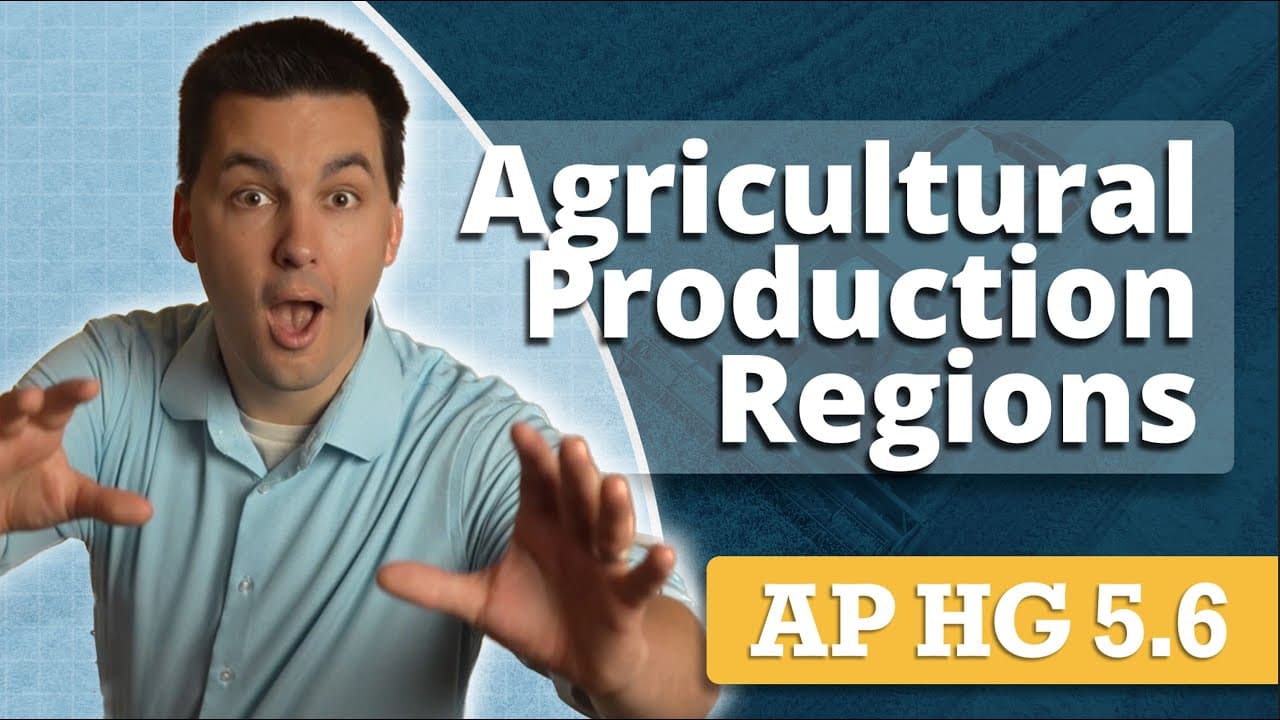
Commercial & Subsistence Agriculture [AP Human Geography Unit 5 Topic 6]
TL;DR
Explains subsistence and commercial agriculture, bid rent theory, and monocropping.
Transcript
hello there geographers and welcome back to the Mr sin Channel today we're going to talk about different types of extensive and intensive subsistence and Commercial agricultural practices plus we're also going to review the bid rent Theory mono cropping and monoculture as always if you find Value in these videos consider subscribing... Read More
Key Insights
- Subsistence agriculture focuses on producing food for local consumption, using less machinery and smaller farms, while commercial agriculture aims for profit with larger farms and advanced machinery.
- Economically developed countries tend to have more commercial agriculture with advanced machinery, whereas less developed countries rely on subsistence agriculture with more human labor.
- Extensive subsistence agriculture requires more land but less machinery and labor, while intensive subsistence agriculture uses less land but more labor and capital.
- Extensive commercial agriculture, like cattle ranching, requires significant land but less machinery, aiming for profit through large-scale production.
- Intensive commercial agriculture, such as dairy farming, uses less land but requires significant capital, machinery, and labor, often located near urban markets.
- The bid rent theory explains land price variations based on proximity to urban areas, affecting the location of agricultural practices.
- Monocropping involves growing the same crop annually, risking soil depletion but offering potential profits through specialization.
- Monoculture involves growing one type of crop at a time, with potential crop changes after harvest to manage soil health and productivity.
Install to Summarize YouTube Videos and Get Transcripts
Explore YouTube Video Summarizer or Get YouTube Transcript Extractor
Questions & Answers
Q: What is the main difference between subsistence and commercial agriculture?
Subsistence agriculture focuses on producing food for a person's family or local community, relying on smaller farms and human labor. In contrast, commercial agriculture aims to produce food for profit, utilizing larger farms and advanced machinery, often seen in more economically developed countries.
Q: How does the economic development of a country affect its agricultural practices?
Economically developed countries tend to have more commercial agriculture with advanced machinery due to better resources and infrastructure. Less developed countries rely more on subsistence agriculture, with a larger portion of the population engaged in agriculture and limited access to advanced machinery.
Q: What are the characteristics of extensive subsistence agriculture?
Extensive subsistence agriculture uses more land and relies less on machinery and human labor. It is typically practiced in regions with abundant land availability, where the focus is on producing enough food to meet local consumption needs rather than maximizing profit.
Q: How does intensive subsistence agriculture differ from extensive subsistence agriculture?
Intensive subsistence agriculture uses less land but requires more human labor and capital, such as in wet rice farming. It focuses on maximizing productivity on smaller plots of land, often seen in densely populated regions where land is scarce and labor is abundant.
Q: What role does the bid rent theory play in agricultural practices?
The bid rent theory explains how land prices vary based on proximity to urban areas. As land near cities is more expensive due to higher demand, intensive agriculture, which requires less land, is often located closer to urban areas, while extensive agriculture is placed farther away to take advantage of cheaper land.
Q: What are the potential risks and benefits of monocropping?
Monocropping involves growing the same crop year after year, which can lead to soil depletion and increased vulnerability to pests and diseases. However, it offers benefits such as specialization, increased efficiency, and potential for higher profits, as farmers become adept at producing a specific crop.
Q: How does monoculture differ from monocropping?
Monoculture involves growing one type of crop during a specific period but may switch crops after harvest. This practice allows for crop rotation, helping to manage soil health and reduce pest issues, unlike monocropping, which focuses on a single crop year after year without rotation.
Q: Why is intensive commercial agriculture often located near urban markets?
Intensive commercial agriculture, such as dairy farming, requires significant capital, machinery, and labor, making it more viable near urban markets where land is expensive. Proximity to urban areas reduces transportation costs and ensures quick delivery of perishable goods, maximizing profitability despite higher land costs.
Summary & Key Takeaways
-
Subsistence agriculture serves local consumption needs, using smaller farms and less machinery, while commercial agriculture targets profit with larger, machine-driven farms.
-
Extensive agriculture requires more land but less machinery and labor, whereas intensive agriculture uses less land but more labor and capital, impacting location and production strategies.
-
Bid rent theory explains land price variations near urban areas, influencing agricultural practices, while monocropping and monoculture present both risks and profitability in farming.
Read in Other Languages (beta)
Share This Summary 📚
Summarize YouTube Videos and Get Video Transcripts with 1-Click
Try YouTube Summary with ChatGPT & Claude or YouTube Transcript Generator
Explore More Summaries from Mr. Sinn 📚
![Political Boundary Disputes & The Law Of The Sea [AP Human Geography Unit 4 Topic 5] thumbnail](/_next/image?url=https%3A%2F%2Fi.ytimg.com%2Fvi%2Fsc_C1y0PsCQ%2Fhqdefault.jpg&w=750&q=75)
![AP Psychology Unit 1 Review [Everything You NEED to Know] thumbnail](/_next/image?url=https%3A%2F%2Fi.ytimg.com%2Fvi%2F4yvfd8aoUBc%2Fhqdefault.jpg&w=750&q=75)

Summarize YouTube Videos and Get Video Transcripts with 1-Click
Try YouTube Summary with ChatGPT & Claude or YouTube Transcript Generator