Products
Features
YouTube Video Summarizer
Summarize YouTube videos
Web & PDF Highlighter
Highlight web pages & PDFs
Chat with PDF
Ask any PDF questions with AI
Ask AI Clone
Chat with your highlights & memories
Audio Transcriber
Transcribe audio files to text
Glasp Reader
Read and highlight articles
Kindle Highlight Export
Export your Kindle highlights
Idea Hatch
Hatch ideas from your highlights
Integrations
Obsidian Plugin
Notion Integration
Pocket Integration
Instapaper Integration
Medium Integration
Readwise Integration
Snipd Integration
Hypothesis Integration
Apps & Extensions
Chrome Extension
Safari Extension
Edge Add-ons
Firefox Add-ons
iOS App
Android App
Discover
Discover
Ideas
Discover new ideas and insights
Articles
Curated articles and insights
Books
Book recommendations by great minds
Posts
Essays and notes from readers
Quotes
Inspiring quotes collection
Videos
Curated videos and summaries
Explore Glasp
Glasp Newsletter
Weekly insights and updates
Glasp Talk
Interview series with great minds
Glasp Blog
Latest news and articles
Glasp Use Cases
Learn how others use Glasp
Build & Support
Glasp API
Access Glasp's API for developers
MCP Connector
Connect Glasp to Claude & ChatGPT
Community
Glasp Reddit Community
Students
Student discount and benefits
FAQs
Frequently Asked Questions
AboutPricing
DashboardLog inSign up

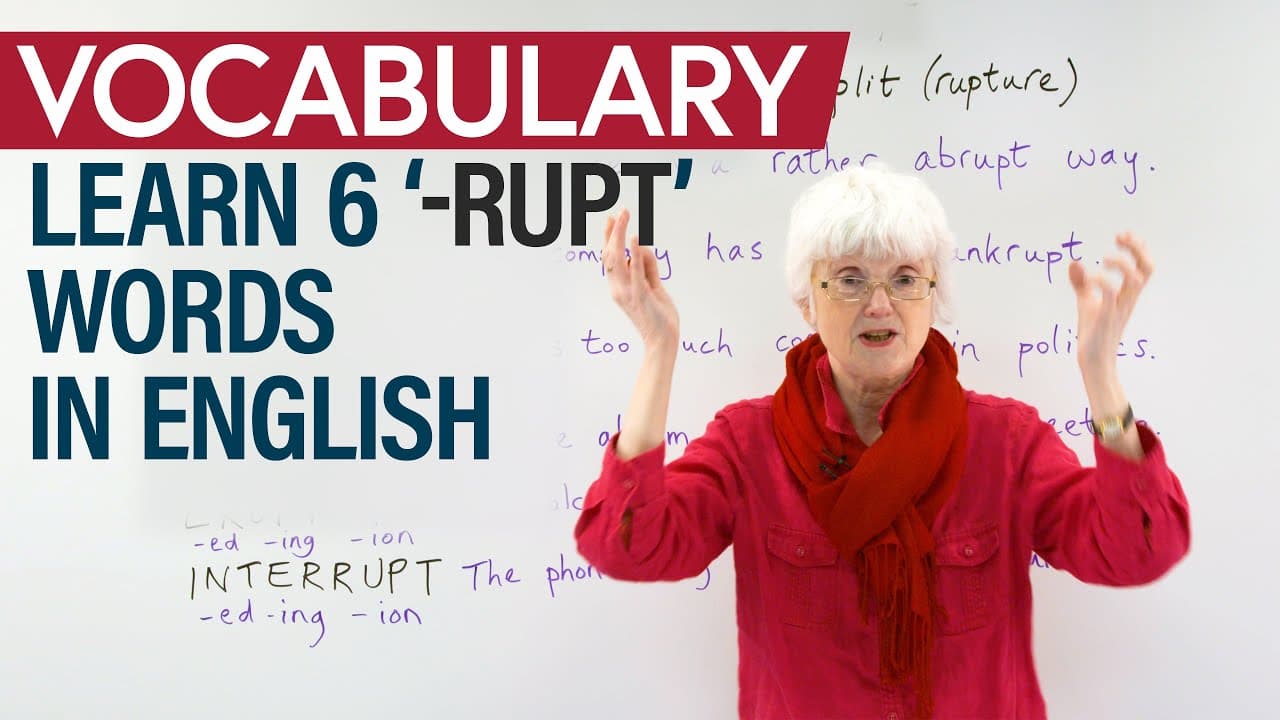
Improve your Vocabulary: 6 English words ending in -RUPT
118.7K views
β€’
October 23, 2019
by
Learn English with Gill Β· engVid
YouTube video player
Improve your Vocabulary: 6 English words ending in -RUPT

TL;DR

Learn six words derived from "rumpere" meaning to break, burst, or split, including "rupt", "abrupt", "bankrupt", "corrupt", "disrupt", and "interrupt".

Transcript

Hello. I'm Gill at engVid, and today we have a lesson on six words that end with the letters "r", "u", "p", "t". "Rupt", which might sound a bit strange, but they all come from a Latin word "rumpere", which means to break, to burst, to split. If this pen, for example, breaks or splits, then it will be in pieces and the ink will come out all over my... Read More

Key Insights

  • πŸ”‘ Understanding the etymology of words enhances vocabulary comprehension.
  • πŸ€‘ Money-related terms like "bankrupt" encompass financial distress and overspending.
  • πŸ‘ The moral connotations of "corrupt" highlight unethical practices in various fields.
  • πŸ™… Disruption denotes a sudden halt or interruption in a process or situation.
  • πŸŒ‹ Eruption symbolizes a sudden and possibly violent outburst, like a volcano.
  • πŸ’ Interrupting signifies breaking the flow of communication or activity abruptly.
  • πŸ“’ Language nuances like adjectives, adverbs, and nouns enrich vocabulary usage.

Install to Summarize YouTube Videos and Get Transcripts

Explore YouTube Video Summarizer or Get YouTube Transcript Extractor

Questions & Answers

Q: What is the origin of words like "abrupt" and "corrupt"?

These words come from the Latin term "rumpere", denoting breakage or fragmentation, leading to their usage in English.

Q: How does bankruptcy impact individuals and companies?

Bankruptcy signifies financial insolvency, affecting both individuals and corporations by indicating a loss of monetary stability.

Q: What does the term "corrupt" typically refer to?

"Corrupt" describes unethical behavior such as bribery and misuse of power, commonly seen in politics and business.

Q: How can one address disruptive behavior effectively?

Handling disruptive behavior involves identifying and rectifying actions that impede normal functioning, ensuring a smooth transition.

Summary & Key Takeaways

  • Words like "abrupt" and "corrupt" come from Latin "rumpere", meaning to break or split.

  • "Bankrupt" relates to financial ruin, "corrupt" to unethical behavior, and "disrupt" to interruption.

  • Examples: "He spoke abruptly", "The company went bankrupt", "Corruption is harmful".


Read in Other Languages (beta)

English

Share This Summary πŸ“š

Summarize YouTube Videos and Get Video Transcripts with 1-Click

Download browser extensions on:

Try YouTube Summary with ChatGPT & Claude or YouTube Transcript Generator

Explore More Summaries from Learn English with Gill Β· engVid πŸ“š

English Pronunciation Practice: CH & SH thumbnail
English Pronunciation Practice: CH & SH
Learn English with Gill Β· engVid
Where do the names of the days of the week come from? thumbnail
Where do the names of the days of the week come from?
Learn English with Gill Β· engVid
Easy English Lesson: Should you use β€œA” or β€œAN”? thumbnail
Easy English Lesson: Should you use β€œA” or β€œAN”?
Learn English with Gill Β· engVid
How to Use the Auxiliary Verb 'Could' in English thumbnail
How to Use the Auxiliary Verb 'Could' in English
Learn English with Gill Β· engVid
The 12 Days of Christmas – Sing and Learn English! thumbnail
The 12 Days of Christmas – Sing and Learn English!
Learn English with Gill Β· engVid
Basic English – How and when to use LOOK, SEE, and WATCH thumbnail
Basic English – How and when to use LOOK, SEE, and WATCH
Learn English with Gill Β· engVid

Summarize YouTube Videos and Get Video Transcripts with 1-Click

Download browser extensions on:

Try YouTube Summary with ChatGPT & Claude or YouTube Transcript Generator

Apps & Extensions

  • Chrome Extension
  • Safari Extension
  • Edge Add-ons
  • Firefox Add-ons
  • iOS App
  • Android App

Key Features

  • YouTube Video Summarizer
  • Web & PDF Summarizer
  • Web & PDF Highlighter
  • Chat with PDF
  • Ask AI Clone
  • Audio Transcriber
  • Glasp Reader
  • Kindle Highlight Export
  • Idea Hatch

Integrations

  • Obsidian Plugin
  • Notion Integration
  • Pocket Integration
  • Instapaper Integration
  • Medium Integration
  • Readwise Integration
  • Snipd Integration
  • Hypothesis Integration

More Features

  • APIs
  • MCP Connector
  • Blog & Post
  • Embed Links
  • Image Highlight
  • Personality Test
  • Quote Shots

Company

  • About us
  • Blog
  • Community
  • FAQs
  • Job Board
  • Newsletter
  • Pricing
Terms

β€’

Privacy

β€’

Guidelines

Β© 2026 Glasp Inc. All rights reserved.