Basic English – How and when to use LOOK, SEE, and WATCH
TL;DR
Learn the distinctions between "look," "see," and "watch" in English and how they are used in different contexts.
Transcript
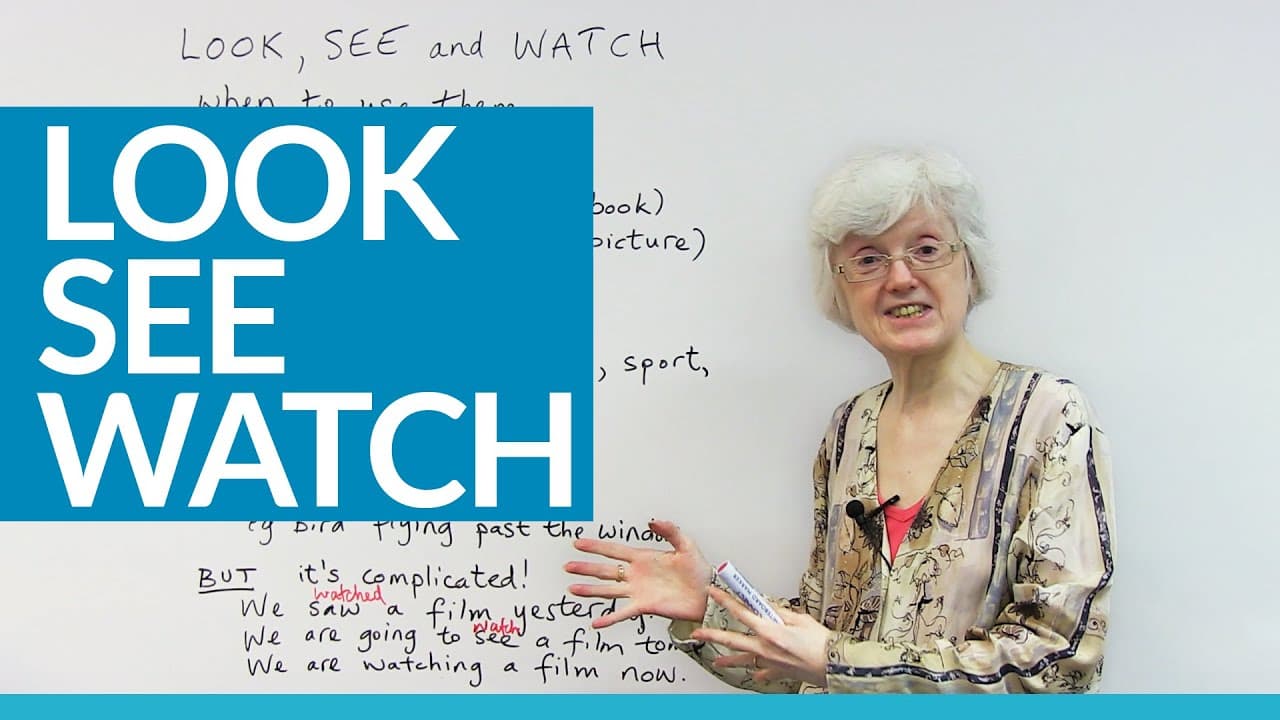
Hi. I'm Gill at engVid, and today we're going to be looking at the verb... Well, three verbs: "to look", "to see", and "to watch", which all involve using your eyes, but they are used in different ways and different contexts. So, it's quite complicated, really, but we're going to look at some examples, and I'll try to explain why you choose "look" ... Read More
Key Insights
- 👀 "Look" is used when actively searching or examining something, often with prepositions like "for" or "at."
- ❓ "Watch" is used when actively observing something in motion or undergoing a process.
- 😃 "See" is a more passive verb, where the image is received through the eyes without active searching.
- 🎚️ The choice between these verbs depends on the level of activity and purpose in observing.
- 👀 In the present tense, "look," "watch," and "see" have distinct meanings, while in the past or future tense, they can be more flexible.
- ❓ These verbs can be influenced by context and specific situations.
- 😒 Native speakers rely on the feeling and intuition of which verb to use.
Install to Summarize YouTube Videos and Get Transcripts
Explore YouTube Video Summarizer or Get YouTube Transcript Extractor
Questions & Answers
Q: What is the difference between "look" and "watch"?
"Look" is used when actively searching or examining something, while "watch" is used when actively observing something in motion or undergoing a process.
Q: Can "see" be used in both active and passive ways?
"See" is primarily used passively, where an image is received through the eyes without active searching. However, it can also be used actively in certain situations like observing a sudden event.
Q: How are prepositions used with "look"?
Prepositions like "for" or "at" are often used with "look" to indicate what is being searched for or observed, such as "looking for my book" or "looking at a picture."
Q: Can "see" and "watch" be used interchangeably when referring to past or future events?
Yes, in the past or future tense, both "saw" and "watched" can be used interchangeably with "see" and "watch" respectively. However, in the present tense, the distinction becomes clearer.
Summary & Key Takeaways
-
"Look" is an active verb used to deliberately search for or examine something, often followed by prepositions like "for" or "at."
-
"Watch" is an active verb used when observing something that is in motion or undergoing a process, such as watching a film, sports, or animals.
-
"See" is a more passive verb, where the image is received through the eyes without actively searching for it, such as noticing something that is already in front of you.
Read in Other Languages (beta)
Share This Summary 📚
Summarize YouTube Videos and Get Video Transcripts with 1-Click
Try YouTube Summary with ChatGPT & Claude or YouTube Transcript Generator
Explore More Summaries from Learn English with Gill · engVid 📚




Summarize YouTube Videos and Get Video Transcripts with 1-Click
Try YouTube Summary with ChatGPT & Claude or YouTube Transcript Generator