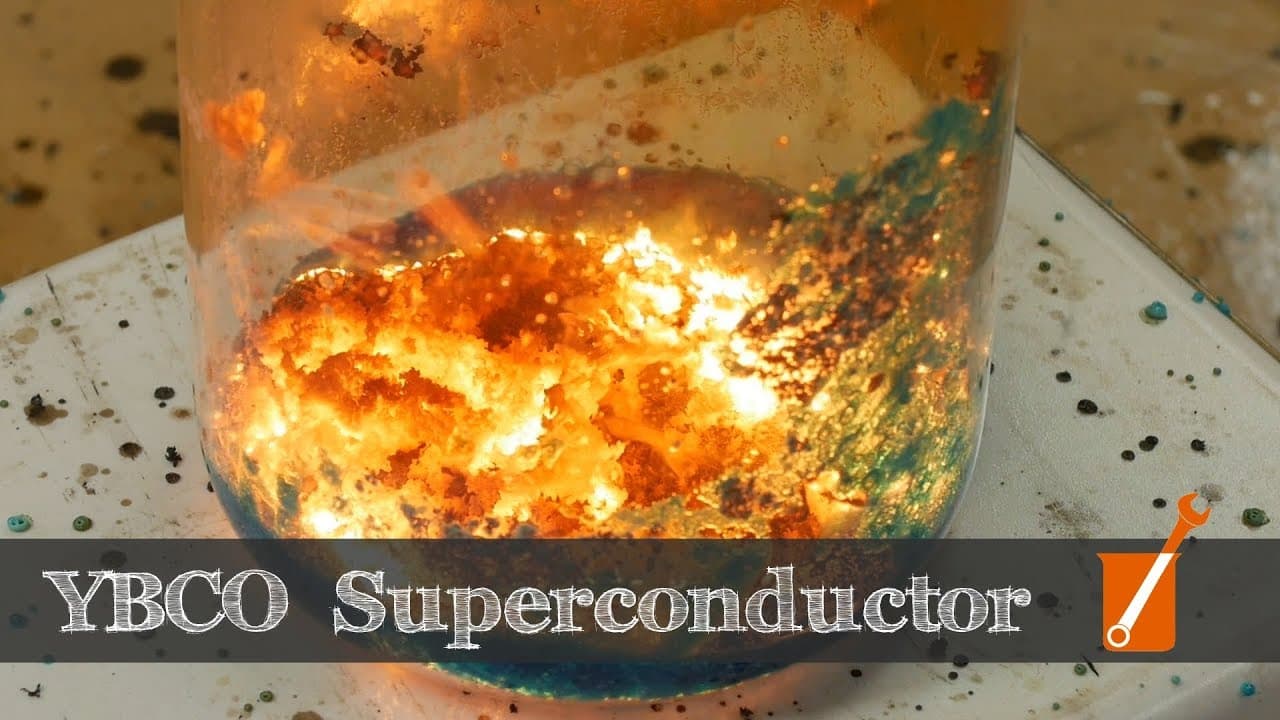
Making YBCO superconductor
TL;DR
Learn how to create high-temperature superconductors at home, with experiments, properties, and levitation demonstrations.
Transcript
today on applied science we're going to talk about superconductors you've probably seen this cool demo of levitating a magnet above a high-temperature superconductor like this and as it turns out making superconductor is completely possible in home shop and involves quite a lot of fun stuff we've got spontaneously combusting mixtures you've got hyd... Read More
Key Insights
- ✋ DIY process for creating ybco high-temperature superconductors at home.
- 😴 Magnetic levitation in superconductors is due to flux pinning, allowing for unique effects.
- 🎮 Importance of temperature control and oxygenation in the creation of superconductors.
- 🥺 Challenges in lead attachment for resistance measurements in superconductors.
- 🤝 Comparison of DIY methods versus traditional shake-and-bake processes for making superconductors.
- ❓ Use of pyrometric cones for accurate temperature calibration in kilns.
- 🧪 Potential applications of vacuum tube furnaces for advanced experiments.
Install to Summarize YouTube Videos and Get Transcripts
Explore YouTube Video Summarizer or Get YouTube Transcript Extractor
Questions & Answers
Q: What materials are required to create high-temperature superconductors at home?
To make high-temperature superconductors at home, you need yttrium, copper, and barium compounds that are soluble in water, nitric acid as an oxidizer, and citric acid as a fuel. These chemicals are mixed, boiled, and ignited to form the material.
Q: How do magnetic levitation and flux pinning work in superconductors?
Magnetic levitation in superconductors occurs due to flux pinning, where imperfections in the crystal structure allow magnetic field lines to pass through and get trapped, creating a levitation effect. This is due to the superconducting properties of the material.
Q: Why is it essential to cool the superconductor gradually after oxygenation?
Cooling the superconductor slowly after oxygenation is crucial to allowing large crystals to form within the material. This process optimizes the superconducting properties and ensures that the resistance drops to zero at the transition temperature.
Q: What challenges were faced in attaching leads to the superconductor for resistance measurements?
Attaching leads to the superconductor for resistance measurements proved challenging, with epoxy and specialized Kelvin probes failing to make effective contact. The simplest method of using alligator clips provided the most successful results.
Summary & Key Takeaways
-
DIY process for creating high-temperature superconductors at home involving ybco material.
-
Properties of superconductors, including magnetic flux pinning and levitation effects.
-
Demonstration of electrical resistance measurement and comparison with literature values.
Read in Other Languages (beta)
Share This Summary 📚
Summarize YouTube Videos and Get Video Transcripts with 1-Click
Try YouTube Summary with ChatGPT & Claude or YouTube Transcript Generator
Explore More Summaries from Applied Science 📚
Summarize YouTube Videos and Get Video Transcripts with 1-Click
Try YouTube Summary with ChatGPT & Claude or YouTube Transcript Generator