To invest or pay-off loans
TL;DR
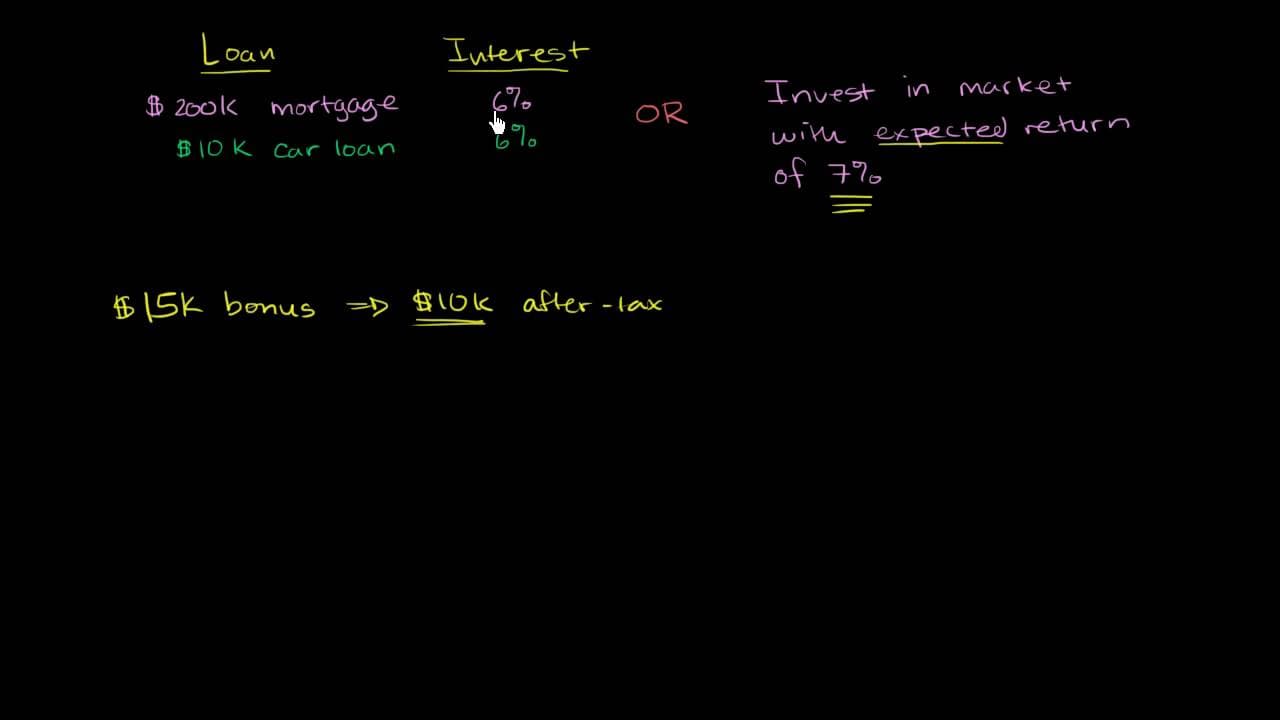
A person receives a $15,000 bonus and has the option to pay off debt or invest in the market, but considering tax implications, it is more financially beneficial to pay off the higher interest car loan.
Transcript
a relative of my wife asked me the other day at a party that they are getting a fifteen thousand dollar bonus they are getting a fifteen thousand dollar bonus from work and they wanted to figure out what should they do with that fifteen thousand dollar bonus not a fifteen dollar bonus fifteen thousand dollar fifteen thousand dollar bonus and right ... Read More
Key Insights
- 💦 A $15,000 bonus after tax becomes a $10,000 net amount to work with.
- ☠️ Mortgage interest is tax-deductible, lowering the effective interest rate to around 4%.
- 😨 Car loan interest is not tax-deductible, making its effective interest rate remain at 6%.
- 😚 Investing in the market has an expected return of around 7%, but considering taxes, it may be closer to 5%.
- 😨 The most financially beneficial option is to pay off the car loan, guaranteeing a 6% savings.
- 🖐️ Tax implications play a crucial role in assessing the true costs and benefits of different financial choices.
- 🔬 It is essential to consider both risk and return when deciding between paying off debt and investing in the market.
Install to Summarize YouTube Videos and Get Transcripts
Explore YouTube Video Summarizer or Get YouTube Transcript Extractor
Questions & Answers
Q: How much will the person have to play with after taxes?
After considering taxes, the person will have a $10,000 bonus to work with.
Q: What are the interest rates on the mortgage and car loan?
The mortgage has a 6% pre-tax interest rate, but after factoring in tax deductions, it is closer to 4%. The car loan has a 6% interest rate.
Q: Why is paying off the car loan the best option?
Paying off the car loan guarantees a 6% annual savings, which is higher than the expected return from investing in the market (around 5%) and the effective interest rate on the mortgage (around 4%).
Q: What are the advantages of considering tax implications?
By factoring in tax deductions, the effective interest rates can be determined for each option, allowing for a more accurate comparison and decision-making process.
Summary & Key Takeaways
-
A person receives a $15,000 bonus after taxes and has the choice to pay off a $10,000 car loan with 6% interest or invest in the stock market with an expected 7% return.
-
The effective interest rate on the mortgage is lower due to tax deductions, making it closer to 4%.
-
Taking tax implications into account, paying off the higher interest car loan is the most advantageous option.
Read in Other Languages (beta)
Share This Summary 📚
Summarize YouTube Videos and Get Video Transcripts with 1-Click
Try YouTube Summary with ChatGPT & Claude or YouTube Transcript Generator
Explore More Summaries from Khan Academy 📚



Summarize YouTube Videos and Get Video Transcripts with 1-Click
Try YouTube Summary with ChatGPT & Claude or YouTube Transcript Generator