Fiscal and monetary policy in parallel | AP Macroeconomics | Khan Academy
TL;DR
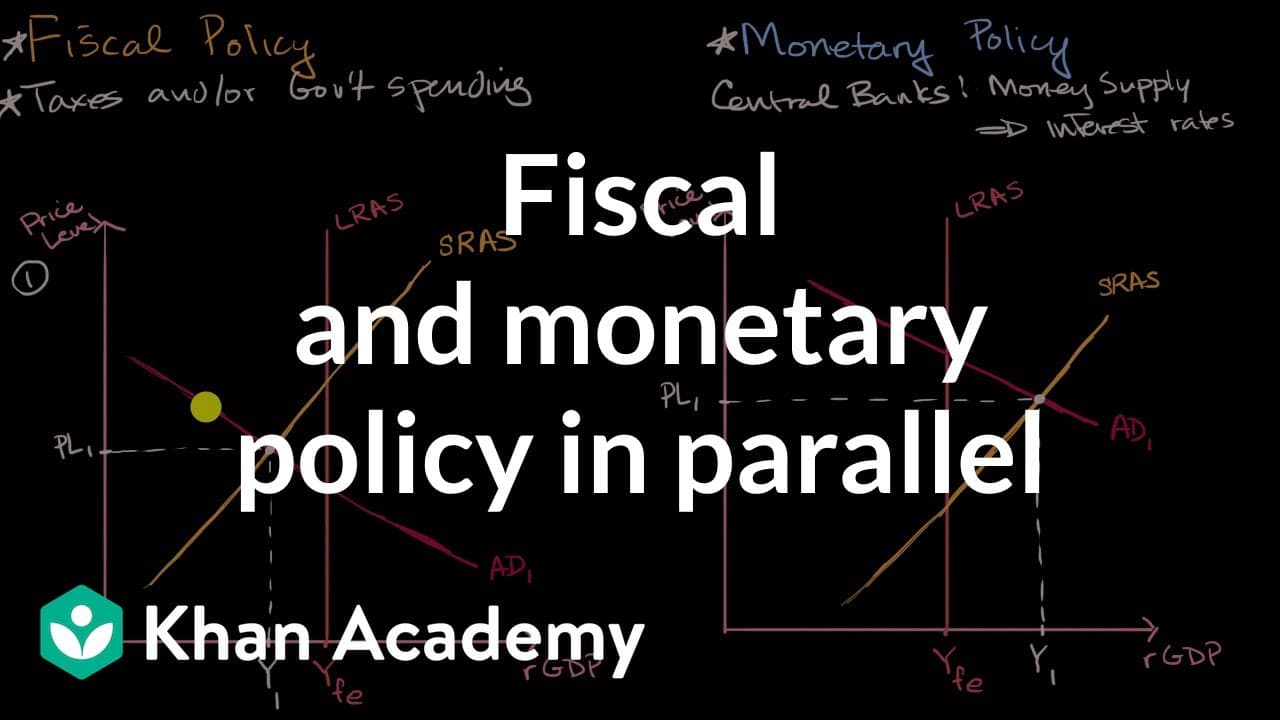
Fiscal policy involves changes in taxes and government spending to impact aggregate demand, while monetary policy focuses on central banks altering the money supply to target interest rates.
Transcript
- [Narrator] In previous videos we've talked at length about fiscal policy and in other videos we've talked at length about monetary policy. But now we're going to talk about them together because at any given time in a country there is some type of fiscal policy going on and in parallel there might be some type of monetary policy going on. But fir... Read More
Key Insights
- 💵 Fiscal policy involves changes in taxes and government spending, while monetary policy deals with central banks altering the money supply to target interest rates.
- ❓ Fiscal policy and monetary policy are often used together to achieve desired economic outcomes.
- 🛄 Expansionary policies aim to stimulate economic growth, while contractionary policies aim to control inflation.
- 🎚️ Fiscal and monetary policies have a direct impact on aggregate demand, which determines the overall level of economic activity.
- 🇺🇸 The Federal Reserve System in the United States is quasi-independent from the government but plays a crucial role in monetary policy.
- ❓ Both fiscal and monetary policy can influence borrowing, spending, and investment decisions of individuals and corporations.
- 😚 In scenarios where the economy is below its full employment output, expansionary policies are typically used to close the output gap.
Install to Summarize YouTube Videos and Get Transcripts
Explore YouTube Video Summarizer or Get YouTube Transcript Extractor
Questions & Answers
Q: What is fiscal policy and how does it impact aggregate demand?
Fiscal policy refers to the government's ability to change taxes or government spending. By lowering taxes or increasing government spending, individuals and corporations have more money, leading to an increase in aggregate demand.
Q: What is monetary policy and how does it influence interest rates?
Monetary policy focuses on central banks changing the money supply to target interest rates. By increasing the money supply, borrowing becomes cheaper, encouraging individuals and corporations to borrow and spend more, thus increasing aggregate demand.
Q: How does expansionary fiscal and monetary policy impact the economy?
Expansionary fiscal policy, such as lowering taxes or increasing government spending, combined with expansionary monetary policy, which increases the money supply, both serve to shift aggregate demand to the right. This stimulates economic growth and can bring the economy closer to full employment output.
Q: How does contractionary fiscal and monetary policy affect the economy?
Contractionary fiscal policy, such as increasing taxes or reducing government spending, along with contractionary monetary policy, which decreases the money supply, both work to shift aggregate demand to the left. This is typically done to curb inflation or address an overheating economy.
Summary & Key Takeaways
-
Fiscal policy refers to the government changing taxes or government spending to affect aggregate demand.
-
Monetary policy involves central banks changing the money supply to impact interest rates.
-
Both fiscal and monetary policy can be used to engineer the economy's output and are interdependent.
Read in Other Languages (beta)
Share This Summary 📚
Summarize YouTube Videos and Get Video Transcripts with 1-Click
Try YouTube Summary with ChatGPT & Claude or YouTube Transcript Generator
Explore More Summaries from Khan Academy 📚



Summarize YouTube Videos and Get Video Transcripts with 1-Click
Try YouTube Summary with ChatGPT & Claude or YouTube Transcript Generator