Laplace Transform Problem 6| Frequency Domain Analysis by using Laplace Transform | EXTC Engineering
TL;DR
Solving a circuit with a delayed ramp signal using Laplace transform.
Transcript
click the bell icon to get latest videos from ekeeda hello guys welcome to ekeeda today we will see laplace transform problem number six and in this problem we will see what happens when we apply delayed ram signal to the input of a circle so let us see what that problem exactly is so here you can see i've drawn one circuit with respective paramete... Read More
Key Insights
- 0️⃣ Initial conditions are assumed to be zero in the absence of specified values.
- ⌛ KVL equations are crucial for analyzing circuits for circuits with time-varying signals.
- 😑 Partial fraction expansions help in breaking down complex expressions for easier computations.
- ⌛ Inverse Laplace transform is essential for obtaining time-domain responses from frequency-domain signals.
- 📡 Delayed unit step signals play a vital role in time-shifting signals for accurate representation.
- ❓ Understanding Laplace transform is fundamental in solving circuit analysis problems efficiently.
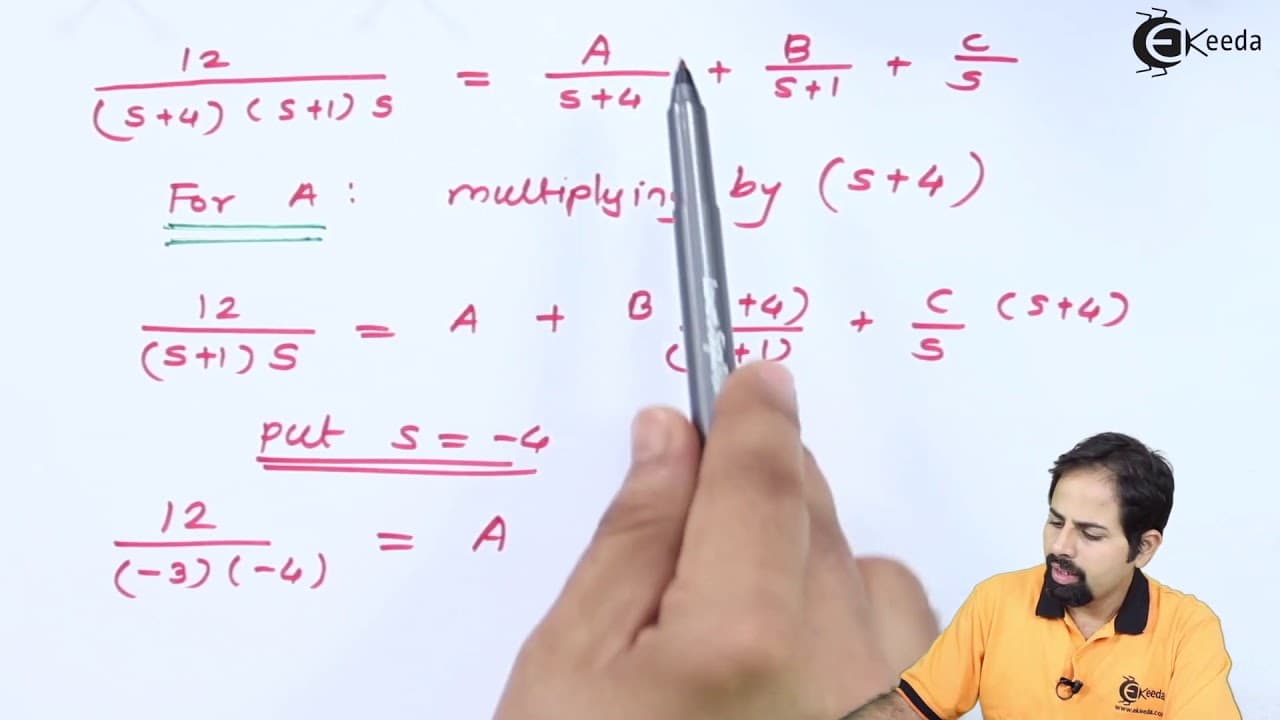
- ❓ Constants in partial fraction expansions are calculated by manipulating and substituting values adeptly.
Install to Summarize YouTube Videos and Get Transcripts
Explore YouTube Video Summarizer or Get YouTube Transcript Extractor
Questions & Answers
Q: What is the initial condition assumed in the problem?
All initial conditions are assumed to be zero as they are not given in the problem.
Q: How is Laplace transform applied to the delayed ramp signal in the circuit?
Laplace transform is employed on the delayed ramp signal using the formula e^-a*s/s^2
Q: How are the constants calculated in the partial fraction expansion?
The constants like a, b, and c are determined by multiplying and substituting specific values of s in the partial fraction expressions.
Q: What is the significance of the delayed unit step signal in the inverse Laplace transform?
The delayed unit step signal reflects the delay caused by the term e^-2s, allowing for the correct time-shifted representation in the inverse Laplace transform.
Summary & Key Takeaways
-
Explains applying Laplace transform to a circuit with delayed ramp signal.
-
Utilizes KVL equations, Laplace transforms, and partial fraction expansions.
-
Demonstrates the process of finding the current in the circuit using inverse Laplace transform.
Read in Other Languages (beta)
Share This Summary 📚
Summarize YouTube Videos and Get Video Transcripts with 1-Click
Try YouTube Summary with ChatGPT & Claude or YouTube Transcript Generator
Explore More Summaries from Ekeeda 📚

Summarize YouTube Videos and Get Video Transcripts with 1-Click
Try YouTube Summary with ChatGPT & Claude or YouTube Transcript Generator