What Is a Logarithmic Scale and How Does It Work?
TL;DR
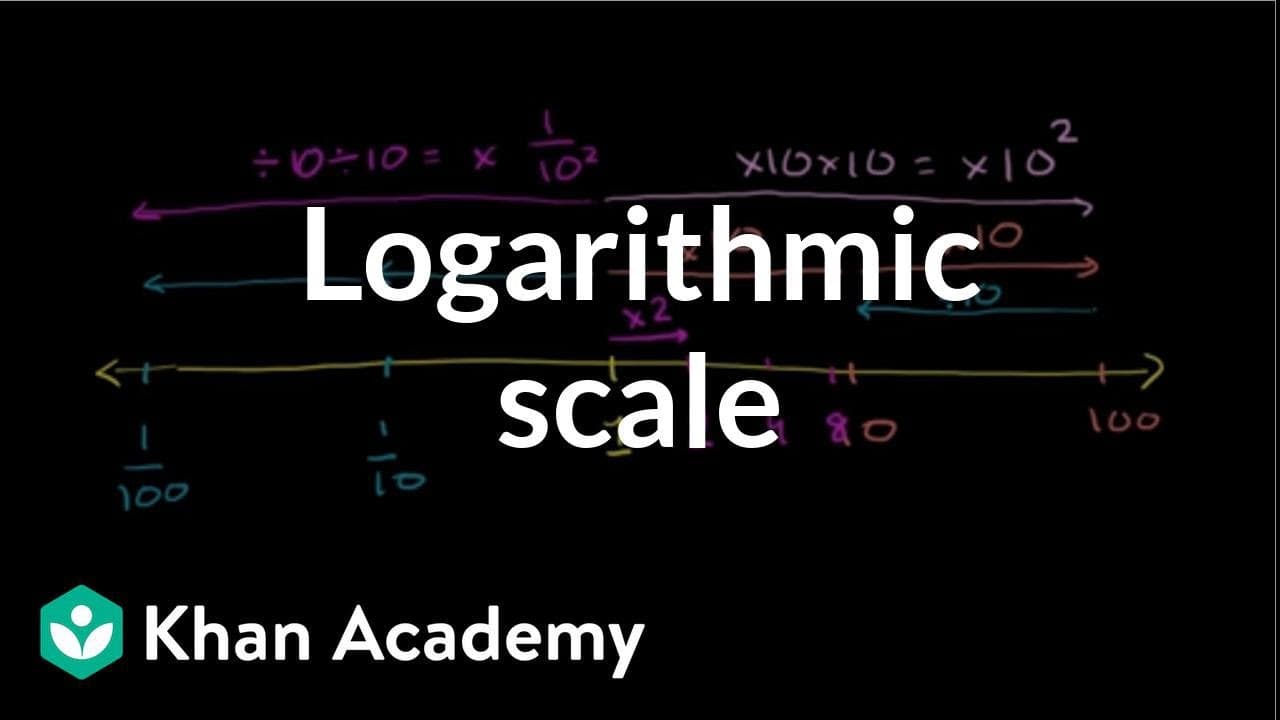
A logarithmic scale uses multiplication and division to represent values, allowing for a broader range of numbers compared to a linear scale, which relies on addition and subtraction. This type of scale is particularly useful in fields like acoustics and seismology, as it can represent exponential growth and decay more intuitively.
Transcript
I would guess that you're reasonably familiar with linear scales. These are the scales that you would typically see in most of your math classes. And so just to make sure we know what we're talking about, and maybe thinking about in a slightly different way, let me draw a linear number line. Let me start with 0. And what we're going to do is, we're... Read More
Key Insights
- 🫥 Linear number lines use addition and subtraction, while logarithmic number lines use multiplication and division.
- 🫥 Logarithmic number lines provide a broader range and more granularity than linear number lines.
- 🫥 The distance traveled on a logarithmic number line represents a fixed factor of multiplication or division.
- ⚖️ Logarithmic scales are frequently used in areas such as acoustics, seismic scales, and measuring pH levels.
- ⚖️ Logarithmic scales can help visualize exponential growth or decay more intuitively.
- #️⃣ The spacing of numbers on a logarithmic number line is not equal, with greater compression at larger values.
- 🫥 Logarithmic number lines can handle a wider range of values compared to linear number lines.
Install to Summarize YouTube Videos and Get Transcripts
Explore YouTube Video Summarizer or Get YouTube Transcript Extractor
Questions & Answers
Q: How does a linear number line work?
A linear number line involves adding or subtracting a fixed distance to move along the line. Moving to the right adds that distance, while moving to the left subtracts it.
Q: How does a logarithmic number line differ from a linear number line?
A logarithmic number line uses multiplication or division instead of addition or subtraction. Moving to the right multiplies the starting point by a fixed factor, while moving to the left divides it.
Q: Why are logarithmic number lines useful?
Logarithmic number lines allow for a broader range of numbers to be represented, with greater granularity at small scales. They can visualize exponential growth or shrinkage more effectively.
Q: How can logarithmic number lines be used to plot specific values?
To plot a value on a logarithmic number line, you can calculate its logarithm to the base of the number line (usually 10) and use that exponent to determine the distance to move.
Summary & Key Takeaways
-
Linear number lines work by adding or subtracting a fixed distance to move along the number line.
-
Logarithmic number lines work by multiplying or dividing a fixed factor to move along the number line.
-
Logarithmic number lines allow for a broader range of numbers to be represented and provide more granularity at small scales.
Read in Other Languages (beta)
Share This Summary 📚
Summarize YouTube Videos and Get Video Transcripts with 1-Click
Try YouTube Summary with ChatGPT & Claude or YouTube Transcript Generator
Explore More Summaries from Khan Academy 📚



Summarize YouTube Videos and Get Video Transcripts with 1-Click
Try YouTube Summary with ChatGPT & Claude or YouTube Transcript Generator