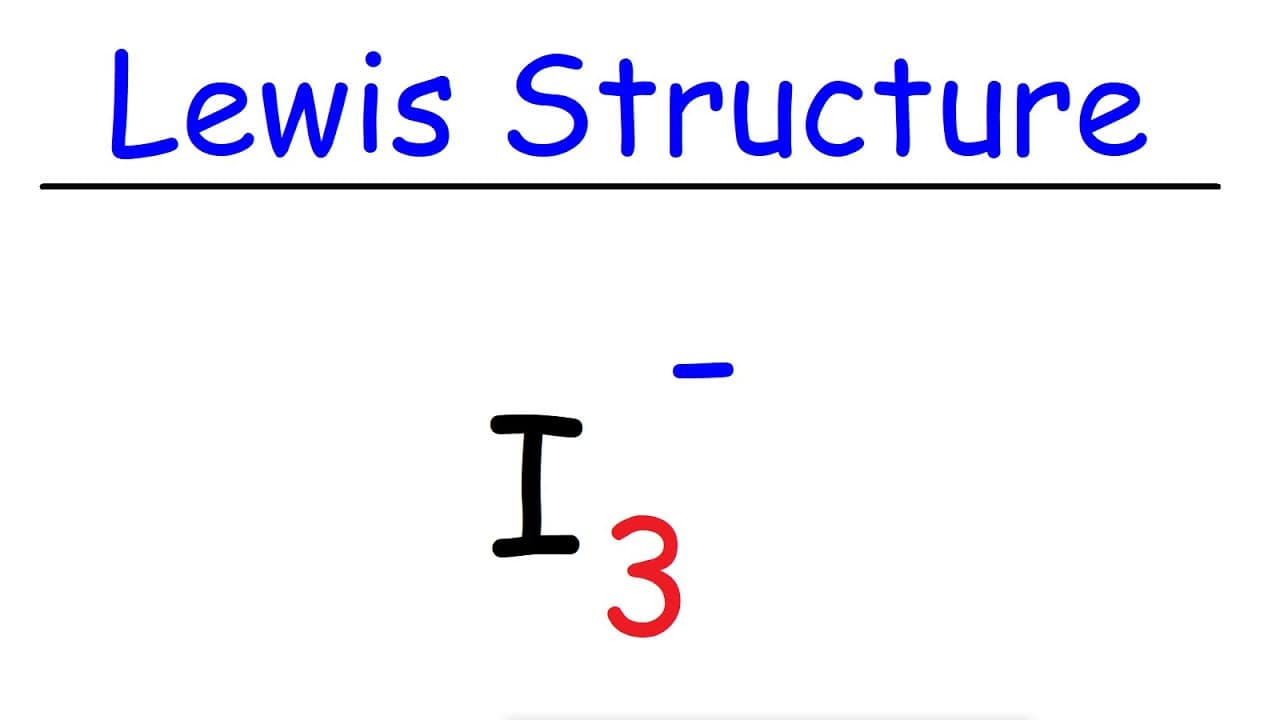
How to Draw the Lewis Structure of Triiodide Ion (I3-)
TL;DR
To draw the Lewis structure of the triiodide ion (I3-), total the valence electrons to 22 by multiplying the three iodine atoms (each with 7 valence electrons) and adding one for the negative charge. The structure features a central iodine with three lone pairs and one bond, resulting in a linear geometry with a bond angle of 180 degrees.
Transcript
in this video we're going to talk about how to draw the lewis structure of the triiodide ion i3 minus so let's begin by adding the valence electrons iodine is in group 7a of the periodic table so therefore has seven valence electrons and there's three of them so we've got to multiply by three now this polyatomic ion does have a negative charge so w... Read More
Key Insights
- 😑 The Lewis structure of the triiodide ion can be determined by calculating the total valence electrons, lone pairs, and formal charges.
- 🫀 Iodine atoms tend to have one bond and three lone pairs when they are not the central atom.
- 😑 The molecular geometry of the triiodide ion is linear, with a bond angle of 180 degrees.
- 💥 The hybridization of the central iodine atom in the triiodide ion is dsp3, consisting of one s orbital, three p orbitals, and one d orbital.
- 🫀 The formal charges in the Lewis structure indicate that the outer iodine atoms are neutral, while the central iodine atom carries a negative charge.
- 🫀 The Lewis structure follows the octet rule, with each iodine atom having a complete outer shell of 8 valence electrons.
- 😑 Understanding the Lewis structure and molecular geometry allows for the prediction of the chemical and physical properties of the triiodide ion.
Install to Summarize YouTube Videos and Get Transcripts
Explore YouTube Video Summarizer or Get YouTube Transcript Extractor
Questions & Answers
Q: How do you determine the total number of valence electrons in the triiodide ion?
The total number of valence electrons can be calculated by multiplying the number of iodine atoms (3) with the valence electron count of iodine (7) and adding 1 for the negative charge. In this case, it is 3 * 7 + 1 = 22 valence electrons.
Q: How do you calculate the number of lone pairs on the central iodine atom?
To calculate the number of lone pairs, find the highest multiple of 8 that is just below the total number of valence electrons. Subtract this number from the total number of valence electrons. In this case, the highest multiple of 8 below 22 is 16, so when subtracted, it gives 6, indicating that the central iodine atom has 6 electrons or 3 lone pairs.
Q: What is the molecular geometry of the triiodide ion?
The triiodide ion has a linear molecular geometry, resembling a straight line. The bond angle for any linear shape is always 180 degrees since it is half of a full circle (360 degrees).
Q: What is the hybridization of the central iodine atom in the triiodide ion?
The hybridization of the central iodine atom in the triiodide ion is dsp3. It consists of one s orbital, three p orbitals, and one d orbital, making a total of five groups attached to the atom.
Summary & Key Takeaways
-
To draw the Lewis structure, determine the total number of valence electrons (22) by multiplying the number of iodine atoms (3) with their valence electron (7) and adding 1 for the negative charge.
-
Calculate the number of lone pairs by finding the highest multiple of 8 (16) that is just below the number of valence electrons (22) and subtracting it. In this case, the central iodine atom has 3 lone pairs (6 electrons).
-
The Lewis structure of the triiodide ion shows that the central iodine atom has three lone pairs and one bond, while the other iodine atoms have one bond and three lone pairs.
-
The formal charges of the iodine atoms are neutral (0) for the outer atoms and negative (-1) for the central atom.
-
The molecular geometry of the triiodide ion is linear, with a bond angle of 180 degrees.
-
The hybridization of the central iodine atom is sp3d, consisting of one s orbital, three p orbitals, and one d orbital.
Read in Other Languages (beta)
Share This Summary 📚
Summarize YouTube Videos and Get Video Transcripts with 1-Click
Try YouTube Summary with ChatGPT & Claude or YouTube Transcript Generator
Explore More Summaries from The Organic Chemistry Tutor 📚



Summarize YouTube Videos and Get Video Transcripts with 1-Click
Try YouTube Summary with ChatGPT & Claude or YouTube Transcript Generator