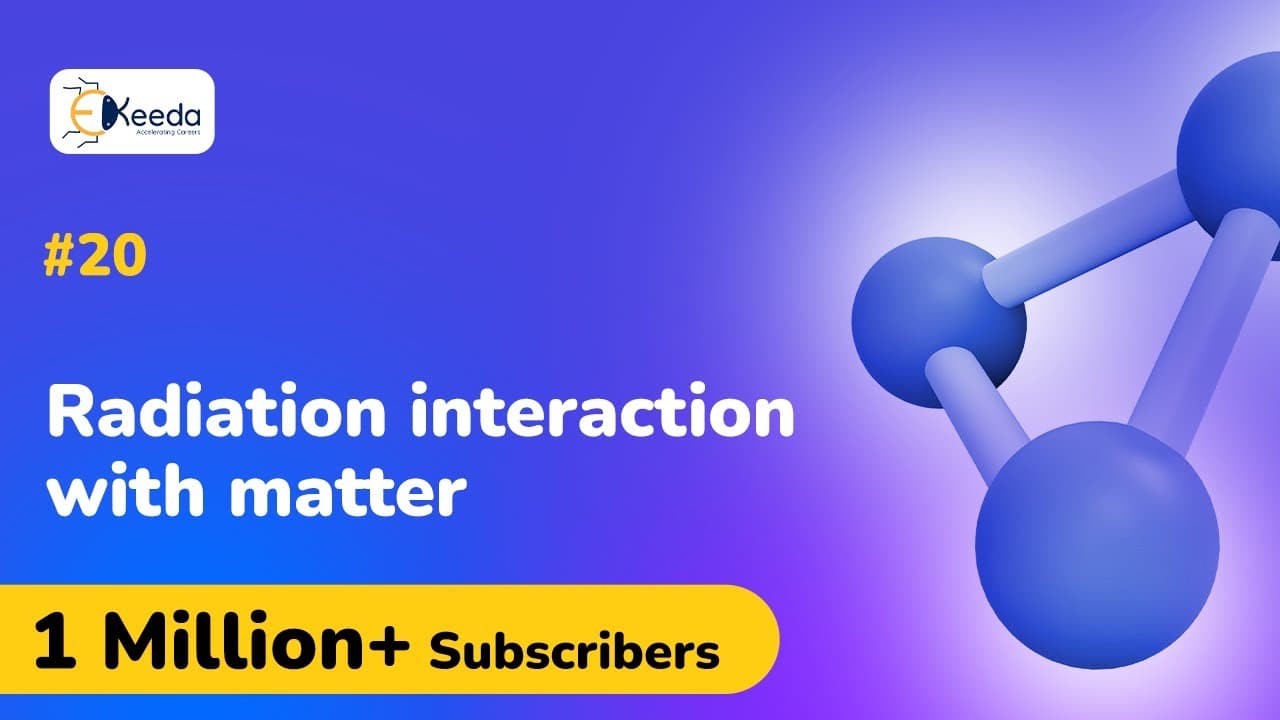
Radiation Interaction with Matter - Lasers and Fibre Optics - Engineering Physics 2
TL;DR
Learn about the three ways radiation interacts with matter through absorption, emission, and stimulated emission.
Transcript
hello my dear students in this lecture we are going to see interaction of radiation with matter now the way of interaction of any radiation with matter that we are going to learn here no matter is nothing but it may be a solid state or it may be a liquid state may be a gas state also now with all these matter how the radiation is interacting that w... Read More
Key Insights
- ❓ Radiation-matter interactions involve three main processes: absorption, emission, and stimulated emission.
- 🫀 Understanding atomic structure, energy levels, and quantum numbers is essential for grasping radiation interactions.
- ✋ Absorption occurs when electrons move to higher energy levels, emission when they move back, and stimulated emission under external energy.
- ❓ Spontaneous emission is natural and scattered, while stimulated emission is artificially induced, coherent, and monochromatic.
- 🙂 Laser light is a product of stimulated emission and exhibits controlled, focused, and coherent properties.
- ⚖️ Energy balance equations can be formulated to understand the transfer of energy during radiation interactions.
- ❓ The process of population inversion is crucial for achieving stimulated emission and is fundamental in laser technology.
Install to Summarize YouTube Videos and Get Transcripts
Explore YouTube Video Summarizer or Get YouTube Transcript Extractor
Questions & Answers
Q: What are the three main ways radiation interacts with matter?
Radiation interacts with matter through stimulated absorption, continuous emission, and stimulated emission, each playing a crucial role in energy transfer.
Q: How does atomic structure influence radiation interactions?
The structure of atoms, including the nucleus, electrons, and energy levels, determines how radiation is absorbed, emitted, and stimulated within matter.
Q: What is the significance of population inversion in radiation interactions?
Population inversion, a concept related to energy levels of atoms, is vital for understanding the possibility of stimulated emission, crucial for technologies like lasers.
Q: How do spontaneous and stimulated emissions differ in terms of coherence?
Spontaneous emission is incoherent and scattered, while stimulated emission is coherent, producing focused, monochromatic laser light.
Summary & Key Takeaways
-
Radiation interacts with matter through three ways: stimulated absorption, continuous emission, and stimulated emission.
-
Understanding atomic structure is crucial for comprehending radiation-matter interactions.
-
Absorption occurs when electrons move to higher energy levels, emission when they move back, and stimulated emission under external energy.
Read in Other Languages (beta)
Share This Summary 📚
Summarize YouTube Videos and Get Video Transcripts with 1-Click
Try YouTube Summary with ChatGPT & Claude or YouTube Transcript Generator
Explore More Summaries from Ekeeda 📚
Summarize YouTube Videos and Get Video Transcripts with 1-Click
Try YouTube Summary with ChatGPT & Claude or YouTube Transcript Generator