Carl Schoonover: How to look inside the brain
TL;DR
In this content, we explore the evolution of neuroscience from a thousand-year-old drawing of the brain to modern techniques using stains and antibodies to visualize and understand the intricate workings of the brain.
Transcript
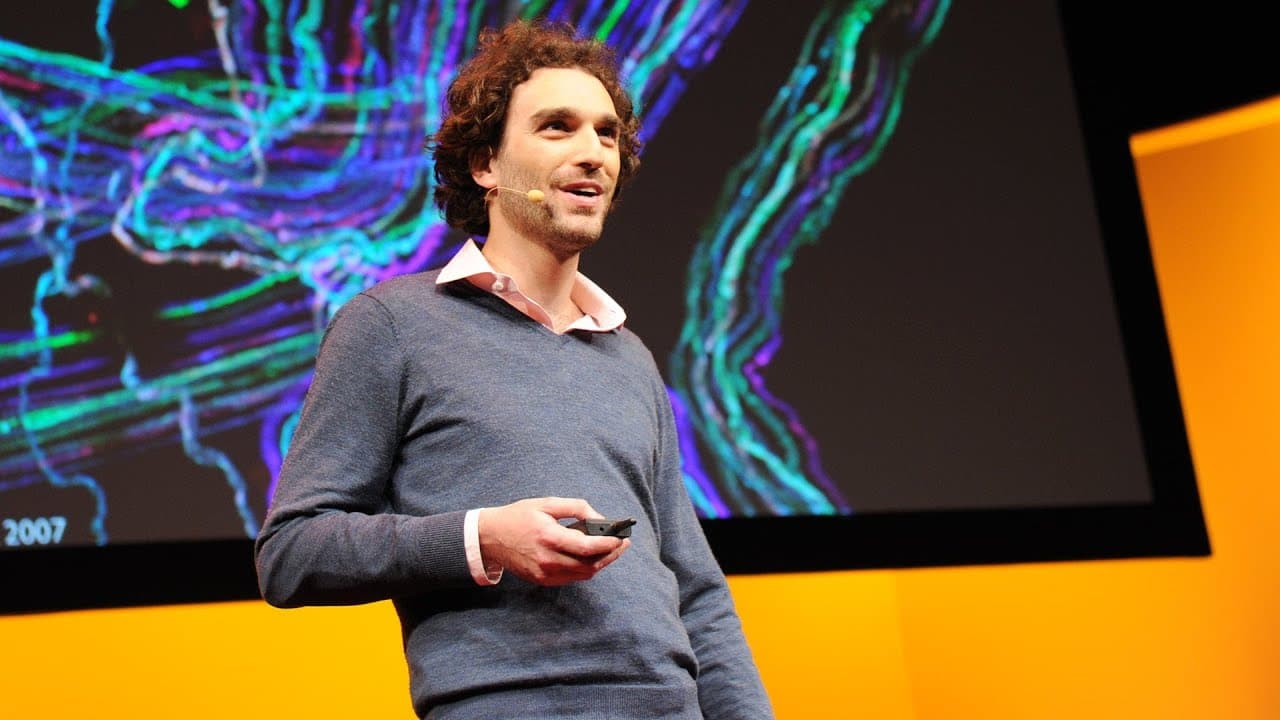
This is a thousand-year-old drawing of the brain. It's a diagram of the visual system. And some things look very familiar today. Two eyes at the bottom, optic nerve flowing out from the back. There's a very large nose that doesn't seem to be connected to anything in particular. And if we compare this to more recent representations of the visual sys... Read More
Key Insights
- 🧠 The complexity of the brain has evolved significantly over time, from simple diagrams to detailed representations of its internal structure and workings.
- 🔬 The development of chemical stains for brain tissue in the late 19th century allowed scientists to see the wiring and structure of the brain for the first time, launching modern neuroscience.
- 💡 The Golgi stain, which selectively stains about one percent of cells, revealed the individual neurons and gave us the modern understanding of nerve cells.
- 💡 Neurons don't function in isolation but form circuits and connections with other neurons, mirroring the way computers operate.
- 🌈 Green fluorescent protein (GFP), derived from a bioluminescent jellyfish, is a powerful tool in neuroscience research as it allows visualization of individual cells and differentiates them with various colors.
- 🧪 Antibodies, known for their role in the immune system, can be used in neuroscience research to identify specific molecules and substructures within neurons.
- 📷 The images obtained through techniques like antibody staining and GFP labeling not only possess aesthetic beauty but also provide crucial insights into the inner workings of the brain.
- 🌍 Nature has provided scientists with incredible tools like GFP and antibodies, which were initially evolved for other purposes but have been harnessed for scientific research, highlighting the brilliance of nature's engineering.
Install to Summarize YouTube Videos and Get Transcripts
Explore YouTube Video Summarizer or Get YouTube Transcript Extractor
Questions & Answers
Q: How has our understanding of the brain changed over the past thousand years?
Over the past thousand years, our understanding of the brain has become more complex. Initially, drawings of the brain showed basic features such as two eyes, the optic nerve, and a large disconnected nose. However, with advancements in neuroscience and the ability to see inside the brain, we have gained a deeper understanding of its internal structure and functioning.
Q: What technological development led to a breakthrough in studying the brain?
The development of new chemical stains for brain tissue, particularly the Golgi stain, revolutionized our ability to study the brain. The Golgi stain selectively stained only about one percent of the cells in brain tissue, allowing researchers to see the intricate wiring and structure of neurons for the first time.
Q: Who is considered the father of modern neuroscience?
Santiago Ramon y Cajal, a Spanish neuroanatomist, is widely considered the father of modern neuroscience. He applied the Golgi stain to brain tissue, which provided the first detailed images of neurons and their connections. Cajal's work laid the foundation for our understanding of neurons as the building blocks of the brain.
Q: How do researchers visualize neurons today?
Today, researchers use various methods to visualize neurons, one of which involves using green fluorescent protein (GFP). GFP is derived from a bioluminescent jellyfish and can be genetically engineered into cells. This allows researchers to observe and track specific cells, which glow green or other colors when the GFP gene is introduced.
Q: What role do antibodies play in studying the brain?
Antibodies, known for their role in the immune system, are also valuable tools for studying the brain. Researchers have harnessed the ability of antibodies to recognize and bind to specific molecules in order to identify and study different components of neurons. Antibody staining can help researchers understand the presence and distribution of molecules within the brain.
Q: How can antibody staining help in understanding mental health disorders?
Antibody staining can provide insights into molecular components of the brain associated with mental health disorders. For example, staining serotonin transporters using antibodies can help researchers understand the location and distribution of these molecules in the brain. This knowledge is crucial for understanding how serotonin, implicated in conditions like depression and anxiety, functions and how drugs like SSRIs may affect it.
Q: How are natural solutions from nature used in neuroscience research?
Scientists have discovered that certain natural products, such as green fluorescent protein and antibodies, have useful applications in neuroscience research. These tools, originally evolved by nature for different purposes, have been repurposed by scientists to study and understand the brain. Rather than designing tools from scratch, scientists have found ready-made solutions developed over millions of years by nature itself.
Summary & Key Takeaways
-
The ancient drawing of the brain shows a simple diagram of the visual system, with recognizable features like two eyes and an optic nerve.
-
In modern neuroscience, advancements in technology have allowed us to see inside the brain, revealing its complex structure and wiring.
-
Stains like the Golgi stain and techniques like using antibodies have enabled researchers to visualize neurons and identify specific molecular components in the brain.
Read in Other Languages (beta)
Share This Summary 📚
Summarize YouTube Videos and Get Video Transcripts with 1-Click
Try YouTube Summary with ChatGPT & Claude or YouTube Transcript Generator
Explore More Summaries from TED 📚






Summarize YouTube Videos and Get Video Transcripts with 1-Click
Try YouTube Summary with ChatGPT & Claude or YouTube Transcript Generator