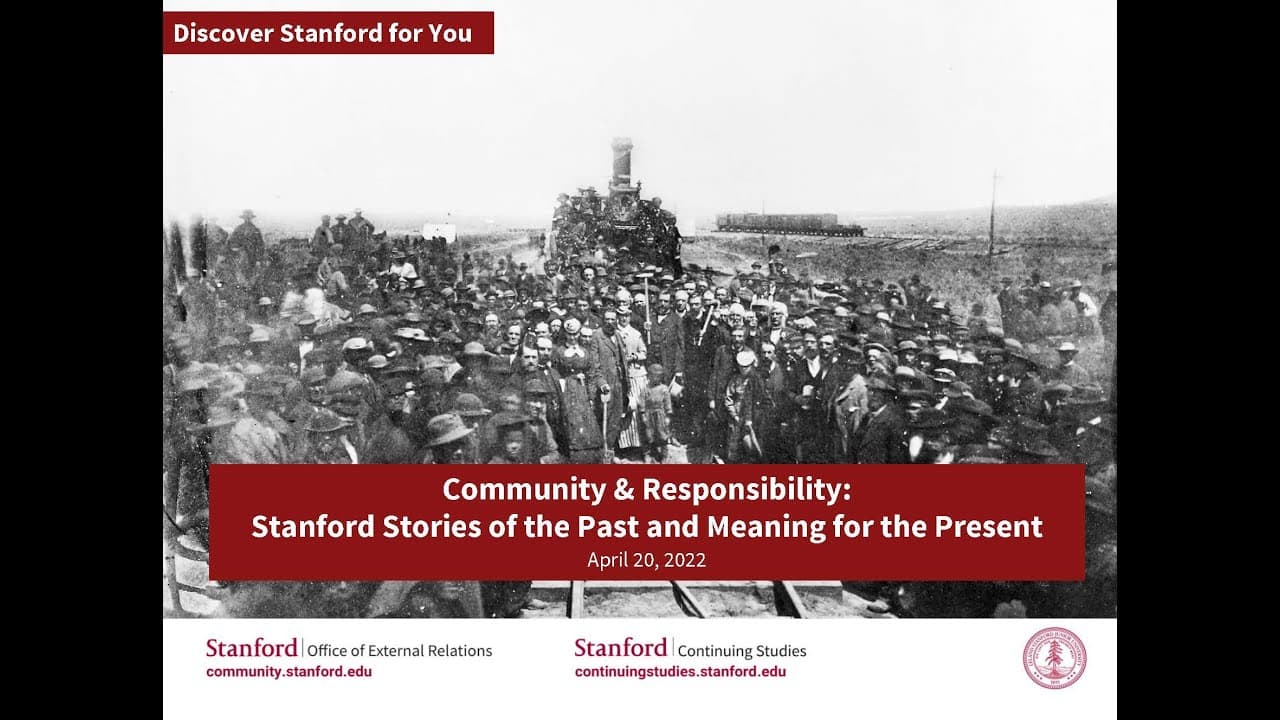
Discover Stanford For You: Stanford Stories of the Past and Meaning for the Present
TL;DR
Stanford explores its own history, including the stories and perspectives of marginalized communities, to create a more diverse and inclusive narrative.
Transcript
hello everyone i'm jennifer dietz director and associate dean for stanford continuing studies thank you for joining us today for discover stanford for you we are very excited to bring you this event it is being co-sponsored by continuing studies and the office of external relations our goal with this series is to provide an opportunity for our neig... Read More
Key Insights
- 👶 Stanford's history is ever-evolving, shaped by new information, changing values, and a commitment to diversity and inclusion.
- 💍 Engaging with marginalized communities and their narratives is crucial to creating a more holistic and accurate understanding of Stanford's history.
- 👯 The university is committed to actively reevaluating its historical legacy, including the renaming of buildings and recognition of Indigenous peoples.
- 🖐️ The archives play a vital role in preserving and sharing historical materials while promoting inclusivity and facilitating community engagement.
- 👨🔬 Stanford's history is not confined to academic research but has a profound impact on the personal lives and experiences of individuals within and connected to the university.
- 👶 The COVID-19 pandemic has posed new challenges for documenting history, but initiatives like oral history projects and online exhibits capture the experiences of the community.
Install to Summarize YouTube Videos and Get Transcripts
Explore YouTube Video Summarizer or Get YouTube Transcript Extractor
Questions & Answers
Q: How has Stanford's understanding of its history evolved over time?
Stanford's understanding of its history has evolved through constant reevaluation, new information, and changing values. This process has led to a more inclusive narrative that acknowledges the contributions of marginalized communities.
Q: What initiatives has Stanford undertaken to retell its history?
Stanford has developed a framework for assessing historical legacy, promoting education and rigorous research. This has led to the reassessment of historical names and the opportunity to tell new stories through exhibits, projects, and oral history programs.
Q: How does Stanford document its history during the pandemic?
The Stanford archives have collected records of the university's emergency operations committee, websites, and Zoom recordings to document the impact of the pandemic on the university community. They also engage with students and community members to collect personal accounts and perspectives.
Q: How can Stanford affiliates support the Muwekma Ohlone tribe?
Support for the Muwekma Ohlone tribe can include volunteering for events like the Stanford powwow, signing petitions for recognition, and advocating for repatriation and cultural preservation. More information can be found on the tribe's website.
Summary & Key Takeaways
-
The event aimed to share Stanford's mission and research efforts to address pressing global problems.
-
Presentations focused on the diverse narratives that contribute to the Stanford story, including the natural history of the Bay Area, social history, and the history of native peoples.
-
Stanford experts discussed their work in engaging questions of community and responsibility, highlighting the importance of historical legacy and diversity, equity, and inclusion.
Read in Other Languages (beta)
Share This Summary 📚
Summarize YouTube Videos and Get Video Transcripts with 1-Click
Try YouTube Summary with ChatGPT & Claude or YouTube Transcript Generator
Explore More Summaries from Stanford 📚





Summarize YouTube Videos and Get Video Transcripts with 1-Click
Try YouTube Summary with ChatGPT & Claude or YouTube Transcript Generator