Products
Features
YouTube Video Summarizer
Summarize YouTube videos
Web & PDF Highlighter
Highlight web pages & PDFs
Chat with PDF
Ask any PDF questions with AI
Ask AI Clone
Chat with your highlights & memories
Audio Transcriber
Transcribe audio files to text
Glasp Reader
Read and highlight articles
Kindle Highlight Export
Export your Kindle highlights
Idea Hatch
Hatch ideas from your highlights
Integrations
Obsidian Plugin
Notion Integration
Pocket Integration
Instapaper Integration
Medium Integration
Readwise Integration
Snipd Integration
Hypothesis Integration
Apps & Extensions
Chrome Extension
Safari Extension
Edge Add-ons
Firefox Add-ons
iOS App
Android App
Discover
Discover
Ideas
Discover new ideas and insights
Articles
Curated articles and insights
Books
Book recommendations by great minds
Posts
Essays and notes from readers
Quotes
Inspiring quotes collection
Videos
Curated videos and summaries
Explore Glasp
Glasp Newsletter
Weekly insights and updates
Glasp Talk
Interview series with great minds
Glasp Blog
Latest news and articles
Glasp Use Cases
Learn how others use Glasp
Build & Support
Glasp API
Access Glasp's API for developers
MCP Connector
Connect Glasp to Claude & ChatGPT
Community
Glasp Reddit Community
Students
Student discount and benefits
FAQs
Frequently Asked Questions
AboutPricing
DashboardLog inSign up

Numerical Type 2 Chapter 5 - Ground Water and Well Hydraulics - Water Resource Engineering 1
3.0K views
•
April 19, 2022
by
Ekeeda
YouTube video player
Numerical Type 2 Chapter 5 - Ground Water and Well Hydraulics - Water Resource Engineering 1

TL;DR

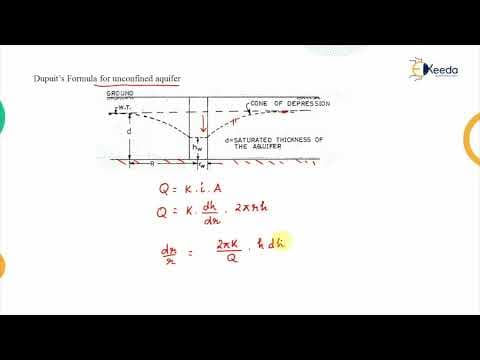
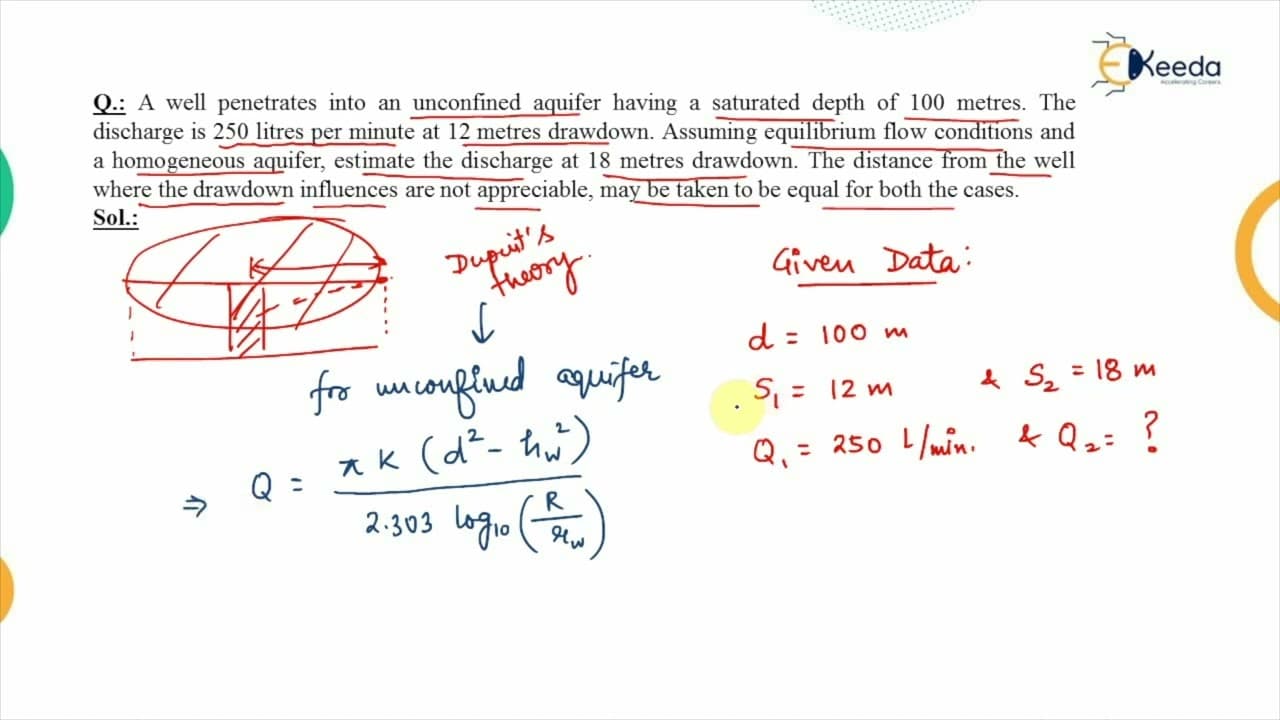
Estimating discharge at different drawdown levels in an unconfined aquifer using Dupit's theory.

Transcript

hello everyone in this video we are going to discuss the type 2 problems based on the chapter of the groundwater so let's start the problem says that a well penetrates into an unconfined aquifer having a saturated depth of 100 meters the discharge rate that has been given to us as 250 liters per minute at 12 meters drawdown assuming the equilibrium... Read More

Key Insights

  • ⛽ Drawdown influences indicate areas where aquifer recharge is impacted by pumping activities.
  • ☠️ Equilibrium flow conditions are crucial for accurately estimating discharge rates in groundwater systems.
  • 🦻 Aquifer homogeneity ensures consistent flow behavior, aiding in reliable discharge estimations.
  • 🎚️ Dupit's theory offers a practical method to analyze drawdown effects on groundwater levels.
  • 🖐️ Radius of influence plays a vital role in determining the extent of well pumping impact on aquifer conditions.
  • ☠️ Considering well depth and drawdown levels are essential for precise discharge rate calculations.
  • ✖️ Groundwater problems require a multi-faceted approach combining theory, observation, and calculation methodologies.

Install to Summarize YouTube Videos and Get Transcripts

Explore YouTube Video Summarizer or Get YouTube Transcript Extractor

Questions & Answers

Q: What important factors are considered when calculating discharge in unconfined aquifers using Dupit's theory?

Factors such as aquifer permeability, well depth, drawdown levels, and the radius of influence are crucial in Dupit's equation to estimate discharge rates accurately.

Q: How does drawdown influence impact the estimation of discharge rates in groundwater problems?

Drawdown influences, represented by the cone of depression, determine the level of recharge and the zone where the well's pumping affects groundwater levels.

Q: Why is it essential to consider equilibrium flow conditions and aquifer homogeneity in groundwater problem-solving?

Equilibrium flow conditions and aquifer homogeneity ensure accurate estimations of discharge rates and help in understanding groundwater behavior in varying drawdown scenarios.

Q: How does Dupit's theory simplify the estimation of discharge rates in complex groundwater systems?

Dupit's theory provides a systematic approach to calculate discharge based on drawdown levels, aquifer characteristics, and well parameters, simplifying complex groundwater problem-solving.

Summary & Key Takeaways

  • Problem involves estimating discharge at different drawdown levels in an unconfined aquifer using Dupit's theory.

  • Drawdown influences are analyzed by considering the cone of depression and the zone of influence.

  • Dupit's equation for unconfined aquifers is applied to calculate discharge rates at varying drawdown levels.


Read in Other Languages (beta)

English

Share This Summary 📚

Summarize YouTube Videos and Get Video Transcripts with 1-Click

Download browser extensions on:

Try YouTube Summary with ChatGPT & Claude or YouTube Transcript Generator

Explore More Summaries from Ekeeda 📚

Software Testing and Quality Assurance - Agile Testing | 12 November | 6 PM thumbnail
Software Testing and Quality Assurance - Agile Testing | 12 November | 6 PM
Ekeeda
Darcy's Law and Duipits Theory -  Ground Water and Well Hydraulics - Water Resource Engineering 1 thumbnail
Darcy's Law and Duipits Theory - Ground Water and Well Hydraulics - Water Resource Engineering 1
Ekeeda
Transient Response and Steady State Error Problem 1 - Time Response Analysis - Control Systems thumbnail
Transient Response and Steady State Error Problem 1 - Time Response Analysis - Control Systems
Ekeeda
Introduction to Simple Machines - Simple Machines - Engineering Mechanics thumbnail
Introduction to Simple Machines - Simple Machines - Engineering Mechanics
Ekeeda
Non   Homogeneous Linear Equations with Constant Coefficients thumbnail
Non Homogeneous Linear Equations with Constant Coefficients
Ekeeda
Numerical on concept of Capillary rise thumbnail
Numerical on concept of Capillary rise
Ekeeda

Summarize YouTube Videos and Get Video Transcripts with 1-Click

Download browser extensions on:

Try YouTube Summary with ChatGPT & Claude or YouTube Transcript Generator

Apps & Extensions

  • Chrome Extension
  • Safari Extension
  • Edge Add-ons
  • Firefox Add-ons
  • iOS App
  • Android App

Key Features

  • YouTube Video Summarizer
  • Web & PDF Summarizer
  • Web & PDF Highlighter
  • Chat with PDF
  • Ask AI Clone
  • Audio Transcriber
  • Glasp Reader
  • Kindle Highlight Export
  • Idea Hatch

Integrations

  • Obsidian Plugin
  • Notion Integration
  • Pocket Integration
  • Instapaper Integration
  • Medium Integration
  • Readwise Integration
  • Snipd Integration
  • Hypothesis Integration

More Features

  • APIs
  • MCP Connector
  • Blog & Post
  • Embed Links
  • Image Highlight
  • Personality Test
  • Quote Shots

Company

  • About us
  • Blog
  • Community
  • FAQs
  • Job Board
  • Newsletter
  • Pricing
Terms

•

Privacy

•

Guidelines

© 2026 Glasp Inc. All rights reserved.