What Are Binary Numbers and How Do They Work?
TL;DR
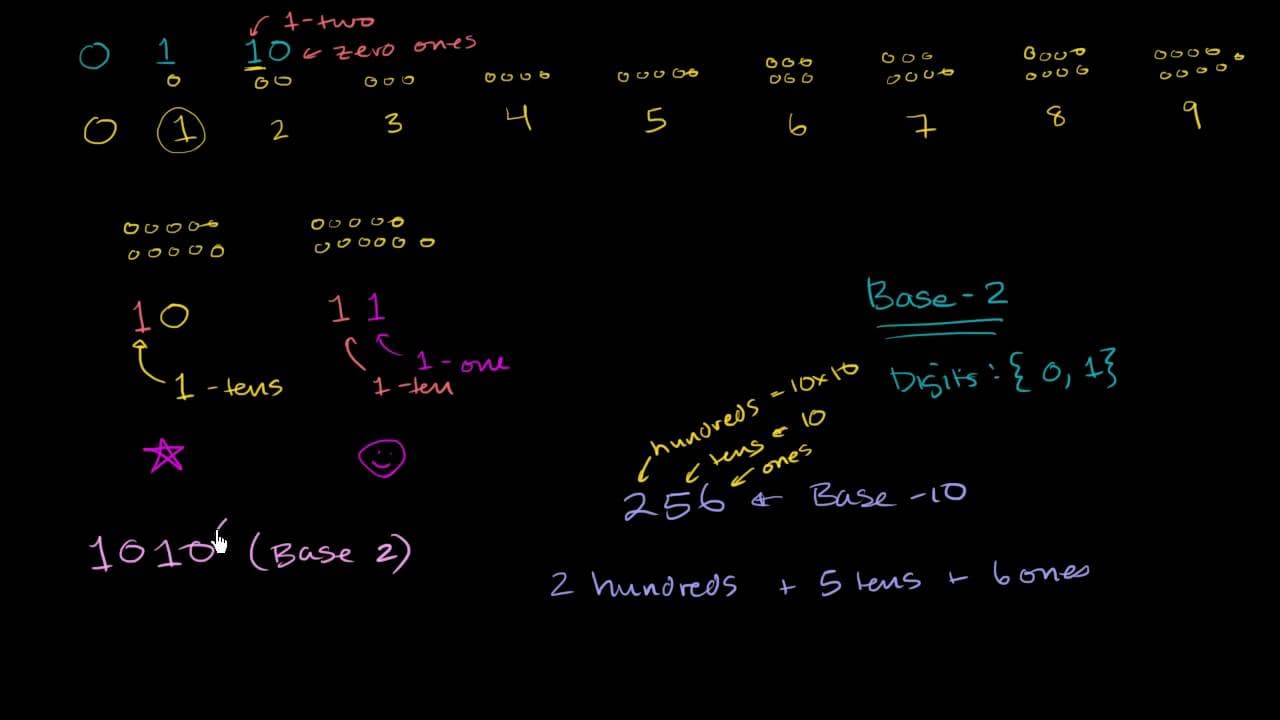
Binary numbers represent values using only two digits: 0 and 1. Each position in a binary number corresponds to a power of 2, similar to how decimal places correspond to powers of 10. For example, the binary number 1010 equals 10 in decimal form, calculated as 1 eight plus 0 fours plus 1 two plus 0 ones.
Transcript
What I want to do in this video is revisit some ideas that you've probably taken for granted since the time that you were like three or four years old. But hopefully, you'll kind of view it in a new light, and it'll help inform us when we think about other types of number systems. So we have 10 digits in our number system. So let me just start coun... Read More
Key Insights
- ⚾ Our traditional number system is base 10, with 10 digits (0-9).
- #️⃣ Base 10 uses number places to represent larger numbers.
- 😒 Base 2, or binary, uses only the digits 0 and 1, with number places representing powers of 2.
- ✊ Counting and representing numbers in base 2 can be achieved by using powers of 2 and the digits 0 and 1.
- ⚾ Base 2 numbers can be converted to base 10 by multiplying each digit by the corresponding power of 2 and summing them.
Install to Summarize YouTube Videos and Get Transcripts
Explore YouTube Video Summarizer or Get YouTube Transcript Extractor
Questions & Answers
Q: What is the meaning of the digits in base 10 number system?
In the base 10 number system, each digit represents a power of 10. The rightmost digit represents ones, the next one represents tens, and so on.
Q: How does the base 2 number system work?
In base 2, or binary, we use only the digits 0 and 1. Each digit represents a power of 2. The rightmost digit represents ones, the next one represents twos, then fours, and so on.
Q: How do you represent the number 7 in base 2?
In base 2, the number 7 is represented as 111. This means there is one four, one two, and one one.
Q: What happens when we reach the limit of available digits in a number system?
When we reach the limit of available digits, we introduce number places to represent larger numbers. In base 10, we use tens, hundreds, thousands, and so on. In base 2, we use twos, fours, eights, and so on.
Q: How can we convert a base 2 number to base 10?
To convert a base 2 number to base 10, we multiply each digit by the corresponding power of 2 and add them together. For example, 1011 in base 2 is equal to 1 eight, 0 fours, 1 two, and 1 one, which adds up to 11 in base 10.
Summary & Key Takeaways
-
The video discusses the base 10 number system and how we count using 10 digits (0-9).
-
It introduces the concept of number places and the use of symbols for larger numbers in base 10.
-
The video then explores counting and representing numbers in base 2, where only the digits 0 and 1 are used.
Read in Other Languages (beta)
Share This Summary 📚
Summarize YouTube Videos and Get Video Transcripts with 1-Click
Try YouTube Summary with ChatGPT & Claude or YouTube Transcript Generator
Explore More Summaries from Khan Academy 📚



Summarize YouTube Videos and Get Video Transcripts with 1-Click
Try YouTube Summary with ChatGPT & Claude or YouTube Transcript Generator