What Are Liquidity Zones in Trading & How to Spot Them?
TL;DR
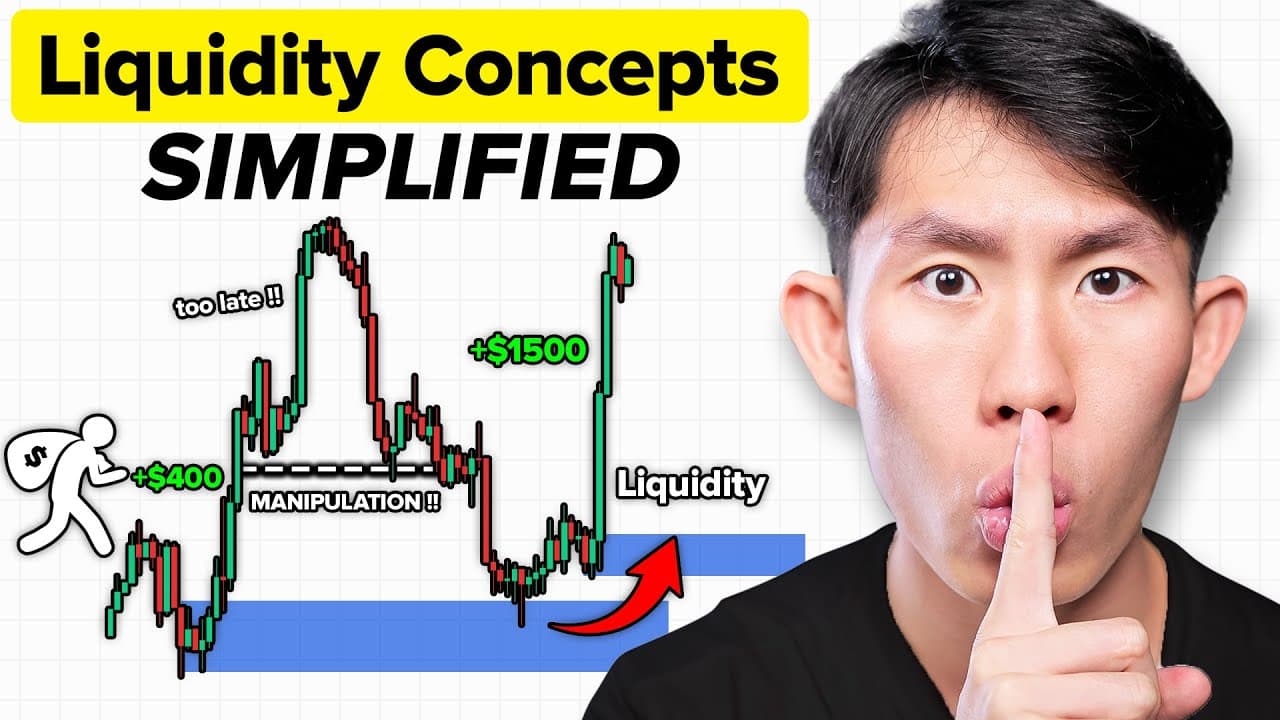
Liquidity zones are critical areas where buy and sell orders accumulate, essential for large financial institutions needing to execute significant trades. Retail traders often unwittingly add liquidity when their stop losses are triggered, highlighting the importance of understanding these concepts to avoid common pitfalls and align with smart money strategies.
Transcript
if you can master and spot liquidity early you will be able to enter the trade right before smart money does and take advantage of this huge move and make a ton of money fast so what exactly is liquidity most trading gurus and idiots try to make these liquidity Concepts seems like something so hard to understand and complex but I promise you that b... Read More
Key Insights
- Liquidity is crucial for large financial institutions as they require significant buy or sell orders to fulfill their trades.
- Retail traders often become liquidity providers unknowingly by having their stop losses triggered by smart money.
- Liquidity zones are areas on the chart where there are pending buy/sell orders and stop losses, often around support and resistance levels.
- Smart money manipulates the market by triggering stop losses and pending orders to create liquidity for their large trades.
- Identifying liquidity sweeps can help traders enter trades with smart money, avoiding common retail trading traps.
- Market structure is essential in understanding price movements, with liquidity serving as an additional confluence.
- Traders should focus on market structure and supply/demand zones before considering liquidity for trade entries.
- Understanding liquidity allows traders to avoid being on the wrong side of the market and enhances profitability.
Install to Summarize YouTube Videos and Get Transcripts
Explore YouTube Video Summarizer or Get YouTube Transcript Extractor
Questions & Answers
Q: What is liquidity in trading?
Liquidity in trading refers to the availability of buy or sell orders in the market. It is crucial for large financial institutions that require substantial orders to fulfill their trades. Liquidity is created when traders place orders or have their stop losses triggered, providing the necessary counterparties for large trades.
Q: Why is liquidity important for large financial institutions?
Large financial institutions trade with significant sums of money, requiring substantial buy or sell orders to execute their trades. Liquidity is essential for them to find counterparties willing to fulfill these large orders, as it is rare to find such large opposing trades naturally in the market.
Q: How do retail traders unknowingly provide liquidity?
Retail traders often provide liquidity unknowingly by having their stop losses triggered. Smart money, or large institutions, manipulate the market to trigger these stop losses, creating liquidity for their large trades. This process often results in retail traders being on the losing side of the trade.
Q: What are liquidity zones in trading?
Liquidity zones are areas on the trading chart where there are clusters of pending buy or sell orders and stop losses. These zones often coincide with support and resistance levels, trend lines, and common chart patterns like double tops or bottoms, where retail traders place their orders.
Q: How does smart money manipulate liquidity?
Smart money manipulates liquidity by triggering stop losses and pending orders in liquidity zones. They push the price to these areas, causing retail traders to exit their positions, thus providing the liquidity smart money needs to execute their large trades, often resulting in significant market moves.
Q: What is a liquidity sweep?
A liquidity sweep occurs when the price moves to trigger stop losses and pending orders in a liquidity zone, effectively 'sweeping' the liquidity available. This often leads to a reversal or continuation of the trend, as smart money uses the liquidity to fuel their trades.
Q: Why is market structure important in trading?
Market structure is crucial as it provides the framework for understanding price movements. It helps traders identify trends, potential reversals, and continuation patterns. Understanding market structure allows traders to make informed decisions and align their trades with the overall market direction.
Q: How should traders use liquidity in their trading strategy?
Traders should use liquidity as an additional confluence in their trading strategy. While market structure and supply/demand zones form the foundation, liquidity can provide confirmation for trade entries. By understanding liquidity dynamics, traders can avoid common traps and align their trades with smart money.
Summary & Key Takeaways
-
The video explains liquidity in trading, emphasizing its importance for large institutions needing significant order fulfillment. It highlights how retail traders often unknowingly provide liquidity through stop losses.
-
It discusses liquidity zones, areas with pending orders and stop losses, often around common chart patterns like double tops/bottoms, and how smart money manipulates these areas for liquidity.
-
The content stresses the importance of market structure and supply/demand zones, suggesting liquidity as an additional confluence for trade entries to align with smart money strategies.
Read in Other Languages (beta)
Share This Summary 📚
Summarize YouTube Videos and Get Video Transcripts with 1-Click
Try YouTube Summary with ChatGPT & Claude or YouTube Transcript Generator
Explore More Summaries from The Trading Geek 📚






Summarize YouTube Videos and Get Video Transcripts with 1-Click
Try YouTube Summary with ChatGPT & Claude or YouTube Transcript Generator