Emf induced in rod traveling through magnetic field | Physics | Khan Academy
TL;DR
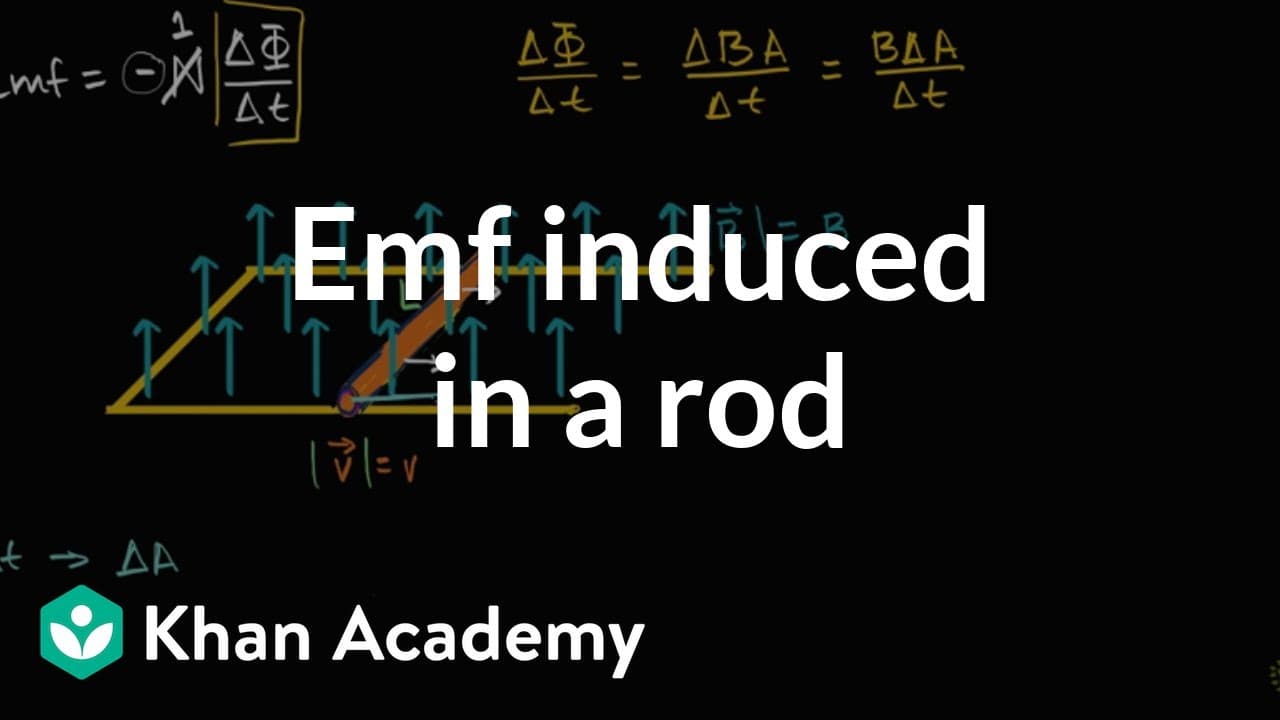
A moving loop in a constant magnetic field induces a change in flux, causing an electromotive force and a current to flow in the loop.
Transcript
- [Voiceover] I have an interesting set up over here. I have a magnetic field that is constant, and it's going straight out of the surface of this loop. The magnitude of the magnetic field at any point of the surface is going to be 'B'. What's interesting here is this loop that we have, This right part of the loop is movable. You can imagine it's a... Read More
Key Insights
- 🔁 A moving loop in a constant magnetic field experiences a change in magnetic flux due to the change in area enclosed by the loop.
- 👮 Faraday's law states that a change in magnetic flux induces an electromotive force (EMF) in the loop, causing a current to flow.
- 👮 The direction of the induced current is determined by Lenz's law, which opposes the change in magnetic flux.
- ☠️ The magnitude of the induced current depends on the rate of change of the magnetic flux and the resistance in the loop.
- 👮 The induced current creates a magnetic field that opposes the change in flux, as required by the law of conservation of energy.
- 😘 Ohm's law relates the induced current to the resistance in the loop. A higher resistance results in a lower magnitude of the current.
- 🏑 The induced current and magnetic field enhance or oppose the change in flux, depending on the direction of the moving loop.
Install to Summarize YouTube Videos and Get Transcripts
Explore YouTube Video Summarizer or Get YouTube Transcript Extractor
Questions & Answers
Q: What causes a change in magnetic flux in a moving loop?
The change in magnetic flux is caused by the movement of the loop, which changes the area enclosed by the loop and perpendicular to the magnetic field. As the loop moves, the magnetic field lines passing through it also change, resulting in a change in flux.
Q: How does Faraday's law explain the induced current in the loop?
Faraday's law states that a change in magnetic flux induces an electromotive force (EMF) in a loop. This EMF causes charges to move, resulting in a current. The magnitude of the current depends on the rate of change of the magnetic flux and the resistance within the loop.
Q: What determines the direction of the induced current?
The direction of the induced current is determined by Lenz's law, which states that the induced current opposes the change in magnetic flux. If the flux is increasing, the induced current will flow in a direction that creates a magnetic field opposing the change. If the flux is decreasing, the induced current will flow in the opposite direction.
Q: How does the resistance in the loop affect the induced current?
The resistance in the loop determines the magnitude of the induced current. According to Ohm's law, the current is equal to the EMF divided by the resistance. Therefore, a higher resistance will result in a lower magnitude of the induced current.
Summary & Key Takeaways
-
When a movable loop moves through a magnetic field, it experiences a change in the area, resulting in a change in magnetic flux through the loop.
-
According to Faraday's law, a change in magnetic flux induces an electromotive force (EMF) in the loop, which causes a current to flow.
-
The magnitude and direction of the induced current depend on the rate of change of the magnetic flux and the resistance in the loop.
Read in Other Languages (beta)
Share This Summary 📚
Summarize YouTube Videos and Get Video Transcripts with 1-Click
Try YouTube Summary with ChatGPT & Claude or YouTube Transcript Generator
Explore More Summaries from Khan Academy 📚



Summarize YouTube Videos and Get Video Transcripts with 1-Click
Try YouTube Summary with ChatGPT & Claude or YouTube Transcript Generator