Storage Zones in a Reservoir - Investigation and Reservoir Planning - Water Resource Engineering 1
TL;DR
Learn about the different zones in a reservoir, from normal pool level to valley storage, impacting water storage efficiency.
Transcript
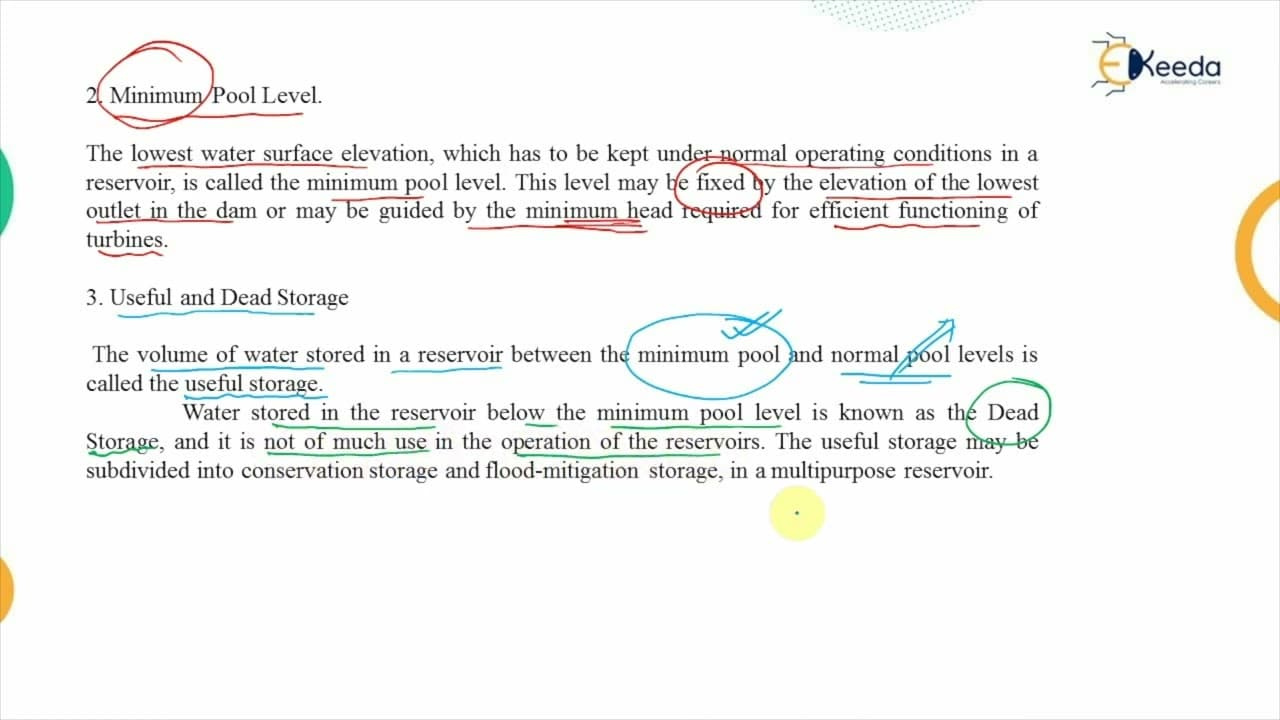
hello everyone in this video we are going to discuss about the different zones in which the water is stored in the reservoir so let's start now whatever discussion that we will be carrying out regarding the storage zones of a reservoir that will be with respect to the given figure so as you can see across a river an object a barrier has been constr... Read More
Key Insights
- 💦 Normal pool level is the maximum water surface elevation stored in a reservoir during regular conditions.
- 💀 Dead storage is water below the minimum pool level, unusable for daily needs or irrigation.
- 💦 Surcharge storage is extra water stored between normal and maximum pool levels during floods.
- 🏦 Bank storage refers to water seepage into permeable banks, increasing reservoir capacity.
- 💦 Valley storage is the minimum water stored in a stream naturally, impacting effective reservoir storage capacity.
- 🤽 Different storage zones play vital roles in water management and efficiency in reservoirs.
- 💦 Understanding reservoir storage zones is crucial for optimizing water storage and usage.
Install to Summarize YouTube Videos and Get Transcripts
Explore YouTube Video Summarizer or Get YouTube Transcript Extractor
Questions & Answers
Q: What is the normal pool level in a reservoir and why is it important?
The normal pool level is the maximum elevation to which the reservoir water surface rises during regular conditions, crucial for operating turbines efficiently and generating electricity.
Q: Why is dead storage in a reservoir not useful for daily needs or irrigation?
Dead storage is the water stored below the minimum pool level, inaccessible for use, and does not contribute to normal reservoir operations since it cannot be utilized.
Q: What is the purpose of surcharge storage in a reservoir?
Surcharge storage is the extra water stored between the normal and maximum pool levels during floods, providing temporary storage during peak flow conditions to prevent overflow.
Q: How does valley storage impact the effective storage capacity of a reservoir?
Valley storage refers to the water already present in a stream before a dam is constructed, reducing the effective storage capacity of a reservoir for flood mitigation due to existing natural water storage levels.
Summary & Key Takeaways
-
Reservoirs have different storage zones: normal pool level, minimum pool level, useful storage, dead storage, maximum pool level, surcharge storage, bank storage, and valley storage.
-
Each zone serves a specific purpose in managing water levels and usage in reservoirs.
-
Understanding these zones is crucial for efficient water storage and management in reservoirs.
Read in Other Languages (beta)
Share This Summary 📚
Summarize YouTube Videos and Get Video Transcripts with 1-Click
Try YouTube Summary with ChatGPT & Claude or YouTube Transcript Generator
Explore More Summaries from Ekeeda 📚






Summarize YouTube Videos and Get Video Transcripts with 1-Click
Try YouTube Summary with ChatGPT & Claude or YouTube Transcript Generator