Types of immune responses: Innate and adaptive, humoral vs. cell-mediated | NCLEX-RN | Khan Academy
TL;DR
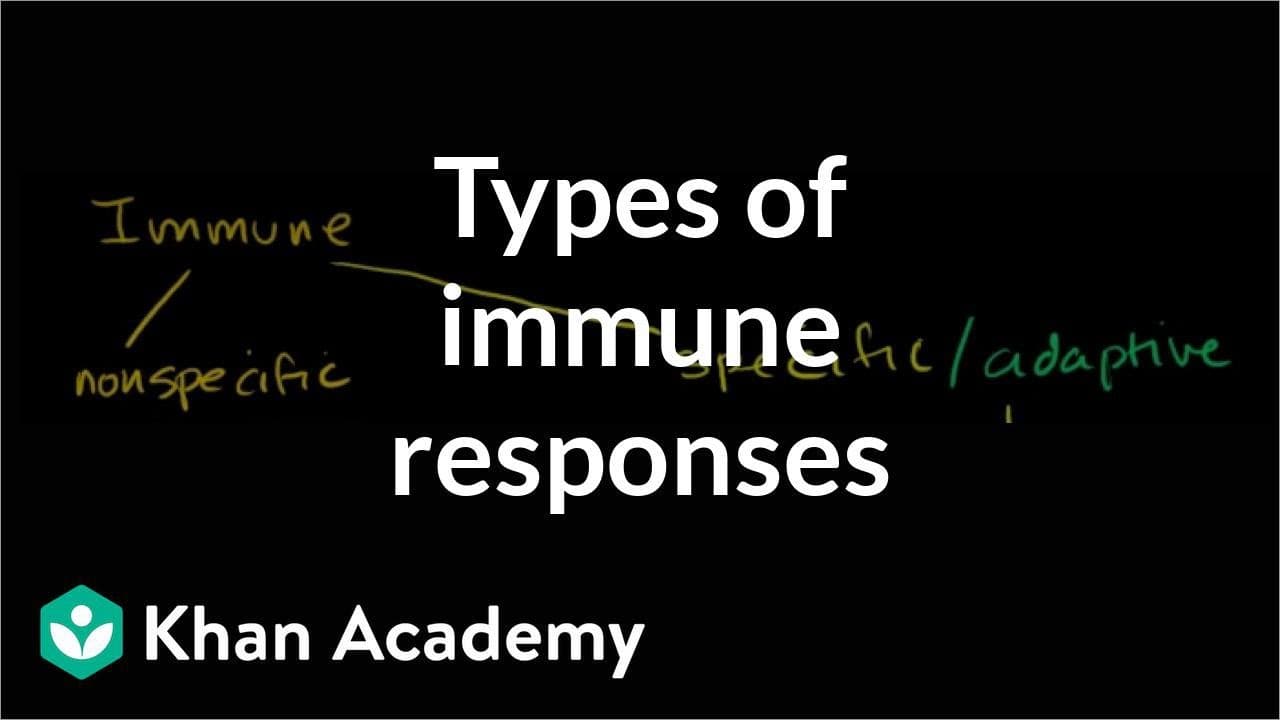
The immune system has two lines of defense - the nonspecific response which includes natural barriers and phagocytes, and the specific response which involves lymphocytes.
Transcript
In the last video, we talked a little bit about the immune system. In that video, we focused on the nonspecific or the innate immune system. So let me write that. And even in the nonspecific immune system, we subdivided that into kind of the first line barriers. And those were things like the skin, or the stomach acid, or the acidity of the oils on... Read More
Key Insights
- ❓ The immune system has both nonspecific and specific responses.
- 🫥 The nonspecific response includes first line barriers and phagocytes.
- ❓ The specific response is adaptive and involves lymphocytes.
- 😃 B lymphocytes participate in the humoral response, while T lymphocytes are involved in the cell-mediated response.
- 🫥 The nonspecific immune system acts as the first line of defense, while the specific immune system targets specific pathogens.
- 🤍 Phagocytes, such as macrophages and neutrophils, are examples of white blood cells.
- 🤔 The specific immune system is thought to be a newer adaptation.
Install to Summarize YouTube Videos and Get Transcripts
Explore YouTube Video Summarizer or Get YouTube Transcript Extractor
Questions & Answers
Q: What are the first line barriers of the nonspecific immune system?
The first line barriers include the skin, stomach acid, and the acidity of the oils on the skin. These natural barriers prevent foreign substances from entering the body.
Q: What is the difference between the nonspecific and specific immune system?
The nonspecific immune system is the first line of defense, while the specific immune system is adaptive and based on exposure to antigens. The nonspecific response is triggered by anything suspicious, while the specific response targets specific pathogens.
Q: What role do phagocytes play in the immune system?
Phagocytes are a type of white blood cell that engulf and destroy foreign substances, such as viruses and bacteria. They are part of the nonspecific immune response and help clear the body of pathogens.
Q: What are lymphocytes and what is their role in the immune system?
Lymphocytes are a type of white blood cell that play a key role in the specific immune response. They can be divided into B lymphocytes (B cells) and T lymphocytes (T cells). B cells participate in the humoral response, while T cells are involved in the cell-mediated response.
Summary & Key Takeaways
-
The immune system has a nonspecific response, which includes first line barriers like the skin and stomach acid, as well as phagocytes that engulf foreign substances.
-
The nonspecific response is triggered by anything that looks suspicious and involves inflammation and phagocytosis.
-
The immune system also has a specific response, which is adaptive and based on exposure to antigens. Lymphocytes play a key role in the specific immune response.
Read in Other Languages (beta)
Share This Summary 📚
Summarize YouTube Videos and Get Video Transcripts with 1-Click
Try YouTube Summary with ChatGPT & Claude or YouTube Transcript Generator
Explore More Summaries from Khan Academy 📚



Summarize YouTube Videos and Get Video Transcripts with 1-Click
Try YouTube Summary with ChatGPT & Claude or YouTube Transcript Generator