Transformations, part 1 | Multivariable calculus | Khan Academy
TL;DR
Functions can be visualized as transformations, where inputs are mapped to outputs, providing insights into how different numbers move and change.
Transcript
- [Voiceover] So I have talked a lot about different ways that you can visualize multivariable functions. Functions that will have some kind of multidimensional input or output. These include three-dimensional graphs, which are very common. Contour maps, vector fields, parametric functions. But here, I want to talk about one of my all-time favorite... Read More
Key Insights
- 👾 Functions can be seen as transformations between input and output spaces.
- 🆘 Visualizing transformations helps understand the relationship between variables.
- 👀 By watching how inputs move to outputs, patterns and trends can be identified.
- #️⃣ One-dimensional functions can be animated to show how numbers move to their respective outputs.
- ✖️ Multi-dimensional functions involve multiple inputs and outputs, providing more complex transformation visualizations.
- 😚 Parametric plots can also represent transformations, but they may lose input information.
- 👻 Visualizing functions as transformations allows for a deeper understanding of the function's behavior.
Install to Summarize YouTube Videos and Get Transcripts
Explore YouTube Video Summarizer or Get YouTube Transcript Extractor
Questions & Answers
Q: How can functions be visualized as transformations?
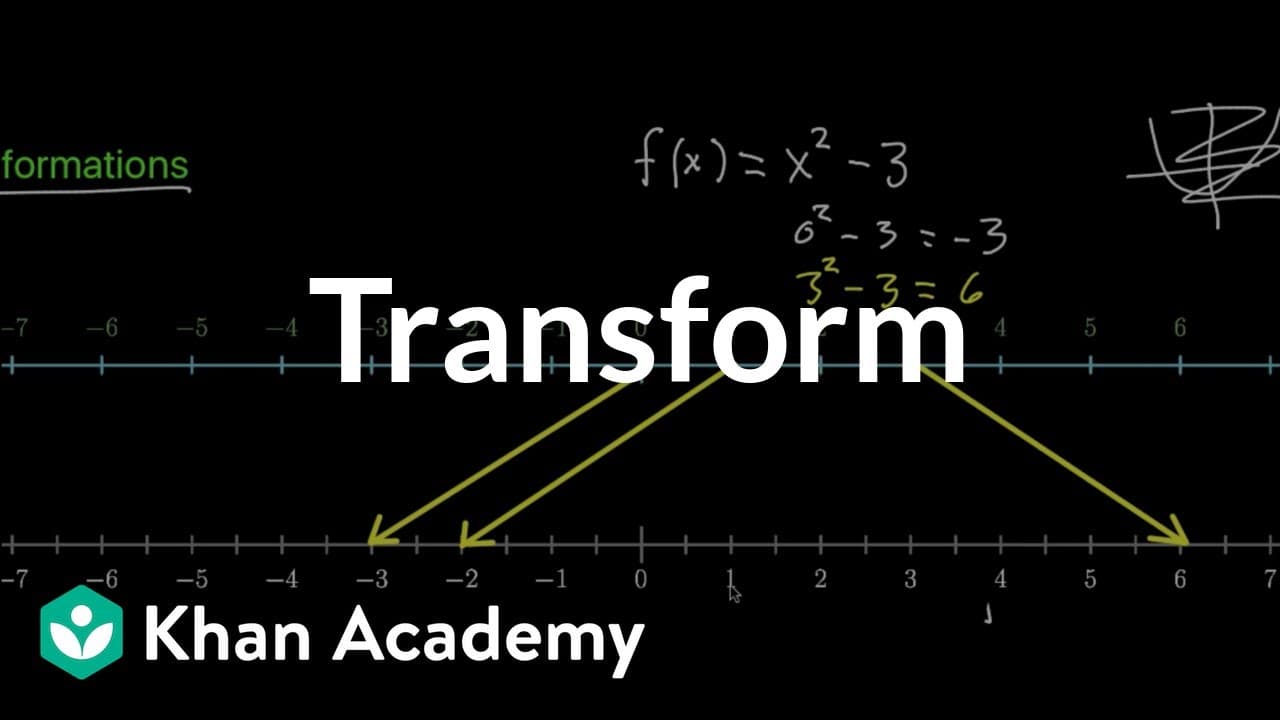
Functions can be thought of as mappings between an input space and an output space. Each input gets associated with a corresponding output, and the visualization involves watching how inputs move to their respective outputs.
Q: Why is visualizing functions as transformations useful?
Visualizing functions as transformations provides insights into how different inputs are mapped to outputs. It allows for a better understanding of the relationship between variables and can reveal patterns or trends in the transformation process.
Q: What are some examples of one-dimensional functions as transformations?
One example is the function f(x) = x^2 - 3. By visualizing the transformation, we can observe how different input numbers, such as zero or one, move to their corresponding outputs (-3 or -2). Animation can be used to demonstrate this process.
Q: How does visualizing multi-dimensional functions differ from one-dimensional functions?
Multi-dimensional functions involve multiple inputs and outputs. An example is f(x) = cos(x) and f(y) = x * sin(y). Visualizing this transformation shows how each input number, such as zero or pi, moves to its corresponding two-dimensional output point.
Summary & Key Takeaways
-
Functions can be visualized as transformations between input and output spaces.
-
Instead of using graphs or contour maps, focusing on how inputs move to outputs provides a different perspective.
-
This approach is demonstrated using both one-dimensional and multi-dimensional functions.
Read in Other Languages (beta)
Share This Summary 📚
Summarize YouTube Videos and Get Video Transcripts with 1-Click
Try YouTube Summary with ChatGPT & Claude or YouTube Transcript Generator
Explore More Summaries from Khan Academy 📚



Summarize YouTube Videos and Get Video Transcripts with 1-Click
Try YouTube Summary with ChatGPT & Claude or YouTube Transcript Generator