What Are Polar Equations for Conic Sections?
TL;DR
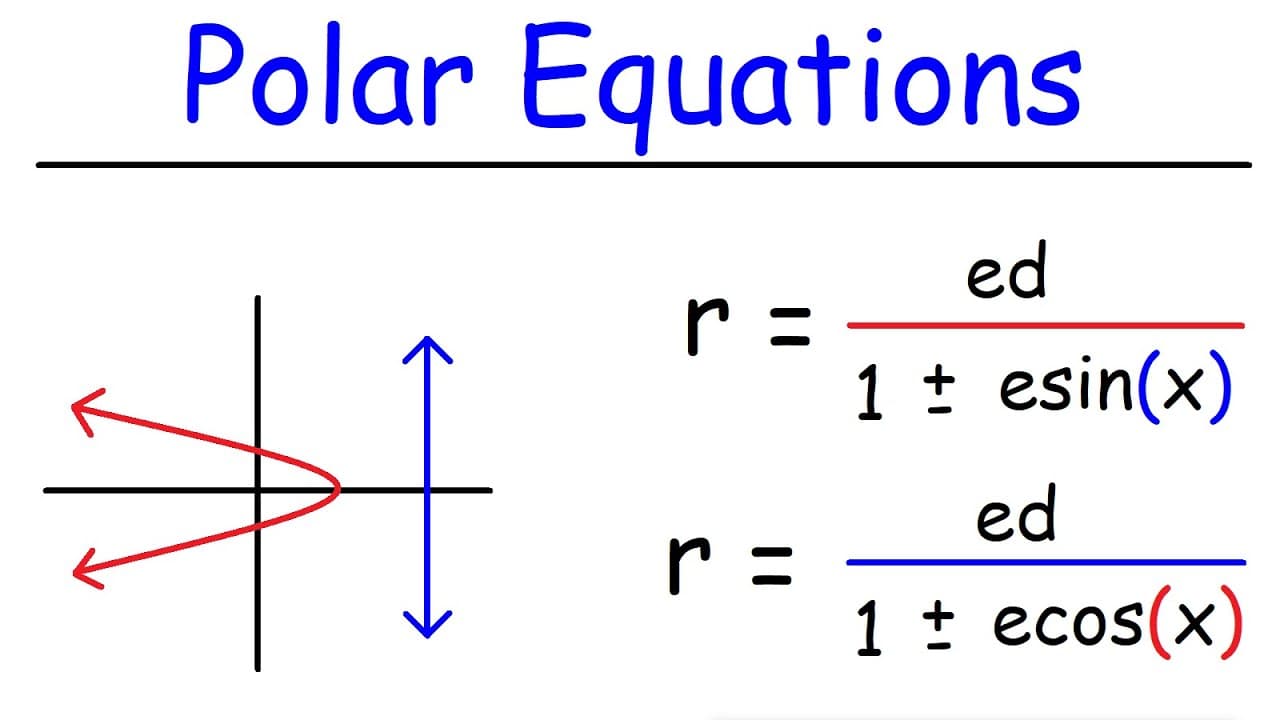
Polar equations for conic sections take the form r = ed / (1 ± e sin/cos θ), where e is the eccentricity. An ellipse occurs when 0 < e < 1, a parabola when e = 1, and a hyperbola when e > 1. Understanding the eccentricity, directrix, and focus is essential for graphing these conics.
Transcript
in this video we're going to talk about how to graph polar equations of conic sections so let's start with this example let's say that r is 6 divided by 2 minus cosine theta sketch the graph and determine the eccentricity of it now there's two forms you need to be familiar with r can equal e d divided by 1 plus or minus e sine theta or it can equal... Read More
Key Insights
- 📈 The type of conic section (ellipse, parabola, or hyperbola) can be determined by the eccentricity of the graph.
- 🖐️ The directrix, focus, and pole (origin) play crucial roles in graphing conic sections.
- ❓ The major and minor axes of an ellipse can be calculated using the distance between the focus and vertex, as well as the distance between the vertex and directrix.
- 😥 The rectangular equation of a conic section can be derived using the values of a, b, and the center point in polar coordinates.
Install to Summarize YouTube Videos and Get Transcripts
Explore YouTube Video Summarizer or Get YouTube Transcript Extractor
Questions & Answers
Q: What are the four possible variations of the polar equation for conic sections?
The four variations are r = ed / (1 + e sin θ), r = ed / (1 - e sin θ), r = ed / (1 + e cos θ), and r = ed / (1 - e cos θ).
Q: How do you determine the eccentricity of a conic section using the polar equation?
The coefficient e in the polar equation represents the eccentricity. It can be calculated by dividing the value of ed by the length of the major axis.
Q: What is the significance of the directrix in graphing conic sections?
The directrix is a line that helps determine the positioning and orientation of the conic section. It is located a distance of d units away from the focus and is either vertical or horizontal, depending on the polar equation.
Q: How do you graph a conic section given its polar equation?
To graph a conic section, determine its eccentricity, locate the focus and directrix, and plot several points using different angles (θ) and the corresponding r values from the polar equation. Connect the points to outline the shape of the conic section.
Summary & Key Takeaways
-
Polar equations of conic sections can be expressed in the form r = ed / (1 ± e sin/cos θ), where e is the eccentricity of the graph.
-
The eccentricity determines the type of conic section: ellipse for e between 0 and 1, parabola for e = 1, and hyperbola for e > 1.
-
Different variations of the polar equation correspond to different orientations and positions of the conic section.
Read in Other Languages (beta)
Share This Summary 📚
Summarize YouTube Videos and Get Video Transcripts with 1-Click
Try YouTube Summary with ChatGPT & Claude or YouTube Transcript Generator
Explore More Summaries from The Organic Chemistry Tutor 📚




Summarize YouTube Videos and Get Video Transcripts with 1-Click
Try YouTube Summary with ChatGPT & Claude or YouTube Transcript Generator