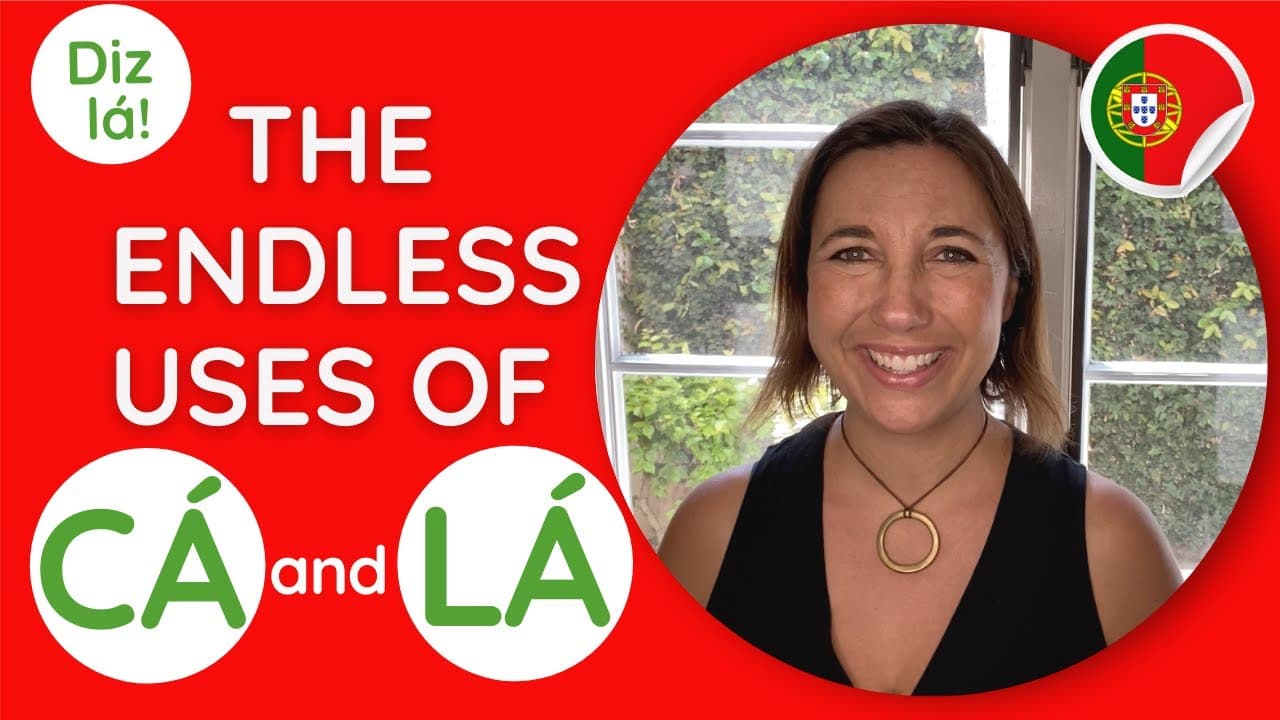
How to use "cá" and "lá" in Portuguese.
TL;DR
Learn the meanings and uses of 'cá' and 'lá' in Portuguese.
Transcript
in today's episode i would like to help you understand the tiny tricky words ka and la i'm sure that you hear them quite often and probably you don't understand their meaning most of the time this happens because at times they mean here and there while in other occasions their use has nothing to do with placement or location and instead these words... Read More
Key Insights
- 'Cá' and 'lá' are often used as adverbs of place in Portuguese, indicating locations relative to the speaker and listener.
- These words can be confusing when compared to 'aqui', 'aí', and 'ali', which have more specific locational meanings.
- 'Cá' and 'lá' also serve as emphatic expressions, altering the tone or emphasis of a sentence without changing its core meaning.
- When used emphatically, 'cá' and 'lá' can express emotions or attitudes, such as certainty, doubt, or encouragement.
- The video provides examples of 'cá' and 'lá' in both locational and emphatic contexts, helping learners understand their usage.
- Expressions like 'lá vou' and 'vá lá' demonstrate how 'lá' can be used to convey actions or encouragement.
- The video emphasizes the importance of context in determining whether 'cá' and 'lá' indicate location or serve an emphatic function.
- Understanding the nuances of 'cá' and 'lá' can enhance conversational skills in Portuguese, making interactions more natural.
Install to Summarize YouTube Videos and Get Transcripts
Explore YouTube Video Summarizer or Get YouTube Transcript Extractor
Questions & Answers
Q: What are the primary meanings of 'cá' and 'lá' in Portuguese?
In Portuguese, 'cá' and 'lá' primarily function as adverbs of place. They indicate locations relative to the speaker and listener. 'Cá' generally refers to a location closer to the speaker, while 'lá' indicates a place further away. However, their meanings can change when used emphatically.
Q: How do 'cá' and 'lá' differ from 'aqui', 'aí', and 'ali'?
'Cá' and 'lá' differ from 'aqui', 'aí', and 'ali' in terms of specificity and usage. 'Aqui', 'aí', and 'ali' specify precise locations: 'aqui' for near the speaker, 'aí' for near the listener, and 'ali' for far from both. 'Cá' and 'lá' are more general and can also serve emphatic roles.
Q: In what contexts do 'cá' and 'lá' function as emphatic expressions?
'Cá' and 'lá' function as emphatic expressions in contexts where the speaker wishes to add emotion or emphasis to a statement. This usage does not change the sentence's core meaning but enhances its expressiveness. Examples include emphasizing certainty, doubt, or encouragement in conversational exchanges.
Q: Can you provide examples of 'cá' and 'lá' used emphatically?
Yes, examples include using 'cá' in a sentence like 'Eu cá não vou à festa' to emphasize a strong refusal. Similarly, 'lá' can be used in 'Lá vou eu' to express resignation or determination. These uses highlight the emotional or expressive function of 'cá' and 'lá' beyond their locational meanings.
Q: What role does context play in interpreting 'cá' and 'lá'?
Context is crucial in interpreting 'cá' and 'lá'. Depending on the situation, these words can indicate physical locations or serve as emphatic expressions. Understanding the context helps determine their intended meaning, whether it's to specify a place or to add emphasis or emotion to a statement.
Q: How can understanding 'cá' and 'lá' improve Portuguese language skills?
Understanding 'cá' and 'lá' can significantly enhance Portuguese language skills by enabling more natural and expressive communication. Mastering their dual function as locational adverbs and emphatic expressions allows learners to convey nuanced meanings and emotions, making interactions more engaging and effective.
Q: What are some common expressions using 'cá' and 'lá'?
Common expressions include 'Lá vou eu' (off I go), which conveys resignation or determination, and 'Vá lá' (come on), used to encourage someone. These expressions demonstrate the versatility of 'cá' and 'lá' in conveying actions, emotions, or encouragement in everyday Portuguese conversations.
Q: Why might learners find 'cá' and 'lá' confusing?
Learners might find 'cá' and 'lá' confusing due to their dual roles and similarities to 'aqui', 'aí', and 'ali'. While 'cá' and 'lá' can indicate locations, they also function as emphatic expressions, which can alter their meaning. Understanding these nuances requires familiarity with context and usage.
Summary & Key Takeaways
-
The video explains the dual role of 'cá' and 'lá' as adverbs of place and emphatic expressions in Portuguese. It highlights their differences from 'aqui', 'aí', and 'ali', and provides examples to illustrate their usage in various contexts.
-
By exploring the meanings and applications of 'cá' and 'lá', the video aims to help learners use these words more confidently in everyday conversations. It also touches on the emotional and expressive aspects of these terms when used emphatically.
-
Through practical examples and explanations, the video clarifies how 'cá' and 'lá' can be used to indicate location or add emphasis. This understanding is crucial for learners seeking to improve their Portuguese language skills.
Read in Other Languages (beta)
Share This Summary 📚
Summarize YouTube Videos and Get Video Transcripts with 1-Click
Try YouTube Summary with ChatGPT & Claude or YouTube Transcript Generator
Explore More Summaries from Learn European Portuguese Online 📚




Summarize YouTube Videos and Get Video Transcripts with 1-Click
Try YouTube Summary with ChatGPT & Claude or YouTube Transcript Generator