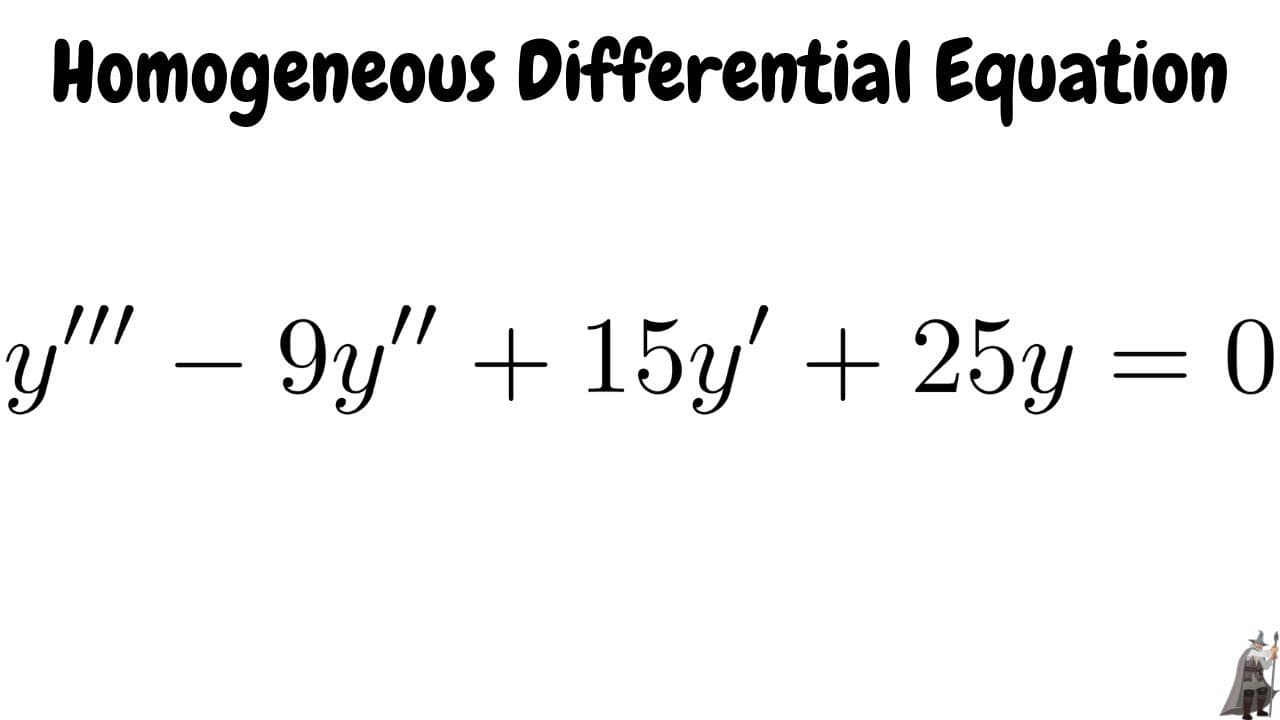
Homogeneous Linear Third Order Differential Equation y''' - 9y'' + 15y' + 25y = 0
TL;DR
Learn how to solve homogeneous linear differential equations with constant coefficients step by step.
Transcript
we have a linear differential equation with constant coefficients and it happens to be homogeneous because the right hand side is equal to zero let's go ahead and solve this we'll start by writing down the characteristic equation so because we have the third derivative of Y here we'll write down M cubed and then minus nine and then here we have the... Read More
Key Insights
- ❓ Understanding the characteristic equation is essential to solving linear differential equations efficiently.
- 🫚 The rational roots theorem aids in narrowing down the search for roots in complex equations.
- 🫚 Roots with multiplicities influence the structure of the general solution in differential equations.
- 🫚 Synthetic division is a helpful tool for verifying potential roots in the solution process.
- 🍉 Multiplicity of roots affects the inclusion of additional terms in the general solution.
- 🫚 Factorization of the characteristic equation simplifies the process of finding roots.
- ❓ Constant coefficients contribute to the homogeneous nature of the differential equation.
Install to Summarize YouTube Videos and Get Transcripts
Explore YouTube Video Summarizer or Get YouTube Transcript Extractor
Questions & Answers
Q: What is the characteristic equation used for in solving linear differential equations?
The characteristic equation helps identify the roots of the differential equation, which are crucial in finding the general solution by representing the exponential functions.
Q: How does the rational roots theorem assist in solving differential equations?
The rational roots theorem provides a systematic method to determine the possible rational roots that can simplify the process of finding solutions, especially when factoring by grouping is not feasible.
Q: Why is finding roots of different multiplicities important in solving differential equations?
Roots with multiplicities indicate how many times a particular root appears in the solution, affecting the general form and allowing for the inclusion of terms like Xe^5x for roots with multiplicity two.
Q: How does synthetic division help in checking possible rational roots of a differential equation?
Synthetic division is used to evaluate the values of possible roots quickly, as a root is validated only if the division results in a remainder of zero, confirming its significance in the solution process.
Summary & Key Takeaways
-
Explanation of the characteristic equation for a third-order linear differential equation.
-
Use of the rational roots theorem for finding possible rational roots.
-
Step-by-step process of solving the differential equation with constant coefficients.
Read in Other Languages (beta)
Share This Summary 📚
Summarize YouTube Videos and Get Video Transcripts with 1-Click
Try YouTube Summary with ChatGPT & Claude or YouTube Transcript Generator
Explore More Summaries from The Math Sorcerer 📚



Summarize YouTube Videos and Get Video Transcripts with 1-Click
Try YouTube Summary with ChatGPT & Claude or YouTube Transcript Generator