Coding Challenge 178: Climate Spiral
TL;DR
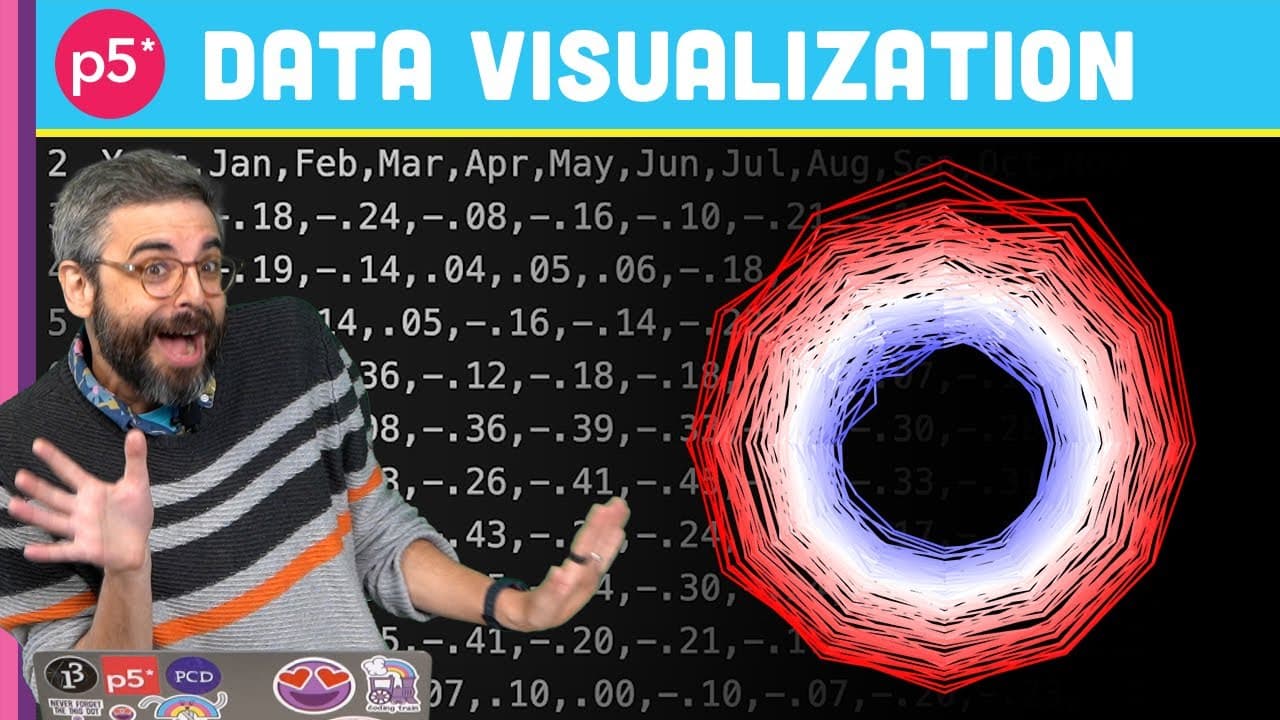
Coding challenge to recreate climate spiral visualization using p5.js, visualizing global temperature anomalies from 1880 to 2022.
Transcript
hello welcome to a special coding train Earth Day coding challenge so today I'm going to attempt to make my own version a p5gs version of the climate spiral this is a visualization designed by climate scientist Ed Hawkins from the University of reading so take a look at Ed hawkins's website many other data sets and visualizations of those data sets... Read More
Key Insights
- 😋 Climate spiral visualization represents temperature anomalies from 1880 to 2022 using color-coded rings.
- ❓ Data parsing and visualization techniques in p5.js enable creating complex climate visualizations.
- ❓ Understanding temperature anomalies relative to baseline averages is crucial for interpreting climate data.
- 😵💫 Color mapping plays a vital role in visually representing data trends and deviations in the climate spiral.
- 👨💻 The coding challenge offers an opportunity to explore data storytelling and visualization methods in climate science.
- 😵💫 Visual improvements and further exploration of different data sets can enhance the climate spiral project.
- ❓ The importance of accurate data collection and analysis is highlighted in creating meaningful visualizations.
Install to Summarize YouTube Videos and Get Transcripts
Explore YouTube Video Summarizer or Get YouTube Transcript Extractor
Questions & Answers
Q: What is the climate spiral visualization by Ed Hawkins?
The climate spiral visualization displays monthly Global temperature anomalies from 1880 to 2022, showing temperature deviations from a baseline average using colors.
Q: How is the data set for the climate spiral collected and processed?
The data set is collected and published by the NASA Goddard Institute for Space Studies, estimating global surface temperature changes. The anomalies are calculated based on temperatures relative to a baseline period.
Q: How is the temperature anomaly visualized in the coding challenge?
The temperature anomalies are represented using color mapping, where cooler anomalies are displayed in blues while warmer anomalies are shown in reds, transitioning through white for zero degrees anomaly.
Q: What are some potential improvements or modifications to the climate spiral visualization?
One can consider enhancing the visual design, adding 3D components, adjusting temperature ranges for a more balanced representation, or exploring different data visualization techniques for storytelling.
Summary & Key Takeaways
-
Visually recreate the climate spiral visualization by Ed Hawkins using temperature anomalies data.
-
Parse and download the data set using p5.js to create a climate spiral representing global temperature changes.
-
Explore color mapping, data visualization techniques, and data storytelling through coding.
Read in Other Languages (beta)
Share This Summary 📚
Summarize YouTube Videos and Get Video Transcripts with 1-Click
Try YouTube Summary with ChatGPT & Claude or YouTube Transcript Generator
Explore More Summaries from The Coding Train 📚






Summarize YouTube Videos and Get Video Transcripts with 1-Click
Try YouTube Summary with ChatGPT & Claude or YouTube Transcript Generator