How to Solve Cauchy Euler Differential Equations
TL;DR
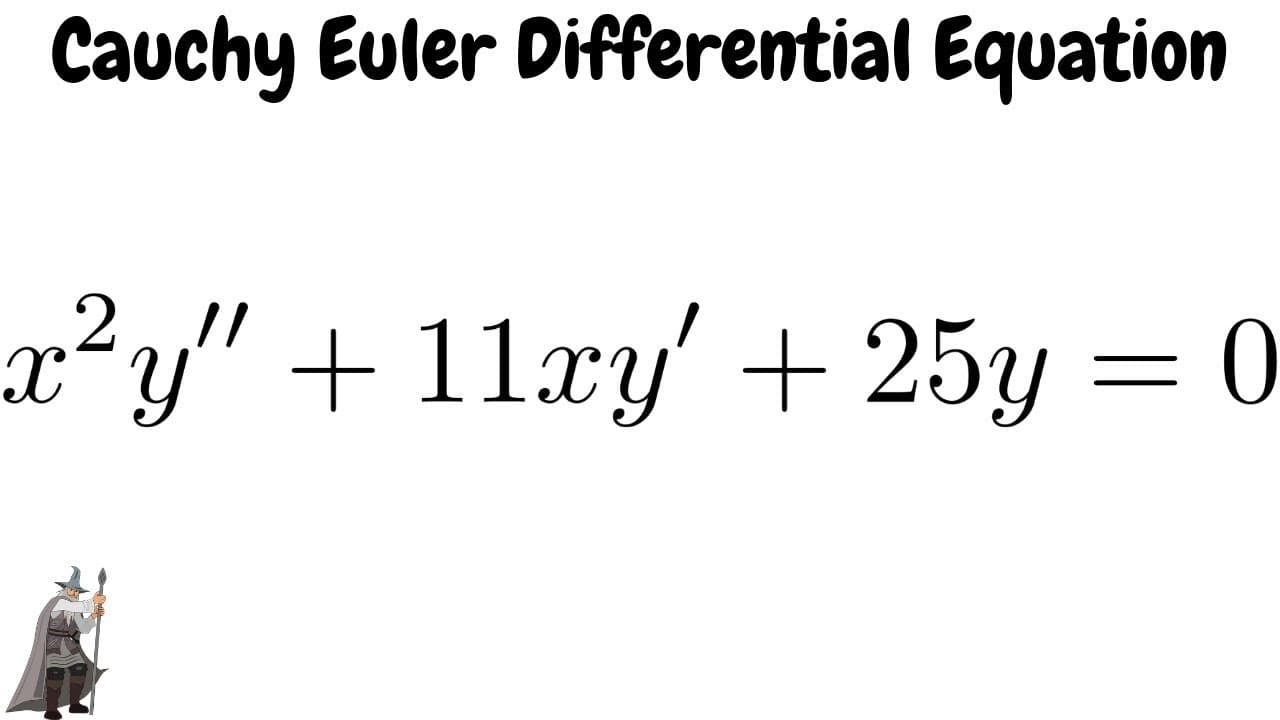
To solve a Cauchy Euler differential equation, start by letting y equal x to the power of m and differentiate. Substitute the derivatives into the equation, factor out x to the m, and identify the roots of the resulting characteristic equation. For repeated real roots, the solution will include terms of x and natural logarithms.
Transcript
in this problem we're going to solve the differential equation this differential equation is called the cauchy euler differential equation the reason is the powers of x match the order of the derivative the power of x matches the order of the derivative and here you can think of it as being x to the 0 times y so the power of x matches the order of ... Read More
Key Insights
- ☺️ Cauchy Euler differential equations have powers of x matching derivatives.
- ❣️ Start solving by setting y as x to the power of m and differentiating.
- ☺️ Group x terms and simplify the equation to find the roots of m.
- 🥺 Repeated real roots in Cauchy Euler equations lead to specific solution forms.
- ☺️ Final solutions for Cauchy Euler equations involve a combination of x and natural logarithm terms.
- ✊ Understanding the power rule and factoring helps simplify the differential equation.
- 😀 Deriving the roots of m is crucial in solving Cauchy Euler differential equations.
Install to Summarize YouTube Videos and Get Transcripts
Explore YouTube Video Summarizer or Get YouTube Transcript Extractor
Questions & Answers
Q: What is the Cauchy Euler differential equation and how do you start solving it?
The Cauchy Euler differential equation has powers of x matching the derivative order. To start, let y be x to the power of m, differentiate y, and plug everything into the equation.
Q: How do you handle grouping x terms when solving Cauchy Euler differential equations?
To group x terms, multiply x coefficients and add exponents. Factor out x to the m to simplify the equation before solving for the roots of m.
Q: What do repeated real roots indicate when solving Cauchy Euler differential equations?
Repeated real roots in Cauchy Euler equations lead to a solution of c1 x to the m + c2 x to the m ln x, where m is the repeated root.
Q: What is the final solution for the example Cauchy Euler equation provided?
The final solution for the example equation is y = c1 x to the -5 + c2 x to the -5 ln x, derived from the repeated real root m = -5.
Summary & Key Takeaways
-
Cauchy Euler differential equations have powers of x matching the order of the derivative.
-
Start solving by letting y be x to the power of m and differentiating y.
-
Plug everything into the differential equation, factor out x to the m, and find the solution.
Read in Other Languages (beta)
Share This Summary 📚
Summarize YouTube Videos and Get Video Transcripts with 1-Click
Try YouTube Summary with ChatGPT & Claude or YouTube Transcript Generator
Explore More Summaries from The Math Sorcerer 📚



Summarize YouTube Videos and Get Video Transcripts with 1-Click
Try YouTube Summary with ChatGPT & Claude or YouTube Transcript Generator