Limit by factoring cubic expression | Limits | Differential Calculus | Khan Academy
TL;DR
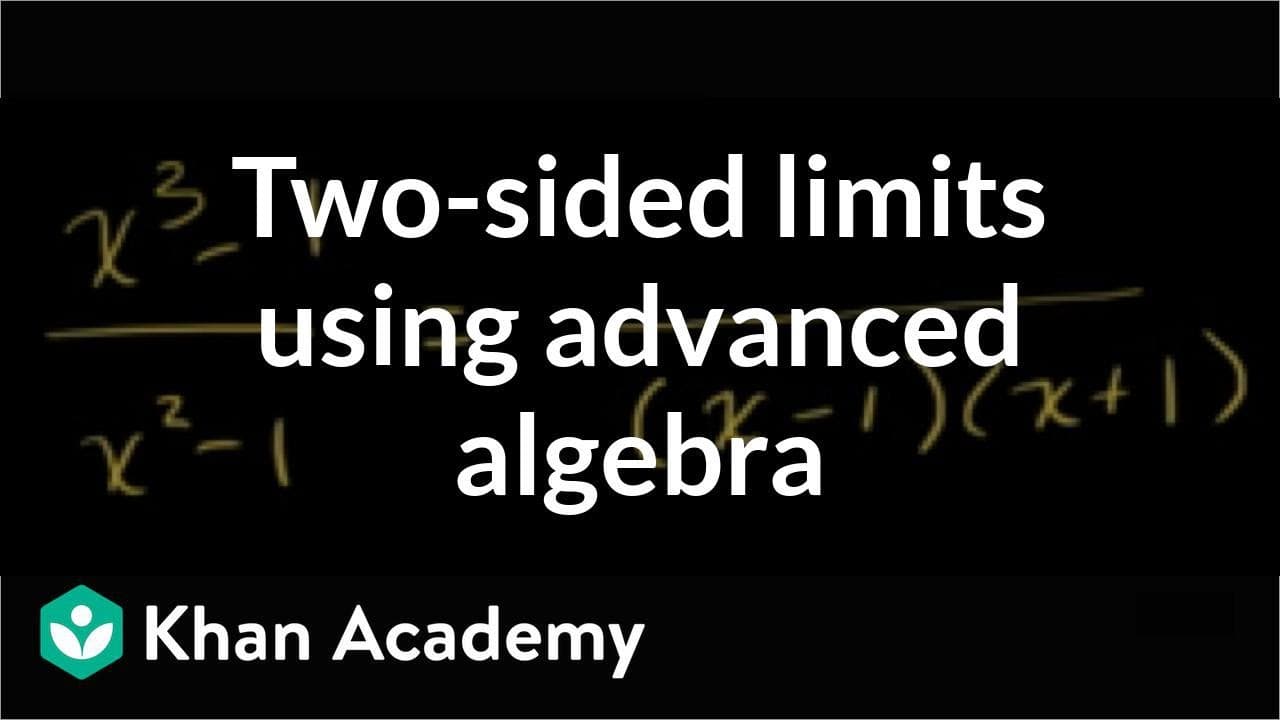
Finding the limit as x approaches 1 of (x^3-1)/(x^2-1) by factoring and canceling common terms.
Transcript
Let's try to find the limit as x approaches 1 of x to the third minus 1 over x squared minus 1. And at first when you just try to substitute x equals 1, you get 0/0 1 minus 1 over 1 minus 1. So that doesn't help us. So let's see if we can try to simplify this in some way. So you might immediately recognize-- so let's rewrite this expression right o... Read More
Key Insights
- 😑 The original expression (x^3-1)/(x^2-1) has an indeterminate form of 0/0 when substituting x=1.
- 😑 By factoring and canceling common terms, the expression can be simplified to (x^2+x+1)/(x+1) for x≠1.
- 🧑🏭 The factor (x-1) in the numerator cancels with the (x-1) factor in the denominator to avoid division by zero at x=1.
Install to Summarize YouTube Videos and Get Transcripts
Explore YouTube Video Summarizer or Get YouTube Transcript Extractor
Questions & Answers
Q: Why does substituting x=1 directly give an indeterminate form of 0/0 in the expression (x^3-1)/(x^2-1)?
Substituting x=1 results in division by zero for the denominator (x^2-1) since (1^2-1)=0. This is why the expression becomes indeterminate.
Q: How does factoring x-1 from the numerator and x^2-1 from the denominator allow cancellation of (x-1) and simplify the expression?
By factoring x-1 from the numerator, the expression becomes (x-1)(x^2+x+1)/(x^2-1). Then, noticing x^2-1 as a difference of squares, it can be further factored to (x-1)(x+1)(x^2+x+1)/(x-1)(x+1). The x-1 terms cancel out, leaving (x^2+x+1)/(x+1).
Q: Why is it important to find a factor of (x-1) in the numerator to avoid the issue of dividing by zero?
Because the denominator becomes zero when x=1, finding a factor of (x-1) in the numerator allows cancellation of (x-1)/(x-1), resolving the issue of dividing by zero and allowing the limit to be evaluated.
Q: Why is it necessary to specify that x≠1 in the final expression after simplification?
The original problem asks for the limit as x approaches 1 of the expression, not the actual value at x=1. Therefore, the x≠1 restriction is necessary when simplifying the expression to avoid division by zero.
Summary & Key Takeaways
-
The problem is to find the limit of (x^3-1)/(x^2-1) as x approaches 1.
-
Initially substituting x=1 gives an indeterminate form, so simplification is necessary.
-
By factoring and canceling common terms, the expression can be reduced to (x^2+x+1)/(x+1) for x≠1.
Read in Other Languages (beta)
Share This Summary 📚
Summarize YouTube Videos and Get Video Transcripts with 1-Click
Try YouTube Summary with ChatGPT & Claude or YouTube Transcript Generator
Explore More Summaries from Khan Academy 📚



Summarize YouTube Videos and Get Video Transcripts with 1-Click
Try YouTube Summary with ChatGPT & Claude or YouTube Transcript Generator