Types of Functions
TL;DR
Learn about linear, polynomial, exponential, modulus, greatest integer, logarithmic, and trigonometric functions and their graphs.
Transcript
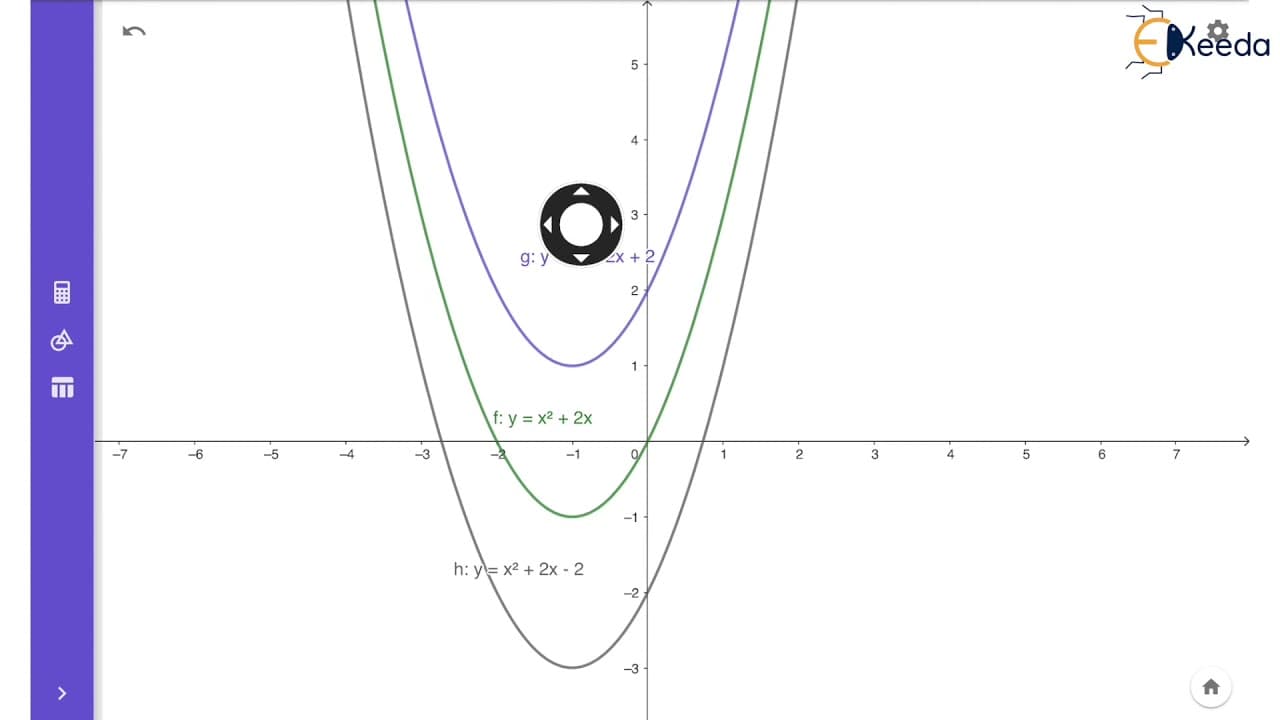
hello in today's session we'll discuss the topic of type of functions in which we'll see the different i4 functions and their graphs and try to understand what small changes can help change the graph and what nature it can change up to so let us start with the first one which is linear function so the first type of function we are going to discuss ... Read More
Key Insights
- 📈 Linear functions display slope and intercept variations impacting their graphs' incline.
- 🫚 Polynomial functions exhibit diverse shapes and roots based on their order, affecting the number of real solutions.
- ☠️ Exponential functions with varying base values showcase different growth rates influencing their graph steepness.
- 😀 Modulus functions provide absolute values, showcasing symmetric shifts about the y-axis.
- ❓ Greatest integer functions exhibit abrupt jumps at integral values, with discontinuities due to the nature of the function.
- ⚾ Logarithmic functions display inverted graphs based on the base value, affecting their direction.
Install to Summarize YouTube Videos and Get Transcripts
Explore YouTube Video Summarizer or Get YouTube Transcript Extractor
Questions & Answers
Q: What are the key components of a linear function?
A linear function comprises a slope (m) that determines the graph's steepness and a y-intercept (c) depicting the point where the line crosses the y-axis.
Q: How do polynomial functions differ based on their order?
Polynomial functions exhibit distinct characteristics based on their order, with quadratic functions having a power of 2 and cubic functions having a power of 3, affecting their graph shapes and roots.
Q: What transformations do exponential functions undergo with varying base values?
Exponential functions with different base values showcase varying growth rates, affecting the steepness of the graph and the speed at which the function increases or decreases.
Q: Explain the behavior of trigonometric functions like sine and cosine.
Trigonometric functions like sine and cosine exhibit periodic behavior with specific amplitudes and wavelengths, showcasing symmetrical properties about the y-axis for cosine functions and odd properties for sine functions.
Summary & Key Takeaways
-
Linear functions like y = mx + c showcase slope and intercept variations.
-
Polynomial functions exhibit quadratic and cubic forms with distinct roots.
-
Exponential functions with base values demonstrate varied growth rates.
Read in Other Languages (beta)
Share This Summary 📚
Summarize YouTube Videos and Get Video Transcripts with 1-Click
Try YouTube Summary with ChatGPT & Claude or YouTube Transcript Generator
Explore More Summaries from Ekeeda 📚




Summarize YouTube Videos and Get Video Transcripts with 1-Click
Try YouTube Summary with ChatGPT & Claude or YouTube Transcript Generator