Direct variation 1 | Rational expressions | Algebra II | Khan Academy
TL;DR
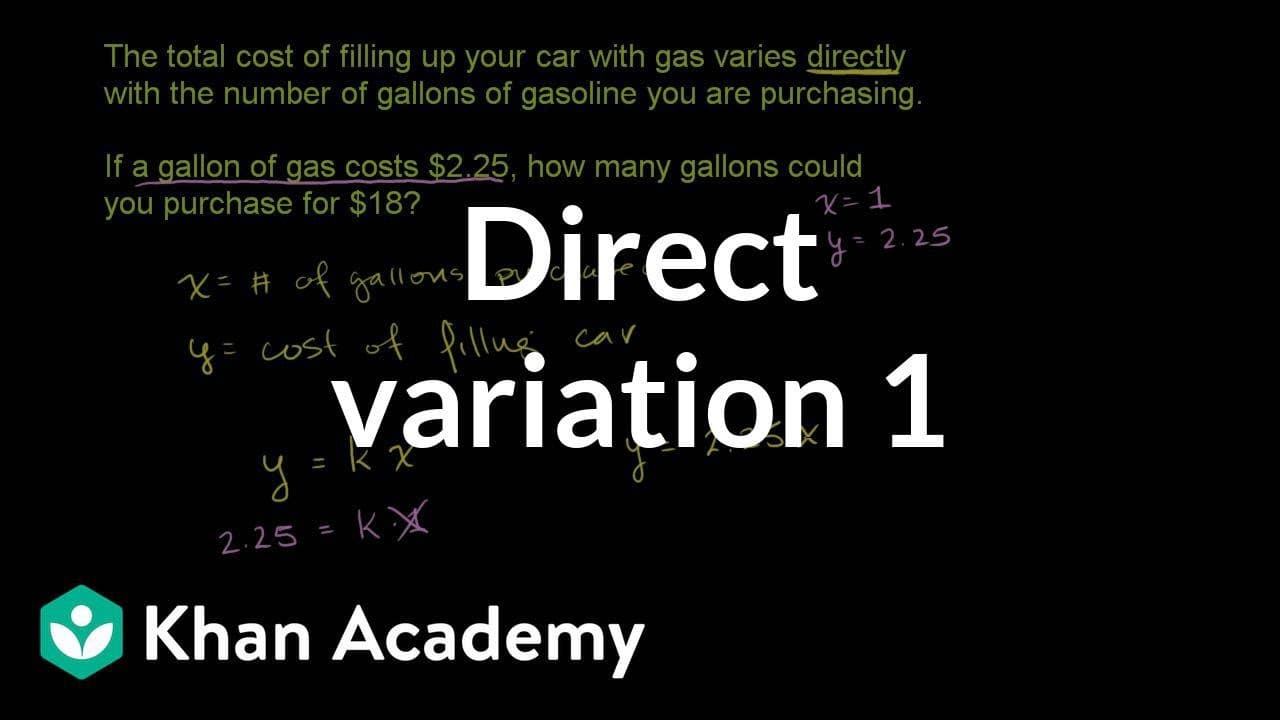
Gas cost varies directly with the number of gallons purchased, and the equation to determine the cost is y = 2.25x. With this equation, we can calculate how many gallons can be purchased for a specific amount, such as $18.
Transcript
We're told that the total cost of filling up your car with gas varies directly with the number of gallons of gasoline you are purchasing. So this first statement tells us that if x is equal to the number of gallons purchased, and y is equal to the cost of filling up the car, this first statement tells us that y varies directly with the number of ga... Read More
Key Insights
- 🇲🇬 The cost of filling up a car with gas varies directly with the number of gallons purchased.
- ❣️ The equation y = 2.25x represents the relationship between the cost (y) and the number of gallons (x).
- ☠️ The constant 2.25 indicates the rate at which the cost increases per gallon.
- 🇨🇷 To find the number of gallons that can be purchased for a specific cost, divide the cost by the constant.
- 💼 In this case, $18 divided by 2.25 equals 8 gallons that can be purchased.
- 🫢 Gas prices can be calculated using a direct variation equation.
- 👻 The direct variation equation allows us to determine the cost of any number of gallons.
Install to Summarize YouTube Videos and Get Transcripts
Explore YouTube Video Summarizer or Get YouTube Transcript Extractor
Questions & Answers
Q: What does it mean for gas cost to vary directly with the number of gallons purchased?
When gas cost varies directly with the number of gallons, it means that as the number of gallons purchased increases or decreases, the total cost will increase or decrease proportionally.
Q: How can we determine the constant k in the equation y = kx?
To determine the constant, we need a known value for both y (the cost of filling the car) and x (the number of gallons purchased). By dividing the cost by the number of gallons, we can find the rate at which the cost varies.
Q: What is the equation to calculate the cost of filling the car based on the number of gallons purchased?
The equation to calculate the cost is y = 2.25x, where y represents the cost of filling the car and x represents the number of gallons purchased. The constant 2.25 shows that the cost increases by $2.25 for each additional gallon.
Q: How can we calculate the number of gallons that can be purchased for a specific cost?
To calculate the number of gallons, divide the total cost by the constant (2.25 in this case). This will give you the number of gallons that can be purchased based on the given cost.
Summary & Key Takeaways
-
Gas cost varies directly with the number of gallons purchased, represented by the equation y = 2.25x.
-
If a gallon of gas costs $2.25, the constant k in the equation is determined to be 2.25.
-
To calculate the number of gallons that can be purchased for a specific cost, divide the cost by the constant. In this case, $18 divided by 2.25 equals 8 gallons.
Read in Other Languages (beta)
Share This Summary 📚
Summarize YouTube Videos and Get Video Transcripts with 1-Click
Try YouTube Summary with ChatGPT & Claude or YouTube Transcript Generator
Explore More Summaries from Khan Academy 📚



Summarize YouTube Videos and Get Video Transcripts with 1-Click
Try YouTube Summary with ChatGPT & Claude or YouTube Transcript Generator