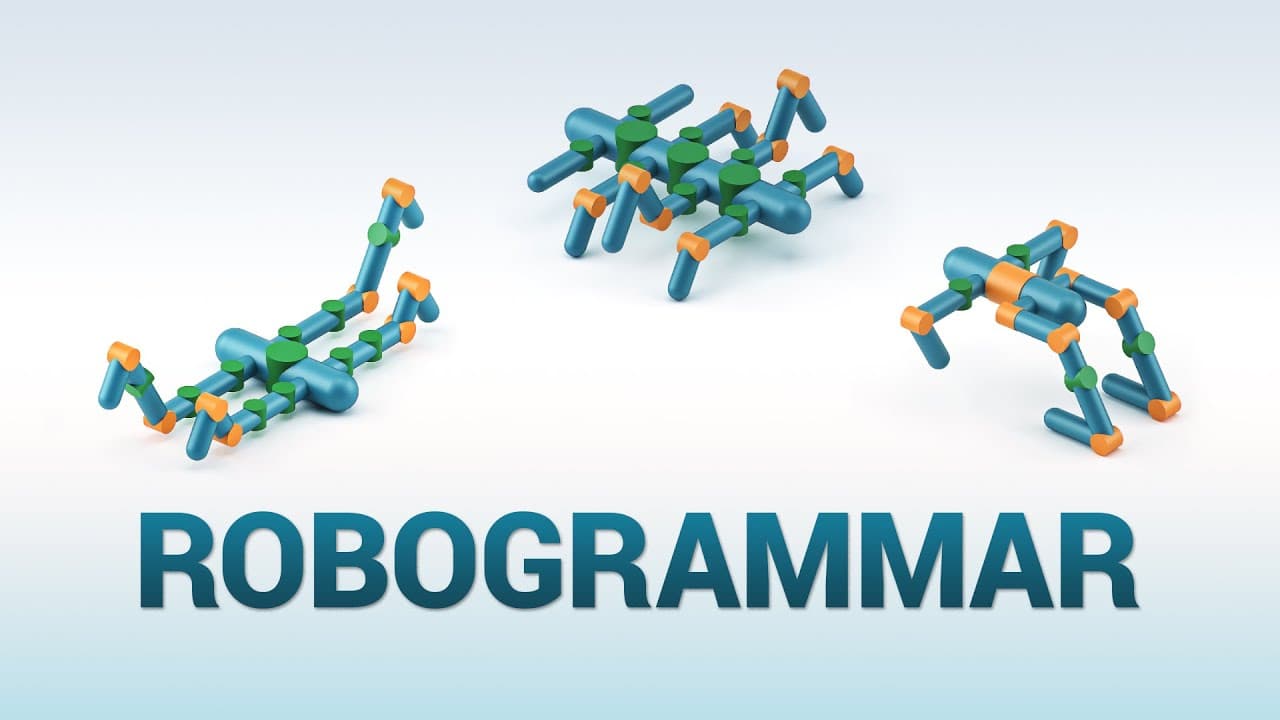
This is Grammar For Robots. What? Why? 🤖
TL;DR
Generating robots using grammars for different terrains to optimize performance.
Transcript
Dear Fellow Scholars, this is Two Minute Papers with Dr. Károly Zsolnai-Fehér. Today we are going to generate robots with grammars. Wait a second. Grammars? Of all things, what do grammars have to do with robots? Do we need to teach them grammar to speak correctly? No no, of course not! To answer these questions, let’s invoke the Second Law Of Pape... Read More
Key Insights
- 🤖 Grammars are used to generate complex structures, including robots, by specifying assembly rules.
- 🤖 Robots are built using joint types, links, and wheels, with algorithms optimizing their structures for different terrains.
- 🤖 Various terrains like flat ground, gapped terrains, ridged surfaces, staircases, frozen lakes, and walled terrains are considered for robot optimization.
- 🤖 Robots are designed with specific characteristics like long limbs, elastic bodies, and multiple legs to navigate different terrains effectively.
- 🤖 Algorithms create optimized robot structures based on terrain features, ensuring efficient traversal.
- 🤖 Real-world scenarios involving multiple terrains are considered, with robots designed to traverse various terrains seamlessly.
- 🤖 Grammars and search algorithms play a crucial role in optimizing robot designs for performance on different terrains.
Install to Summarize YouTube Videos and Get Transcripts
Explore YouTube Video Summarizer or Get YouTube Transcript Extractor
Questions & Answers
Q: How are grammars used in building structures like buildings and robots?
Grammars provide rules for assembling structures from small elements like nouns, adjectives, joints, links, and wheels, ensuring proper construction and functionality.
Q: How are robots designed to traverse different terrains effectively?
Robots are built as collections of joint types, links, and wheels, with algorithms using grammars and search methods to create optimized structures for various terrains.
Q: What types of terrains are considered in optimizing robot structures?
Terrains such as flat ground, gapped terrains, surfaces with ridges, staircases, frozen lakes, and walled terrains are considered, with specific robot designs tailored for each terrain type.
Q: How do algorithms adapt robot structures to navigate different terrains efficiently?
Algorithms recognize terrain features, such as gaps, ridges, slippery surfaces, and walls, to design robots with specific characteristics like rigid bodies, long limbs, elastic bodies, and multiple legs for optimal traversal.
Summary & Key Takeaways
-
Grammars are used to build structures by specifying rules for assembly from small elements.
-
Robots are built using joint types, links, and wheels of varying sizes and weights.
-
Algorithms utilizing grammars and search methods optimize robot structures for different terrains.
Read in Other Languages (beta)
Share This Summary 📚
Summarize YouTube Videos and Get Video Transcripts with 1-Click
Try YouTube Summary with ChatGPT & Claude or YouTube Transcript Generator
Explore More Summaries from Two Minute Papers 📚





Summarize YouTube Videos and Get Video Transcripts with 1-Click
Try YouTube Summary with ChatGPT & Claude or YouTube Transcript Generator