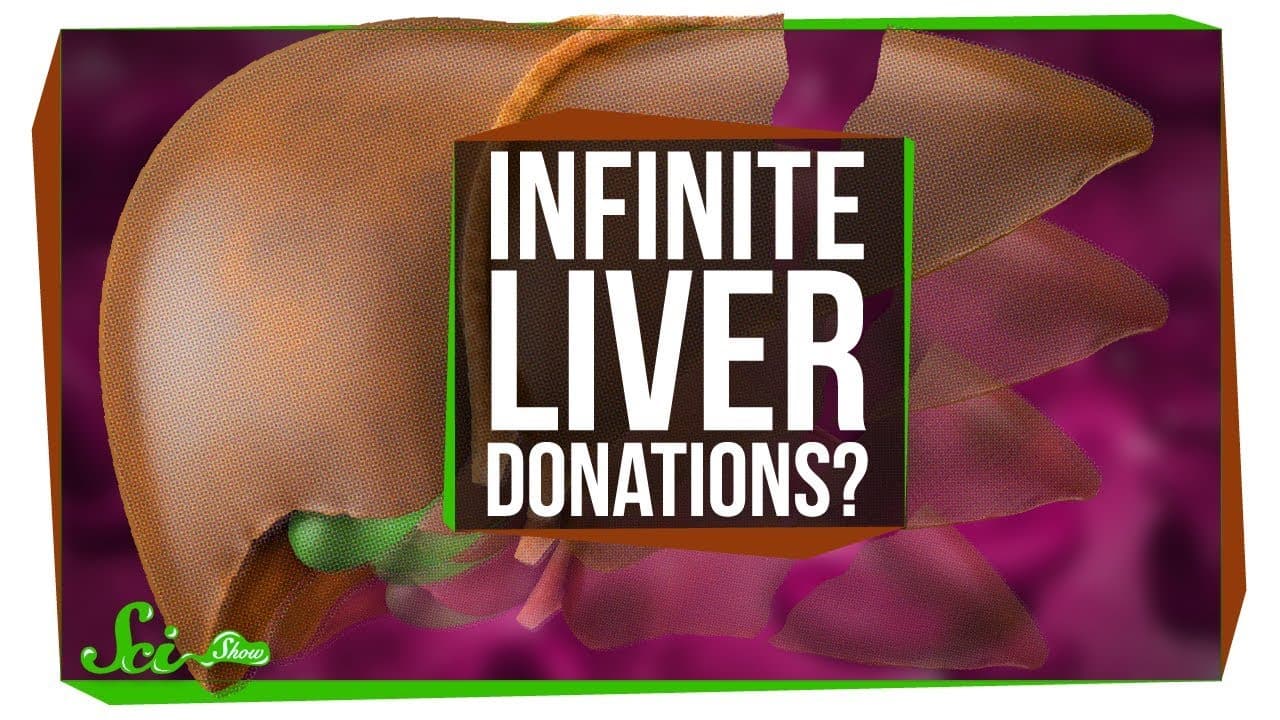
Can You Keep Donating and Regrowing Your Liver?
TL;DR
Liver regrowth after donation is possible but not true regeneration.
Transcript
[♩INTRO] Here at SciShow, we recently learned a fun fact: You can donate over half your liver to someone who needs a transplant, and the tissue will grow back within a year. So then we got super curious: Could you just keep cutting chunks off and donating them and regrowing your liver, kind of like donating blood, except it's an organ? Turns out, t... Read More
Key Insights
- 🚚 Liver regrowth after donation is possible but not true regeneration.
- 🚚 True regeneration involves dedifferentiation of cells, unlike liver regrowth in humans.
- 🚚 Multiple liver donations are not recommended due to structural and functional challenges.
- ❓ Salamanders exhibit true regeneration by complete tissue replication through dedifferentiation.
- 🚚 Regrown liver tissue in humans lacks the exact structure of a fresh liver due to compensatory hyperplasia.
- 🚚 Liver donation can save lives, but multiple donations pose risks for donors and recipients.
- 🚚 Connective challenges with regrown liver tissue make multiple donations impractical.
Install to Summarize YouTube Videos and Get Transcripts
Explore YouTube Video Summarizer or Get YouTube Transcript Extractor
Questions & Answers
Q: Can you keep donating parts of your liver like donating blood?
While liver regenerates after donation, multiple donations are not recommended due to structural differences and difficulties with reconnection to blood vessels.
Q: How does true regeneration in animals like salamanders differ from liver regrowth in humans?
True regeneration in animals involves dedifferentiation of cells, leading to complete replication of lost tissue structure, unlike liver regrowth in humans.
Q: Why do transplant doctors discourage multiple liver donations?
Multiple donations are discouraged due to the challenges in safely removing and reconnecting regrown liver tissue, which might not replicate the original structure.
Q: What is the difference between compensatory hyperplasia and true regeneration?
Compensatory hyperplasia in liver regrowth involves cell multiplication without complete structural replication, while true regeneration seen in animals involves dedifferentiation leading to exact tissue recreation.
Summary & Key Takeaways
-
Donating part of your liver can lead to regrowth within a year, but multiple donations are not recommended due to the liver's structure.
-
True regeneration, as seen in animals like salamanders, involves dedifferentiation of cells, unlike liver regrowth in humans.
-
While liver donation can save lives, multiple donations aren't advisable due to potential issues with structure and function.
Read in Other Languages (beta)
Share This Summary 📚
Summarize YouTube Videos and Get Video Transcripts with 1-Click
Try YouTube Summary with ChatGPT & Claude or YouTube Transcript Generator
Explore More Summaries from SciShow 📚





Summarize YouTube Videos and Get Video Transcripts with 1-Click
Try YouTube Summary with ChatGPT & Claude or YouTube Transcript Generator