What Are the Classifications of Airport Obstructions?
TL;DR
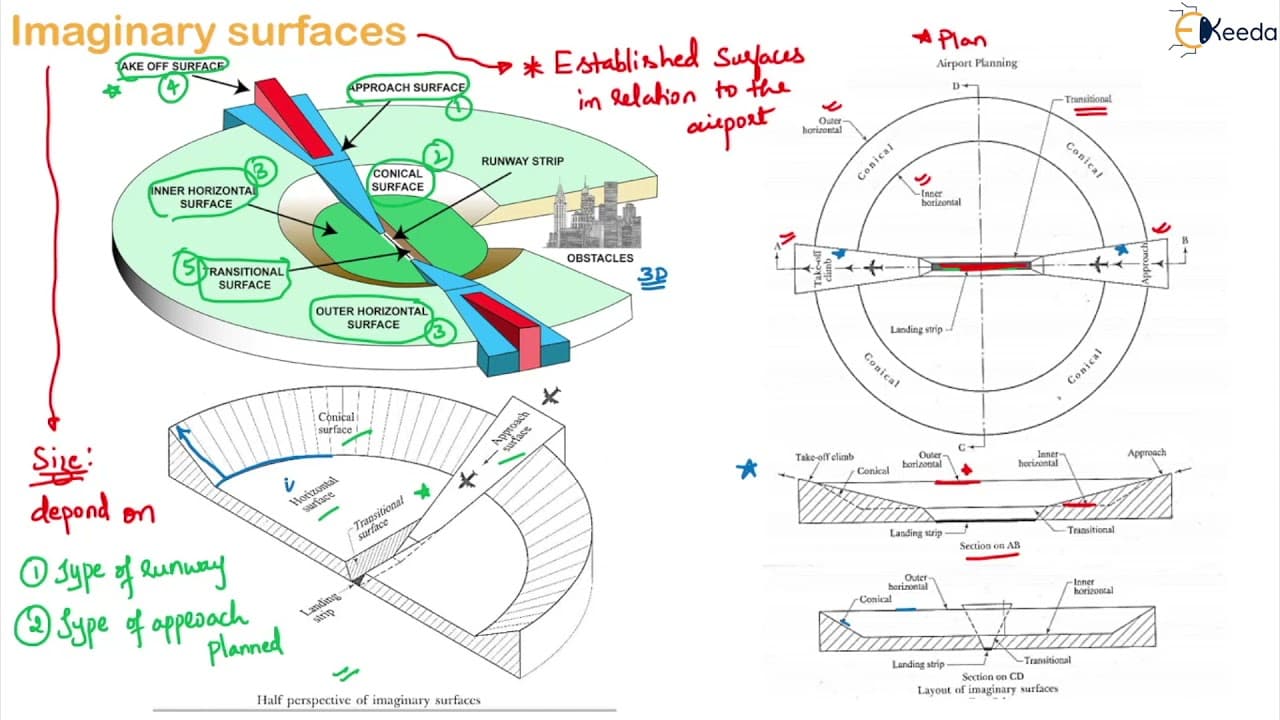
Airport obstructions are classified into two main categories: imaginary surfaces and objects with actual heights. Imaginary surfaces include approach, conical, horizontal, transitional, and takeoff climb surfaces, which are essential for maintaining flight safety. Objects above specific height limits, such as over 30 meters within 4.5 kilometers of a runway, are regarded as obstructions to air navigation.
Transcript
hello students in this lesson let us study about the airport obstructions okay we will see what are the classification of airport obstructions and study in detail about each one of it your airport obstruction is classified as follows okay so basically it is classified into two divisions right first one is the imaginary surfaces and the second one i... Read More
Key Insights
- ✈️ Imaginary surfaces at airports, like approach and conical, are established to prevent obstructions to flight paths.
- ✈️ Height limits for objects near runways and flight paths are crucial for ensuring safe air navigation.
- 👨💻 ICAO standards govern the dimensions and slopes of imaginary surfaces for different runway codes.
- 🛄 Understanding airport obstructions is vital for pilots, air traffic controllers, and airport authorities to maintain aviation safety.
- 🤒 Objects above specified heights, like 30 meters within 4.5 kilometers, are considered obstructions to air navigation.
- 🛄 The classification of airport obstructions includes both imaginary surfaces and objects with actual heights.
- 🛄 Airport obstruction standards ensure consistent safety measures across different airports and runways.
Install to Summarize YouTube Videos and Get Transcripts
Explore YouTube Video Summarizer or Get YouTube Transcript Extractor
Questions & Answers
Q: What are the types of imaginary surfaces at an airport?
Imaginary surfaces at airports include approach, conical, horizontal, transitional, and take off climb surfaces, each serving specific safety functions in relation to runways and flight paths.
Q: How are airport obstructions classified based on actual heights?
Objects with actual heights are considered obstructions if they extend above specified limits, such as 30 meters within 4.5 kilometers of a runway, with additional height restrictions beyond that distance.
Q: What standards govern the dimensions of imaginary surfaces at airports?
ICAO defines standards for the width, divergence, length, and slope of imaginary surfaces based on runway codes and specific conditions like instrumental and non-instrumental landings.
Q: Why is it important to understand airport obstructions for aviation safety?
Knowledge of airport obstructions, both imaginary surfaces and objects with heights, is crucial to ensure safe takeoffs, landings, and flight paths, minimizing the risk of collisions or accidents.
Summary & Key Takeaways
-
Airport obstructions are divided into imaginary surfaces and objects with actual heights.
-
Imaginary surfaces like approach, conical, horizontal, transitional, and take off climb play a crucial role in aviation safety.
-
Objects with actual heights above certain limits are considered obstructions to air navigation as per defined standards.
Read in Other Languages (beta)
Share This Summary 📚
Summarize YouTube Videos and Get Video Transcripts with 1-Click
Try YouTube Summary with ChatGPT & Claude or YouTube Transcript Generator
Explore More Summaries from Ekeeda 📚



Summarize YouTube Videos and Get Video Transcripts with 1-Click
Try YouTube Summary with ChatGPT & Claude or YouTube Transcript Generator