What Is Vowel Shifting in English Irregular Verbs?
TL;DR
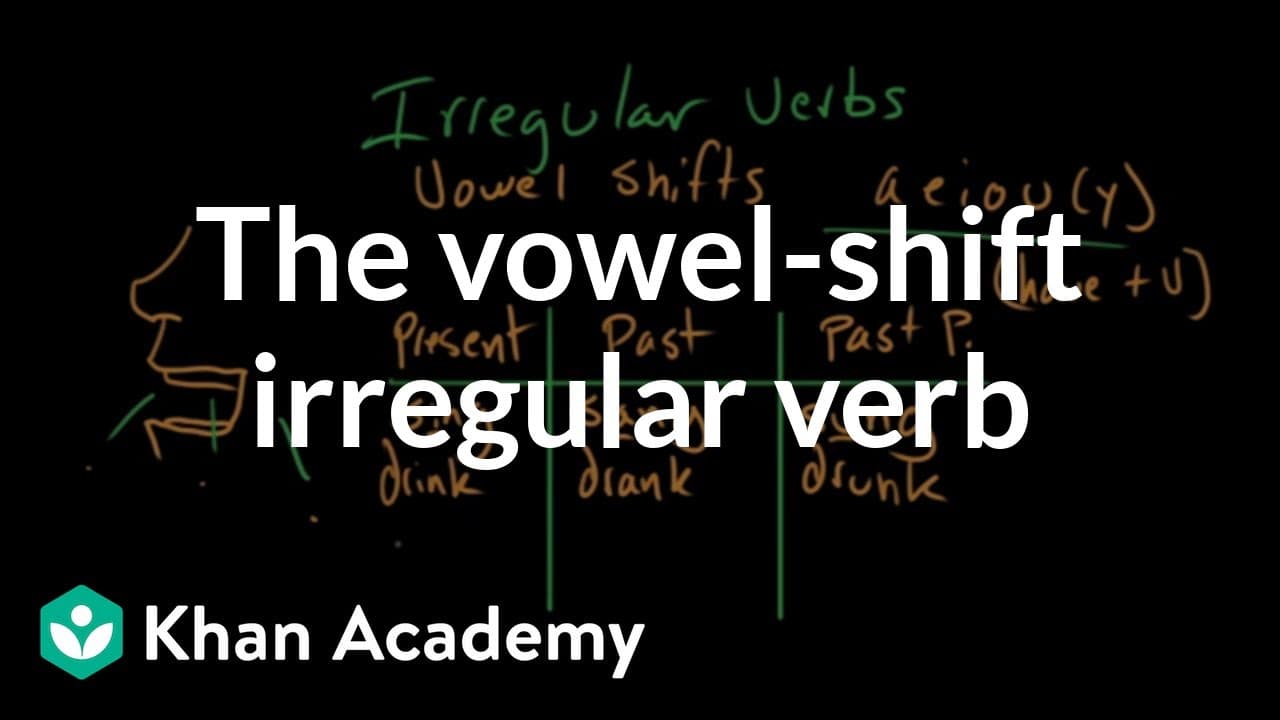
Vowel shifting in English irregular verbs refers to the change in vowel sounds between the present, past, and past perfect tenses. For example, 'sing' shifts to 'sang' and 'have sung,' while 'drink' goes from 'drink' to 'drank' and 'had drunk.' This shift illustrates how vowel sounds progress from the front to the back of the mouth across different tenses.
Transcript
- [Voiceover] Hello grammarians! We're talking about vowel shifting in irregular verbs, which is gonna sound a little weird, but bear with me. To review what a vowel is super quick, a vowel is any sound that your mouth can make while your tongue isn't touching your lips or your teeth or the roof of your mouth, basically. In English we render vowels... Read More
Key Insights
- 🍝 Vowel shifting occurs in irregular verbs between the present, past, and past perfect tenses.
- 🤑 The vowel sounds in irregular verbs move from the front to the middle and back of the mouth.
- 🍝 Some irregular verbs have the same past and past perfect forms, while others exhibit vowel shifts between the present and past tenses.
- 💯 Not all irregular verbs follow the same vowel shifting patterns, and some may have unique forms in past perfect tense.
- ❓ English irregular verbs can be challenging to learn due to the various vowel shifts.
- 🆘 Understanding vowel shifting in irregular verbs can help in accurately conjugating verbs in different tenses.
- ❓ Vowel shifting showcases the linguistic complexity of the English language.
Install to Summarize YouTube Videos and Get Transcripts
Explore YouTube Video Summarizer or Get YouTube Transcript Extractor
Questions & Answers
Q: What is a vowel?
A vowel is any sound you produce with your mouth, where your tongue isn't touching your lips, teeth, or the roof of your mouth.
Q: What is vowel shifting?
Vowel shifting refers to the change in vowel sounds between different tenses of irregular verbs, specifically from the present to the past and past perfect forms.
Q: What are some examples of vowel shifting in irregular verbs?
Examples of vowel shifting include the verb "sing" (present), "sang" (past), and "sung" (past perfect), where the vowel sound changes from "ih" to "ah" to "uh" respectively.
Q: Are there irregular verbs that have the same past and past perfect forms?
Yes, there are irregular verbs like "won" (present, past, and past perfect) or "found" (present) and "found" (past and past perfect) that exhibit vowel shifting only between the present and past tenses.
Summary & Key Takeaways
-
Vowel sounds in irregular verbs change as you go back in time from the present to the past and past perfect tenses.
-
The vowel shifting occurs from the front to the middle, and then to the back of the mouth.
-
While most regular verbs have the same past and past perfect forms, irregular verbs exhibit vowel shifts between the present and past tenses.
Read in Other Languages (beta)
Share This Summary 📚
Summarize YouTube Videos and Get Video Transcripts with 1-Click
Try YouTube Summary with ChatGPT & Claude or YouTube Transcript Generator
Explore More Summaries from Khan Academy 📚



Summarize YouTube Videos and Get Video Transcripts with 1-Click
Try YouTube Summary with ChatGPT & Claude or YouTube Transcript Generator