Moving Averages Explained - Time Series Data
TL;DR
Moving averages are crucial in time series analysis for predicting trends.
Transcript
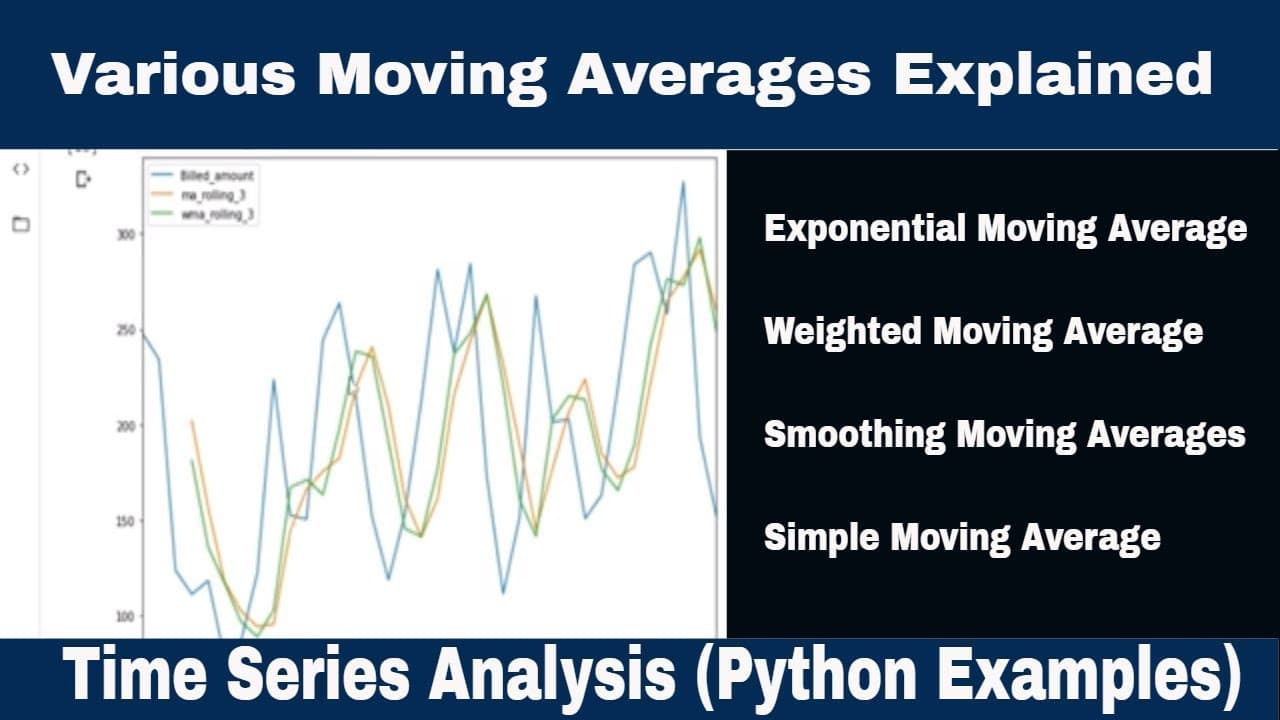
hi in this video we'll be talking about moving averages moving averages are some of the core foundational concept of time series analysis and in this video we'll be talking in detail about moving averages the various moving averages type you have your simple moving average you have your weighted moving average you have your exponent... Read More
Key Insights
- Moving averages are essential for time series analysis, providing baseline models to predict future trends based on past data.
- Different types of moving averages include simple, weighted, exponential, and exponential smoothing, each with unique characteristics and applications.
- The simple moving average calculates the mean of a specific number of past data points, offering a straightforward method to analyze trends.
- Weighted moving averages assign different weights to data points, allowing more recent data to influence predictions more significantly.
- Exponential moving averages quickly adapt to changes in data, providing a more responsive analysis compared to simple moving averages.
- Exponential smoothing uses a smoothing factor to control the influence of past data, allowing for more nuanced trend detection.
- Moving averages are used in various domains, including feature engineering in machine learning models and streaming analytics.
- For data with high fluctuations, more complex models like ARIMA or LSTM may be necessary for accurate predictions.
Install to Summarize YouTube Videos and Get Transcripts
Explore YouTube Video Summarizer or Get YouTube Transcript Extractor
Questions & Answers
Q: What are the main types of moving averages discussed?
The video discusses four main types of moving averages: simple moving average, weighted moving average, exponential moving average, and exponential smoothing moving average. Each type offers different methods of analyzing time series data, with varying levels of complexity and responsiveness to data changes.
Q: How does a simple moving average work?
A simple moving average calculates the mean of a specific number of past data points, providing a straightforward way to identify trends in time series data. It involves summing up the data points within a defined window and dividing by the number of points, offering a basic analysis of data trends.
Q: What is the advantage of using a weighted moving average?
Weighted moving averages assign different weights to data points, allowing more recent data to influence predictions more significantly. This approach helps capture trends more accurately, especially when recent data is more relevant to future predictions, making it more responsive than simple moving averages.
Q: What is the role of exponential moving averages in analysis?
Exponential moving averages provide a more responsive analysis by quickly adapting to changes in data. Unlike simple moving averages, they do not require manual weight assignment, as they inherently give more weight to recent data points, making them useful for detecting trends in volatile data sets.
Q: How does exponential smoothing differ from exponential moving averages?
Exponential smoothing uses a smoothing factor, or alpha, to control the influence of past data on predictions. A higher alpha value focuses more on recent data, while a lower value considers historical data more. This allows for more nuanced trend detection compared to exponential moving averages.
Q: What are the applications of moving averages in machine learning?
Moving averages are used in feature engineering for machine learning models, helping to identify trends and patterns in data. They are also applied in streaming analytics, where window functions based on moving averages are used to process and analyze continuous data streams effectively.
Q: Why might more complex models be necessary for some data sets?
For data sets with high fluctuations or non-stationary characteristics, moving averages may not capture trends accurately. In such cases, more complex models like ARIMA or LSTM may be necessary to account for variability and provide more precise predictions, as they can model complex patterns and dependencies.
Q: What is the significance of the smoothing factor in exponential smoothing?
The smoothing factor, or alpha, in exponential smoothing controls how much influence past data has on predictions. A higher alpha focuses on recent data, while a lower alpha considers historical data more. This allows for adjusting the sensitivity of the model to changes, making it adaptable to different data characteristics.
Summary & Key Takeaways
-
Moving averages are fundamental tools in time series analysis, used to predict future trends by analyzing past data. The video explores different types of moving averages, including simple, weighted, exponential, and exponential smoothing, and their applications in various domains.
-
The simple moving average provides a basic method to identify trends by calculating the mean of past data points. Weighted moving averages enhance this by assigning different weights to data, allowing more recent data to have a greater impact on predictions.
-
Exponential moving averages and exponential smoothing offer more responsive and nuanced trend detection by incorporating a smoothing factor, making them suitable for data with high variability. These methods are also applied in machine learning and streaming analytics.
Read in Other Languages (beta)
Share This Summary 📚
Summarize YouTube Videos and Get Video Transcripts with 1-Click
Try YouTube Summary with ChatGPT & Claude or YouTube Transcript Generator
Explore More Summaries from AIEngineering 📚

Summarize YouTube Videos and Get Video Transcripts with 1-Click
Try YouTube Summary with ChatGPT & Claude or YouTube Transcript Generator