MLOps with Azure - Hands on Session
TL;DR
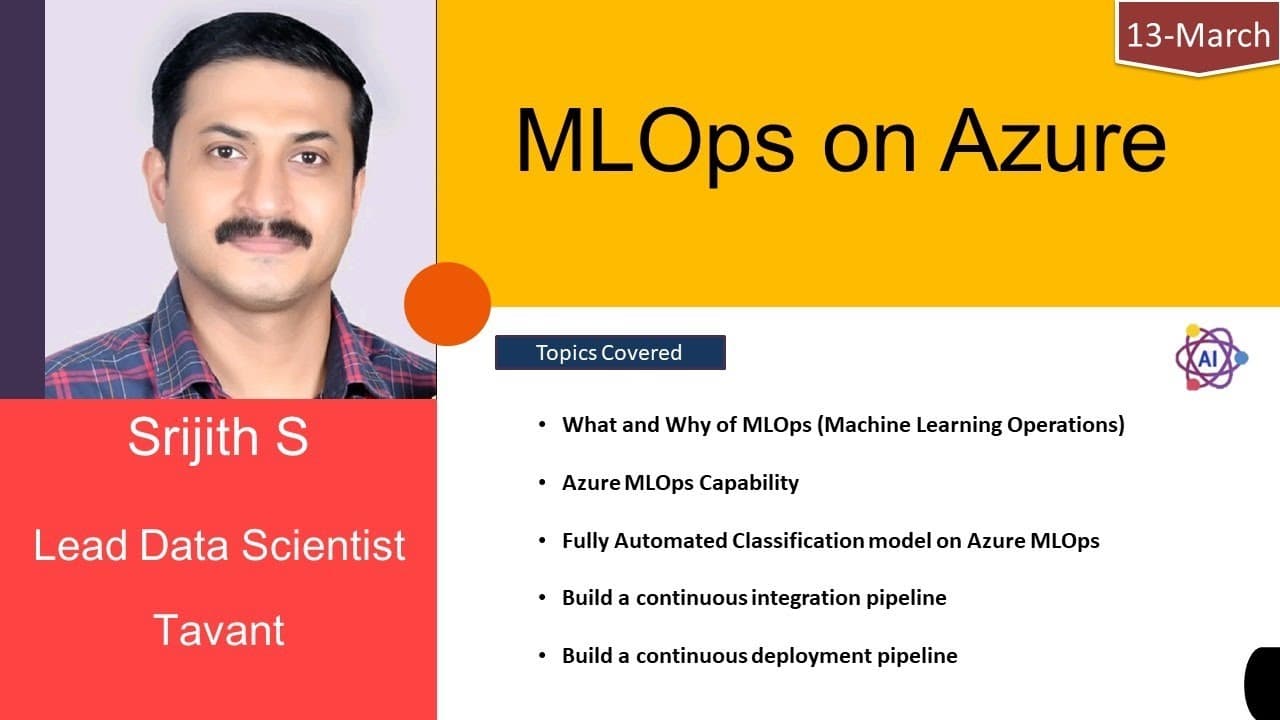
An in-depth analysis of ML Ops and Azure ML, covering the importance of ML Ops, challenges in machine learning projects, and the components and benefits of Azure ML.
Transcript
hello everyone and welcome to today's session on ml of azure thank you for taking time out and being here today i would like to introduce today's presenters rigid s series we're here to talk on what and why of amalops deep dive into azure envelopes capability and further show us how to build a fully automated training and deployment pipeline on azu... Read More
Key Insights
- 👨💻 ML Ops is essential for effectively managing and organizing machine learning projects, addressing challenges in code and data management, model building, model management, and deployment.
- 😫 Azure ML provides a comprehensive set of tools and capabilities to streamline the ML Ops process, including workspaces, compute targets, data sets, experiments, model registry, and deployment pipelines.
- 👨💻 CI pipelines automate code management, data management, and model profiling, ensuring efficient project tracking and versioning.
- 🎮 CD pipelines automate deployment processes, enable governance and data drift monitoring, and ensure quality control in production environments.
- ⚾ Azure ML supports data capture, model profiling, and data drift monitoring, facilitating proactive actions based on early indications of model degradation.
- 🏛️ A well-structured ML Ops process in Azure ML can help organizations build, train, deploy, and monitor machine learning models effectively and efficiently.
Install to Summarize YouTube Videos and Get Transcripts
Explore YouTube Video Summarizer or Get YouTube Transcript Extractor
Questions & Answers
Q: What is ML Ops?
ML Ops, or ML Operations, is the management and organization of machine learning projects, encompassing code management, data management, model building, model management, model profiling, deployment, governance, and data drift monitoring.
Q: What are the challenges in machine learning projects?
Common challenges include code management, data management, model building, model management, version control, infrastructure provisioning, deployment, and monitoring for drift in data and model performance.
Q: How does Azure ML address these challenges?
Azure ML provides a set of tools and capabilities, such as workspaces for project management, compute targets for training and deployment, data sets for data management, experiments for tracking runs, model registry for versioning, and deployment pipelines for automated CI/CD.
Q: What is model profiling in ML Ops?
Model profiling is the process of determining the memory and processor requirements of a machine learning model before deployment. It helps in sizing the deployment infrastructure accurately.
Q: What is data drift monitoring?
Data drift monitoring involves capturing real-time data from the deployed model's input and monitoring for changes in data distribution or quality. It helps detect any degradation in model performance and enables proactive actions.
Q: How does Azure ML support data capture and data drift monitoring?
Azure ML allows data capture at the endpoint level, capturing inputs and model predictions into a central location. Data drift monitoring can be enabled to track changes in data distribution or quality, providing early indications of model degradation.
Q: What is the purpose of the CI pipeline in ML Ops?
The CI pipeline focuses on code management, data management, model building, and model profiling. It automates these processes and ensures efficient tracking, versioning, and organizing of machine learning projects.
Q: What is the purpose of the CD pipeline in ML Ops?
The CD pipeline handles the deployment of the trained model, governance processes, and data drift monitoring. It automates the deployment process and ensures transparency, traceability, and quality control in production environments.
Key Insights:
- ML Ops is essential for effectively managing and organizing machine learning projects, addressing challenges in code and data management, model building, model management, and deployment.
- Azure ML provides a comprehensive set of tools and capabilities to streamline the ML Ops process, including workspaces, compute targets, data sets, experiments, model registry, and deployment pipelines.
- CI pipelines automate code management, data management, and model profiling, ensuring efficient project tracking and versioning.
- CD pipelines automate deployment processes, enable governance and data drift monitoring, and ensure quality control in production environments.
- Azure ML supports data capture, model profiling, and data drift monitoring, facilitating proactive actions based on early indications of model degradation.
- A well-structured ML Ops process in Azure ML can help organizations build, train, deploy, and monitor machine learning models effectively and efficiently.
- The integration of ML Ops and Azure DevOps enables a fully automated CI/CD pipeline for machine learning projects, improving efficiency, traceability, and quality assurance.
Summary & Key Takeaways
-
ML Ops, short for ML Operations, is the end-to-end management of a machine learning project, focusing on adding structure and process to efficiently manage and organize the project.
-
ML Ops addresses challenges faced in code management, data management, model building, model management, model profiling, deployment, governance, and data drift monitoring.
-
Azure ML offers a comprehensive set of tools and capabilities to streamline the ML Ops process, including workspace management, compute targets, data sets, experiments, model registry, and deployment pipelines.
Read in Other Languages (beta)
Share This Summary 📚
Summarize YouTube Videos and Get Video Transcripts with 1-Click
Try YouTube Summary with ChatGPT & Claude or YouTube Transcript Generator
Explore More Summaries from AIEngineering 📚



Summarize YouTube Videos and Get Video Transcripts with 1-Click
Try YouTube Summary with ChatGPT & Claude or YouTube Transcript Generator