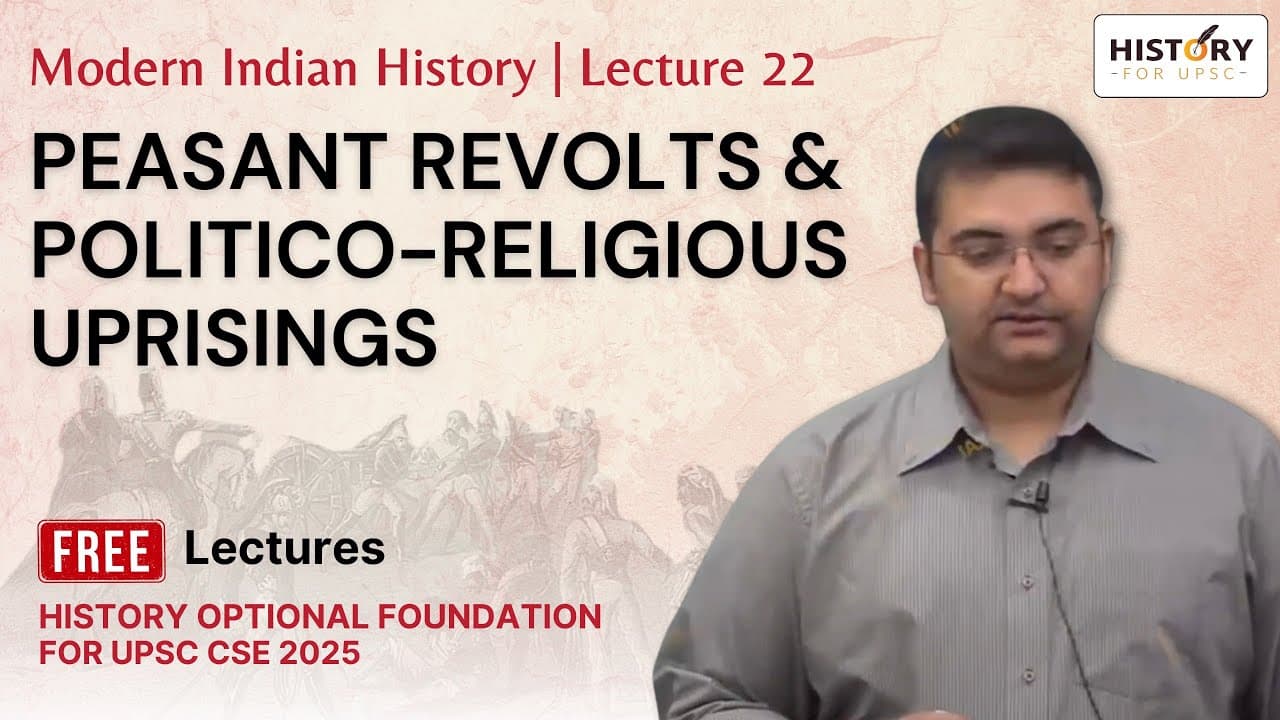
Modern India History Lecture 22: Peasant Revolts & Politico-Religious Uprisings #indianhistory
TL;DR
Lecture discusses various peasant and politico-religious uprisings in colonial India.
Transcript
good morning students I hope you're doing well if I'm audible please let me know good morning good morning right so we were talking about the anti-colonial rebellions we had covered the tribal revolts and now we have to talk about the PE uprisings the political religious rebellions and feudal revols right localized anticolonial uprisings so first w... Read More
Key Insights
- The lecture covers various peasant uprisings like the Rangpur Rebellion, Indigo Revolt, and others, highlighting the widespread discontent among peasants due to British policies.
- Peasant revolts were fueled by increased taxation, loss of traditional rights, and the adverse effects of British economic policies like deindustrialization.
- The commercialization of agriculture led to food shortages and increased vulnerability of Indian farmers to global market fluctuations.
- Politico-religious uprisings were often cloaked in religious sentiment but were primarily driven by economic and political factors.
- The British administrative system replaced traditional intermediaries, leading to increased peasant desperation and frequent rebellions.
- Rebellions like the Mopla revolt and the Fakir uprising were deeply rooted in economic exploitation despite their religious overtones.
- The British response to these uprisings was often violent, but some led to policy changes, like the prohibition of forced Indigo cultivation.
- Gandhi's non-cooperation movement intersected with these uprisings, leading to tensions between his vision of class cooperation and peasant radicalism.
Install to Summarize YouTube Videos and Get Transcripts
Explore YouTube Video Summarizer or Get YouTube Transcript Extractor
Questions & Answers
Q: What were the main causes of peasant uprisings in colonial India?
Peasant uprisings in colonial India were primarily caused by increased taxation, loss of traditional rights, and the adverse effects of British economic policies such as deindustrialization. The commercialization of agriculture led to food shortages and increased vulnerability to global market fluctuations, further exacerbating peasant distress.
Q: How did the British administrative system affect traditional rural intermediaries?
The British administrative system replaced traditional rural intermediaries like zamindars and local leaders, leading to increased peasant desperation. This system was often apathetic or hostile towards peasants, leaving them with little recourse but to rebel. The removal or undermining of intermediaries disrupted the balance between state interests and peasant welfare.
Q: What role did religion play in politico-religious uprisings?
Religion in politico-religious uprisings served as a mobilizing tool due to its emotional appeal. While these uprisings appeared religious, they were driven by material factors such as economic and political grievances. Religious leaders used their influence to rally support, but the underlying causes were often related to loss of privileges and economic pressures.
Q: What was the impact of the Indigo Revolt?
The Indigo Revolt led to significant policy changes, including the prohibition of forced Indigo cultivation in Bengal. The revolt gained global attention due to the involvement of the Bengali intelligentsia and highlighted the exploitative practices of British planters. Despite the revolt's success in Bengal, Indigo cultivation continued in Bihar where local intelligentsia had not yet emerged.
Q: How did the commercialization of agriculture affect Indian farmers?
The commercialization of agriculture in India led to acute food shortages and exposed farmers to global market fluctuations. While it could have led to prosperity, the British controlled profits, leaving Indian farmers with insufficient returns. This forced shift from food to cash crops increased economic vulnerability and contributed to frequent famines.
Q: What were the consequences of the Mopla revolt?
The Mopla revolt was marked by severe communal violence, targeting both British officials and Hindu communities. It was driven by economic exploitation and class conflict, exacerbated by religious tensions. The revolt highlighted the deep-seated communal and economic issues in Malabar and had long-term consequences for the region's political and social fabric.
Q: How did Gandhi's non-cooperation movement intersect with peasant uprisings?
Gandhi's non-cooperation movement intersected with peasant uprisings like the Eka movement, leading to tensions between his vision of class cooperation and rising peasant radicalism. The non-payment of rent campaigns threatened to divide Indians along class lines, prompting Gandhi to withdraw the movement, according to some historians, to protect the interests of the zamindar class.
Q: What were the outcomes of the Deccan riots?
The Deccan riots resulted from class conflict between local Marathi peasants and outsider Marwari moneylenders. The riots highlighted the exploitation facilitated by the British revenue system and led to the Deccan Agriculturalists Relief Act of 1879, which provided some protections to peasants, including preventing imprisonment for loan defaults. However, these reforms were not sufficient to bring substantial change.
Summary & Key Takeaways
-
The lecture discusses various peasant uprisings in colonial India, including the Rangpur Rebellion and the Indigo Revolt, driven by increased taxation and loss of traditional rights.
-
Politico-religious uprisings were cloaked in religious sentiment but were primarily driven by economic and political factors, leading to widespread discontent.
-
The British administrative system replaced traditional intermediaries, increasing peasant desperation and leading to frequent rebellions, with some resulting in policy changes.
Read in Other Languages (beta)
Share This Summary 📚
Summarize YouTube Videos and Get Video Transcripts with 1-Click
Try YouTube Summary with ChatGPT & Claude or YouTube Transcript Generator
Explore More Summaries from History Optional for UPSC 📚
Summarize YouTube Videos and Get Video Transcripts with 1-Click
Try YouTube Summary with ChatGPT & Claude or YouTube Transcript Generator