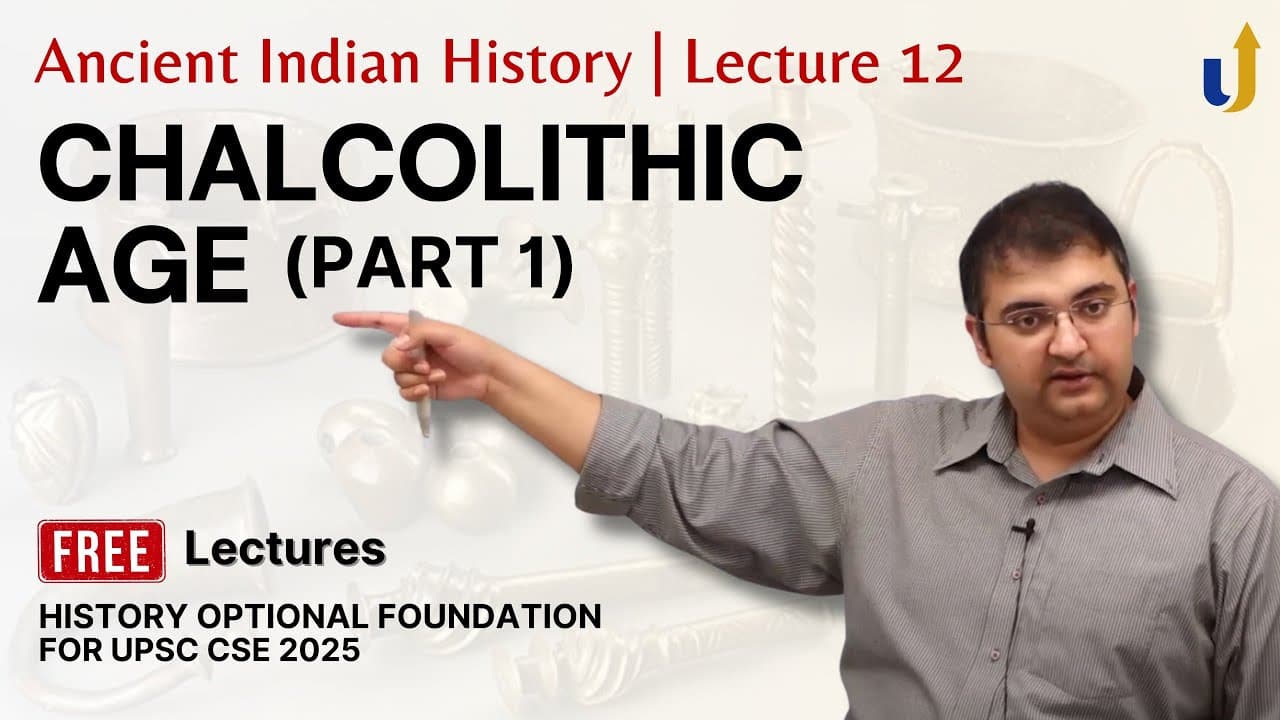
Ancient Indian History Lecture 12: Chalcolithic Age (Part 1) | UPSC History Optional 2025
TL;DR
The Chalcolithic Age marked a transition with copper and stone tool usage.
Transcript
welcome guys I hope you all doing well uh now in our previous lecture we had talked about the late heran culture now civilization next topic that we have to cover is the calic age now calic agea background their geographical extent Etc as the name suggests when we use the term calcul theic age we are referring to those cultures where a combination ... Read More
Key Insights
- The Chalcolithic Age is characterized by the use of both stone and metal tools, specifically copper, marking a transitional period in human development.
- Various Chalcolithic cultures existed, such as Ganeshwar Jura, Ahar Banas, Kayath, Malwa, and Jor, each with distinct geographical and cultural traits.
- Despite being contemporaries of the Harappan civilization, Chalcolithic cultures did not reach the same level of urban development due to ecological and agricultural limitations.
- Chalcolithic agriculture was primarily dryland farming, utilizing the moisture-retentive properties of black cotton soil, with barley as the principal crop.
- Animal husbandry and hunting supplemented the Chalcolithic diet, with evidence of domesticated animals like cattle, sheep, and goats, and hunted species including deer and rhinoceros.
- Technological advancements in the Chalcolithic age included pottery, metallurgy, and bead-making, reflecting a sophisticated understanding of materials.
- Trade and commerce in the Chalcolithic period involved the exchange of copper, pottery, and other goods, primarily through land and river routes.
- Chalcolithic pottery, with its varied designs and uses, provides insights into the technological, cultural, and economic aspects of these ancient communities.
Install to Summarize YouTube Videos and Get Transcripts
Explore YouTube Video Summarizer or Get YouTube Transcript Extractor
Questions & Answers
Q: What defines the Chalcolithic Age?
The Chalcolithic Age is defined by the use of both stone and metal tools, specifically copper, marking a transitional period in human development. This era saw the emergence of various cultures that utilized these tools for agriculture, hunting, and crafting, setting the stage for more advanced civilizations.
Q: How did Chalcolithic cultures differ from the Harappan civilization?
Chalcolithic cultures differed from the Harappan civilization in their level of urban development. While contemporaneous with the Harappans, Chalcolithic cultures did not reach the same stage of urbanization due to ecological and agricultural limitations, such as reliance on dryland farming in semi-arid regions.
Q: What were the primary agricultural practices in the Chalcolithic Age?
Agriculture in the Chalcolithic Age was primarily based on dryland farming, utilizing the moisture-retentive properties of black cotton soil. Barley was the principal crop, and there was evidence of crop rotation and flood irrigation. This subsistence agriculture was supplemented by animal husbandry and hunting.
Q: What role did animal husbandry and hunting play in Chalcolithic societies?
Animal husbandry and hunting played a supplementary role in the diet of Chalcolithic societies. They domesticated animals like cattle, sheep, and goats for meat rather than milk, and hunted a variety of wild animals such as deer and rhinoceros, indicating a diverse subsistence strategy.
Q: How advanced was Chalcolithic technology?
Chalcolithic technology was fairly advanced, with significant developments in pottery, metallurgy, and bead-making. Pottery was both hand-thrown and wheel-turned, and copper was widely used for tools. The presence of specialized tools and techniques indicates a sophisticated understanding of material properties.
Q: What insights does Chalcolithic pottery provide?
Chalcolithic pottery provides insights into the technological, cultural, and economic aspects of these ancient communities. The variety in design and function of pottery suggests different uses, such as storage, cooking, and rituals, while the presence of painted motifs can reveal cultural and religious beliefs.
Q: What were the trade practices during the Chalcolithic period?
Trade during the Chalcolithic period involved the exchange of copper, pottery, and other goods, primarily through land and river routes. Large settlements served as trade centers, and there was evidence of regional and interregional exchange, indicating a complex network of trade relations among different cultures.
Q: What were the limitations of Chalcolithic cultures in terms of development?
The limitations of Chalcolithic cultures in terms of development were largely due to their ecological and agricultural conditions. Being situated in semi-arid regions, they practiced dryland farming, which did not produce a large agricultural surplus necessary for urbanization, unlike the Harappan civilization.
Summary & Key Takeaways
-
The Chalcolithic Age is marked by the simultaneous use of stone and copper tools, indicating a significant transition in human technology and culture. This period ran parallel to the Harappan civilization but continued beyond its decline.
-
Distinct Chalcolithic cultures such as Ganeshwar Jura, Ahar Banas, and Jor developed in different regions, each with unique characteristics. These cultures were primarily located in semi-arid regions, affecting their agricultural practices and limiting urban development.
-
Despite their technological advancements in pottery and metallurgy, Chalcolithic cultures did not achieve the urbanization seen in the Harappan civilization. Their trade networks relied on land and river routes, facilitating the exchange of goods like copper tools and pottery.
Read in Other Languages (beta)
Share This Summary 📚
Summarize YouTube Videos and Get Video Transcripts with 1-Click
Try YouTube Summary with ChatGPT & Claude or YouTube Transcript Generator
Explore More Summaries from History Optional for UPSC 📚
Summarize YouTube Videos and Get Video Transcripts with 1-Click
Try YouTube Summary with ChatGPT & Claude or YouTube Transcript Generator