Variational Methods of Least Square 2 Dimensions
TL;DR
Analyzing a 2D beam using the method of least squares for deflection calculations.
Transcript
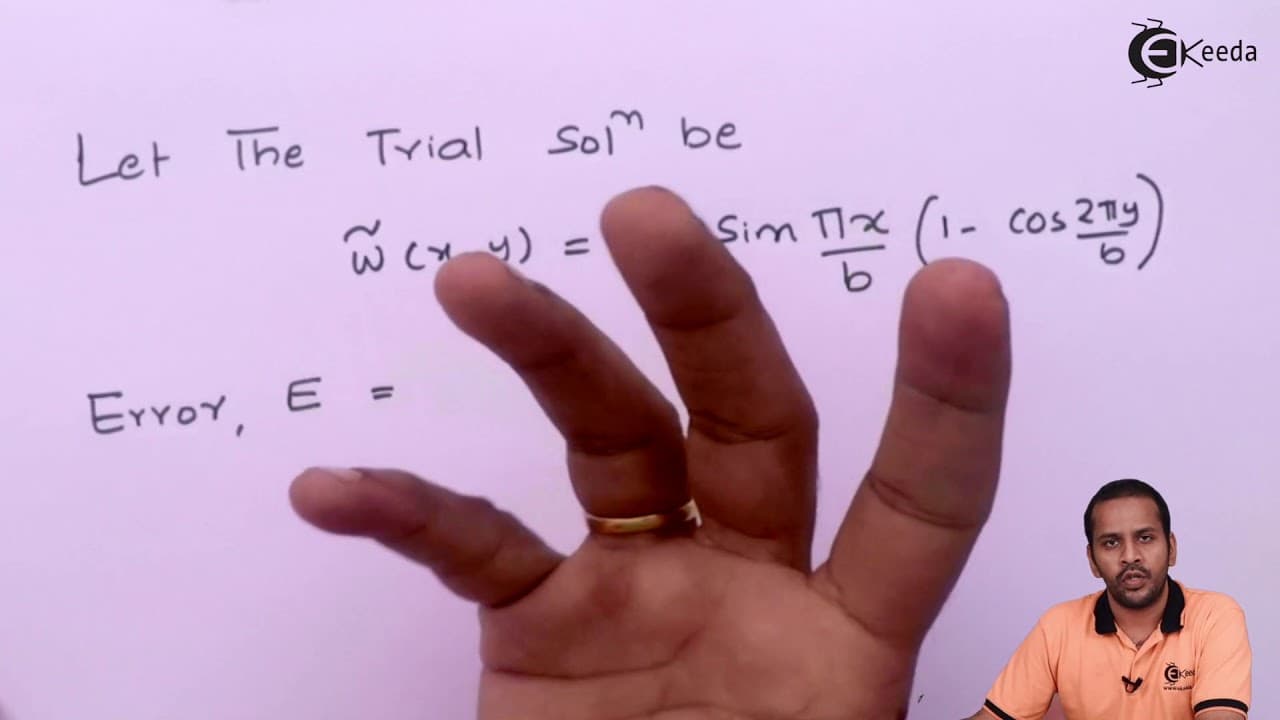
click the bell icon to get latest videos from equator hello friends welcome to finite element methods in the last class we have seen the application of method of least squares to one-dimensional problem in the present class let's so let's use the same method of least squares to a 2d problem let us choose the same two-dimensional beam whatever we ha... Read More
Key Insights
- 😁 Boundary conditions are crucial in determining the behavior of simply supported and fixed 2D beams.
- 😁 The governing equation for a 2D beam involves terms related to deflection, loading intensity, and flexural rigidity.
- 🍃 Error calculation in the method of least squares involves finding the residue left over after substituting the trial solution in the governing equation.
- 😁 The approximate solution obtained using the method of least squares may not always match the analytical solution, emphasizing the need for accuracy in beam analysis.
Install to Summarize YouTube Videos and Get Transcripts
Explore YouTube Video Summarizer or Get YouTube Transcript Extractor
Questions & Answers
Q: What are the boundary conditions for a simply supported 2D beam?
The boundary conditions for a simply supported 2D beam involve deflection and curvature being zero at the fixed positions, ensuring no moments are present.
Q: How is the governing equation for a 2D beam defined?
The governing equation for a 2D beam is given by Dell power for W minus Q by D equal to 0, where W is deflection, Q is loading intensity, and D represents flexural rigidity.
Q: How is error calculated in the method of least squares for beam analysis?
Error in the method of least squares for beam analysis is calculated by substituting the trial solution into the governing equation and determining the residue left over after simplification.
Q: Why is the analytical solution preferable over the approximate solution for beam deflection?
The analytical solution for beam deflection is preferred over the approximate solution obtained from the method of least squares as it provides a more accurate and reliable result.
Summary & Key Takeaways
-
Introduction to analyzing a 2D beam using the method of least squares.
-
Explanation of boundary conditions for simply supported and fixed conditions.
-
Derivation of governing equations and comparison of approximate and analytical solutions.
Read in Other Languages (beta)
Share This Summary 📚
Summarize YouTube Videos and Get Video Transcripts with 1-Click
Try YouTube Summary with ChatGPT & Claude or YouTube Transcript Generator
Explore More Summaries from Ekeeda 📚



Summarize YouTube Videos and Get Video Transcripts with 1-Click
Try YouTube Summary with ChatGPT & Claude or YouTube Transcript Generator