Thomas Malthus and population growth | Cosmology & Astronomy | Khan Academy
TL;DR
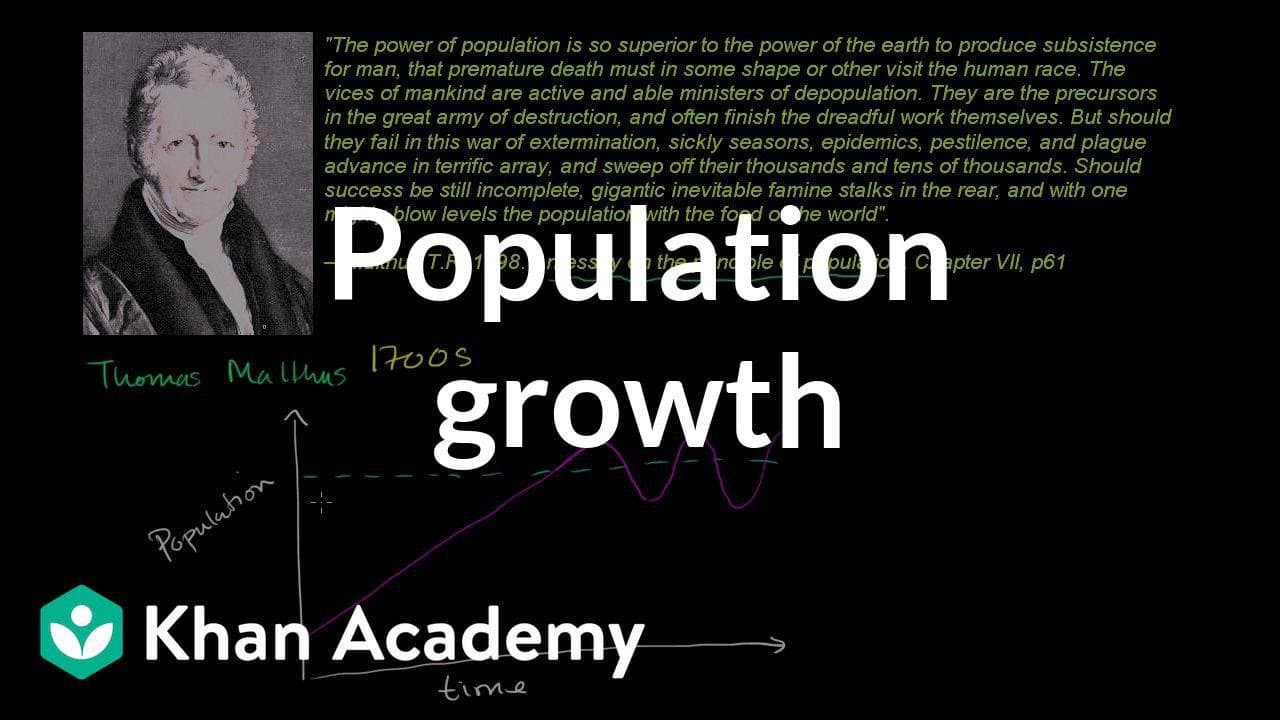
Thomas Malthus believed that population growth would lead to resource scarcity, inevitable famine, and other catastrophic events, challenging the idea of endless progress.
Transcript
The 1700s in Europe are often referred to as the Age of Enlightenment. It was a time, we'd come out of the Renaissance. We'd rediscovered science and reason and in the 1700s, we saw that come about with even more progress of society. As we exit the 1700s and enter into the 1800s, we start having the Industrial Revolution. And people saw the steady ... Read More
Key Insights
- 🌍 The Age of Enlightenment in Europe was a time of progress and optimism, but Thomas Malthus provided a dissenting perspective on population growth and its consequences.
- 🥺 Malthus argued that population growth would lead to famine, epidemics, wars, and other catastrophes as resources were unable to keep up with the increasing population.
- 🌍 Modern evidence from developed nations shows that population growth can be limited when societies become educated and prosperous.
- ⛔ While Malthus' predictions have not fully materialized, the concept of a Malthusian limit, where resources are unable to sustain the population, remains relevant.
- ✋ Bangladesh, with its high population density and resource challenges, serves as a contemporary example of the potential implications of rapid population growth.
- 😋 The ongoing increase in food productivity and the level of development of different societies will determine if Malthus' concerns will be realized or averted.
- 🍉 Malthus' perspective highlights the need for sustainable practices and equitable distribution of resources to ensure the long-term well-being of societies.
Install to Summarize YouTube Videos and Get Transcripts
Explore YouTube Video Summarizer or Get YouTube Transcript Extractor
Questions & Answers
Q: What was the general sentiment about progress and population growth in the 1700s?
In the 1700s, people were optimistic that progress would continue indefinitely and lead to a utopian civilization with no poverty or strife.
Q: Who was Thomas Malthus, and what was his perspective on population growth?
Thomas Malthus was a prominent figure in the late 1700s who believed that population growth would eventually result in resource scarcity, famine, and other calamities.
Q: How did Malthus perceive the relationship between population growth and resource availability?
Malthus believed that if people had enough food and time, they would reproduce, leading to population growth. This would continue until resources could no longer sustain the population, leading to various depopulation factors.
Q: How do modern, developed nations challenge Malthus' perspective?
Developed nations like Japan and Germany have experienced negative population growth, suggesting that affluence, education, and other factors can reduce population growth and mitigate Malthusian predictions.
Summary & Key Takeaways
-
The 1700s marked a period of optimism and progress, but Thomas Malthus disagreed, arguing that population growth would eventually outstrip resources and lead to calamities.
-
Malthus believed that despite technological advancements, population growth would always catch up and lead to famine, epidemics, and wars.
-
However, modern evidence from developed nations suggests that as societies become more educated and affluent, population growth can be mitigated.
Read in Other Languages (beta)
Share This Summary 📚
Summarize YouTube Videos and Get Video Transcripts with 1-Click
Try YouTube Summary with ChatGPT & Claude or YouTube Transcript Generator
Explore More Summaries from Khan Academy 📚



Summarize YouTube Videos and Get Video Transcripts with 1-Click
Try YouTube Summary with ChatGPT & Claude or YouTube Transcript Generator